Daily Pergamon Tours: Acropolis, Zeus Altar & Asclepion
Daily Pergamon tours visit one of the most complete and historically layered ancient cities in Turkey — a site that served as the capital of a powerful Hellenistic kingdom, housed the second greatest library of antiquity, gave the world its most sophisticated medical centre before the medieval period, and produced an altar so monumental that an entire wing of Berlin's Pergamon Museum was built to contain its reconstructed frieze. The ancient city of Pergamon, known today as Bergama, is located in Izmir Province, approximately 100 km north of Izmir and 200 km from Kusadasi.
Apasas Travel offers private daily Pergamon tours from both Izmir and Kusadasi with Ministry of Culture-licensed guides who specialise in Aegean history. The tour covers the Pergamon Acropolis — the hilltop complex containing the Zeus Altar site, the Great Library, and the cliff-top theatre — and the Asclepion healing complex below the hill, where the physician Galen practised in the 2nd century AD.
Pergamon Acropolis: Capital of the Attalid Kingdom
The Pergamon Acropolis is a fortified hilltop city 335 metres above the valley floor, accessible today by cable car or a 20-minute uphill walk from the lower town. It was the political and cultural heart of the Kingdom of Pergamon (281–133 BC), ruled by the Attalid dynasty who transformed it from a garrison town into one of the major centres of the Hellenistic world. The Attalids chose to resist the cultural dominance of Ptolemaic Alexandria rather than submit to it, constructing their library in direct competition and commissioning sculptural programmes — including the Great Altar — that asserted Pergamon's equal standing in the Greek world.
Site of the Zeus Altar (Pergamon Altar)
The Zeus Altar — formally the Pergamon Altar of Zeus and Athena — was built during the reign of Eumenes II (197–159 BC) to celebrate a military victory over the Galatians. The altar's base measured 35.6 × 33.4 metres and was covered with a continuous high-relief frieze 113 metres long depicting the Gigantomachy (the battle between the Olympian gods and the Giants). This frieze was excavated by German archaeologist Carl Humann between 1878 and 1886 and transported to Berlin, where it forms the centrepiece of the Pergamon Museum. The original altar base remains in situ on the acropolis; a platform marks its location with explanatory panels. The altar is included on some classical lists of the Seven Wonders of the Ancient World.
Pergamon Great Library
The Pergamon Great Library held approximately 200,000 scroll volumes at its height, making it the second largest library in antiquity after the Library of Alexandria. The library building occupied the northern terrace of the acropolis, adjacent to the Temple of Athena, and was built in the 3rd century BC by Eumenes II. The rivalry between Alexandria and Pergamon over books was so intense that Egypt reportedly banned the export of papyrus to Pergamon, forcing Pergamon's scribes to develop a writing surface from processed animal skin — which became known as pergamena, the origin of the English word "parchment." Mark Antony later gave Pergamon's library collection to Cleopatra as a gift, transferring the volumes to Alexandria.
Pergamon Theatre
The Theatre of Pergamon is the steepest ancient theatre in the world, built at an 80-degree angle into the western face of the acropolis hill. It seats 10,000 spectators across 80 rows of marble seats and was designed this way specifically to preserve the acropolis's architectural terrace space above it. A wooden stage was assembled and dismantled for each performance, as a permanent structure would have blocked the valley view that the seating was designed to frame. The theatre offers the most dramatic panorama of the city of Bergama and the Bakırçay Valley from the acropolis.
Temple of Trajan
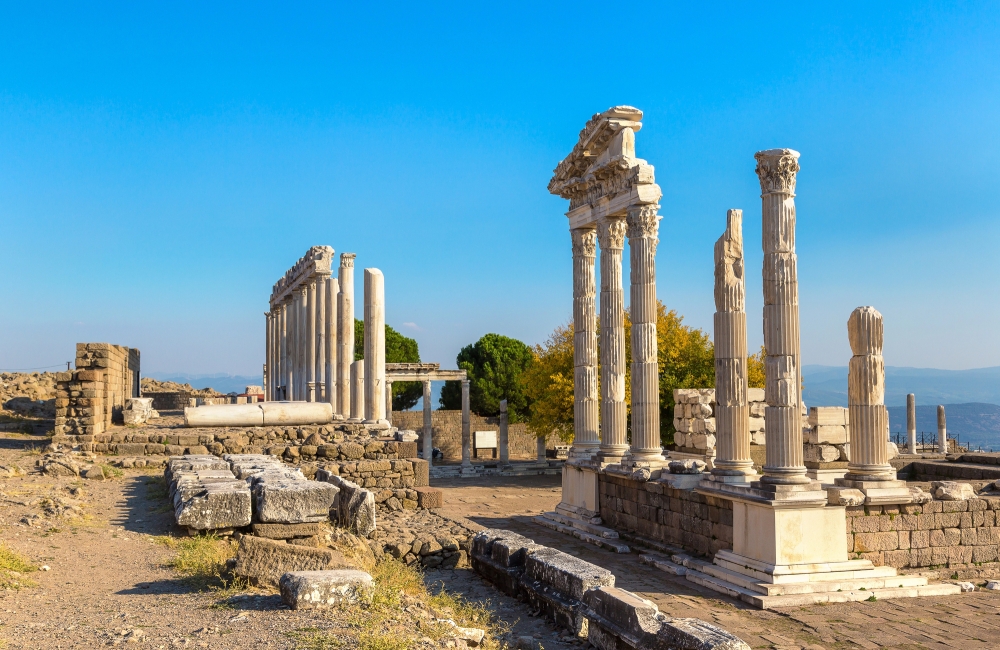
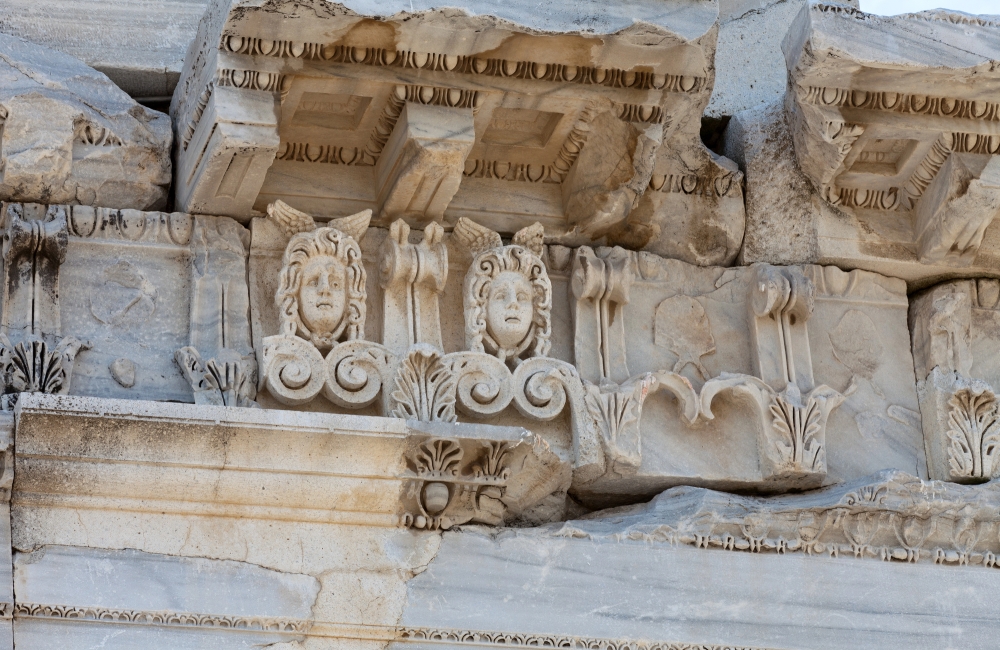
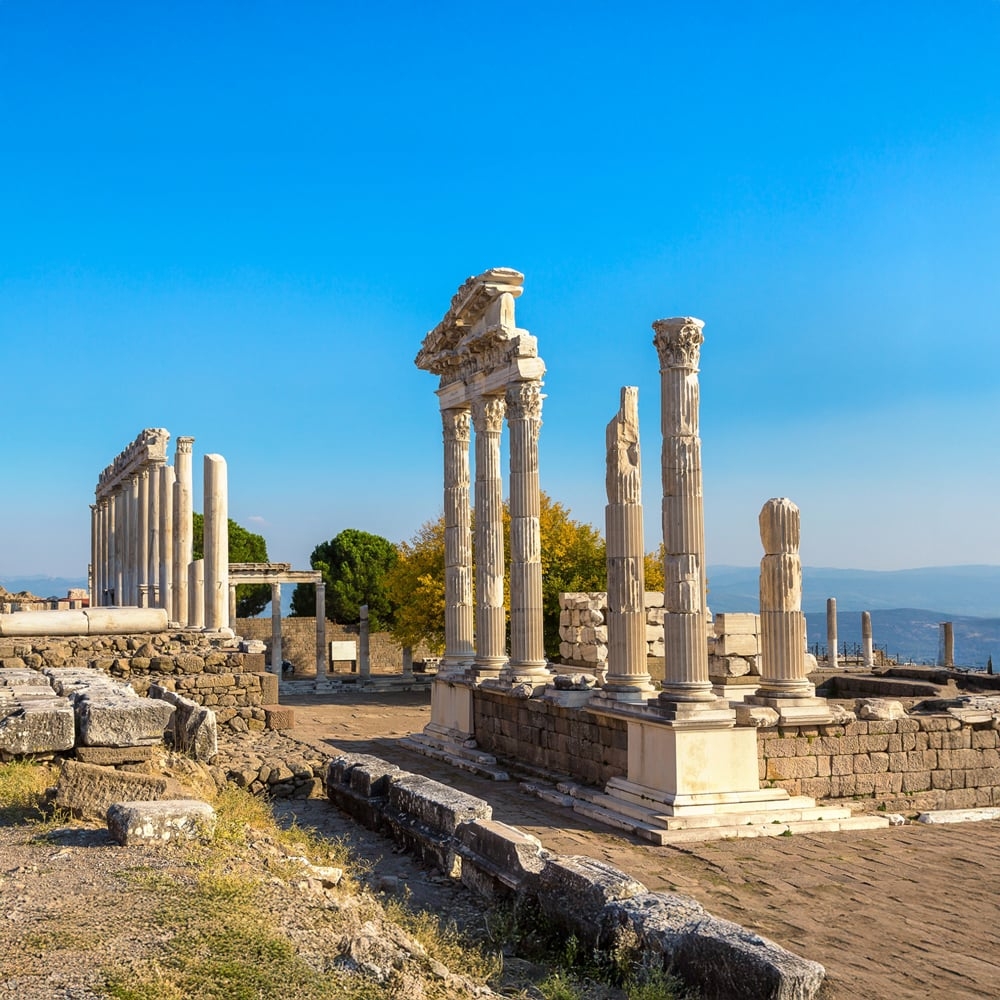
The Temple of Trajan stands on the highest terrace of the Pergamon Acropolis and is the only major Roman-period structure at the site. Construction began under Emperor Trajan (98–117 AD) and was completed under his successor Hadrian. The temple's raised platform — built out over the hill on vaulted substructures — made it visible from the entire Bakırçay Plain below, a deliberate demonstration of Roman imperial power on a Hellenistic skyline. Ten Corinthian columns have been re-erected in a partially reconstructed colonnade.
Pergamon Asclepion: The Ancient World's Most Famous Healing Centre
The Pergamon Asclepion is the best-preserved ancient healing complex in the world and one of the most important sites in the history of medicine. Located 2 km from the Acropolis in the lower city, the Asclepion was a sanctuary of Asclepius (the god of healing) that functioned as a combination of temple, spa, and therapeutic hospital from the 4th century BC through the Roman period.
Galen of Pergamon
Galen of Pergamon (129–216 AD) is the most important physician of the ancient world, whose medical writings remained the authoritative texts in Western and Islamic medicine for over 1,400 years. Galen trained at the Asclepion and later worked as physician to the gladiators of Pergamon before moving to Rome, where he served emperors Marcus Aurelius and Commodus. His anatomical work — primarily performed on Barbary macaques and pigs — provided the first systematic description of the human body's organs and functions. The Asclepion's connection to Galen gives Pergamon a direct line to the foundations of Western medical science.
Asclepion Treatments and Sacred Spring
Treatment at the Pergamon Asclepion involved a combination of physical and psychological methods: patients drank and bathed in the sacred spring water (which modern analysis shows contained mild mineral compounds with documented relaxant effects), underwent dream therapy in the incubation hall (sleeping in the sanctuary to receive diagnostic visions from Asclepius), walked 80-metre-long underground tunnels with piped sound effects designed to induce healing trances, and attended theatrical performances in the Asclepion theatre — because Galen and his predecessors understood that psychological wellbeing affected physical recovery.
Pergamon: UNESCO World Heritage Site Since 2014
The ancient city of Pergamon and its Multi-Layered Cultural Landscape was inscribed as a UNESCO World Heritage Site in 2014, designated for its "outstanding universal value" as a centre of Hellenistic civilisation and for its palimpsest of archaeological layers — Greek, Roman, Byzantine, and Ottoman — visible within the modern city of Bergama. The UNESCO designation includes not only the Acropolis and Asclepion but also the Red Basilica (the largest Roman-era building in Asia Minor north of Ephesus), the Gymnasium complex, and the city's lower agora.
Pergamon vs. Ephesus: Choosing Your Daily Tour
Pergamon and Ephesus: Daily Tour Comparison
| Feature |
Pergamon |
Ephesus |
| Distance from Kusadasi |
~200 km (2.5 hrs) |
~20 km (25 min) |
| Distance from Izmir |
~100 km (1.5 hrs) |
~80 km (1 hr) |
| UNESCO Status |
2014 |
2015 |
| Primary highlights |
Acropolis, Library, Asclepion |
Library of Celsus, Great Theatre, Terrace Houses |
| Physical demand |
Moderate-high (hilltop, steep terrain) |
Moderate (marble streets, flat-ish) |
| Visitor density |
Low-Medium |
Very High (summer) |
| Unique factor |
Steepest theatre in antiquity; Galen's Asclepion |
Best-preserved Greco-Roman street in the world |
Book Your Daily Pergamon Tour
The ancient capital of the Attalid Kingdom, the birthplace of parchment, and the world's most celebrated healing centre — all in one expertly guided day. Apasas Travel runs private Pergamon tours from both Izmir and Kusadasi, with licensed guides and no deposit required.
Tour from Izmir Tour from Kusadasi