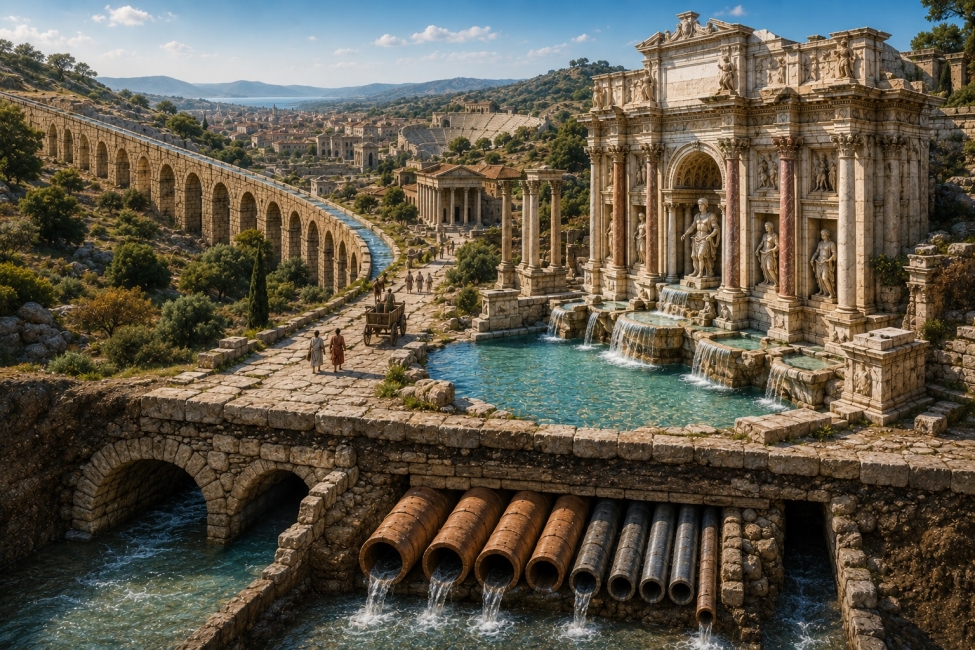
It's a hot summer afternoon in Ephesus.
The temperature has climbed well above 35°C (95°F), and thousands of people fill the city's marble streets.
Merchants are selling their goods in the Agora.
Citizens relax in the Roman baths.
Children play near monumental fountains.
Fresh water flows continuously through public toilets.
Elegant homes in the Terrace Houses receive clean water every day.
But here's the mystery.
Ephesus had no major river flowing through its center.
There was no giant reservoir beside the city.
No electric pumps.
No modern plumbing.
So how did one of the largest cities in the Roman Empire provide fresh water for nearly 200,000 people?
The answer lies in one of the greatest engineering achievements of the ancient world.
Water was the lifeblood of Ephesus.
Without it, the city simply could not function.
Every single day, enormous quantities of fresh water were needed for:
Unlike many ancient settlements built directly beside large rivers, Ephesus depended almost entirely on carefully planned engineering to bring water from distant mountain springs.
This challenge pushed Roman engineers to create a remarkably sophisticated water supply system that still impresses archaeologists today.
The journey of every drop of water began far from the city.
Fresh water was collected from natural springs in the surrounding hills, many kilometers away from Ephesus.
Rather than relying on pumps, Roman engineers designed long aqueducts that carried water entirely by gravity.
The principle was simple.
The execution was extraordinary.
The channels maintained an incredibly gentle downward slope over many kilometers, allowing water to flow continuously without stopping.
Too steep, and the water would damage the channels.
Too flat, and it would stop flowing altogether.
The Romans calculated these gradients with astonishing precision.
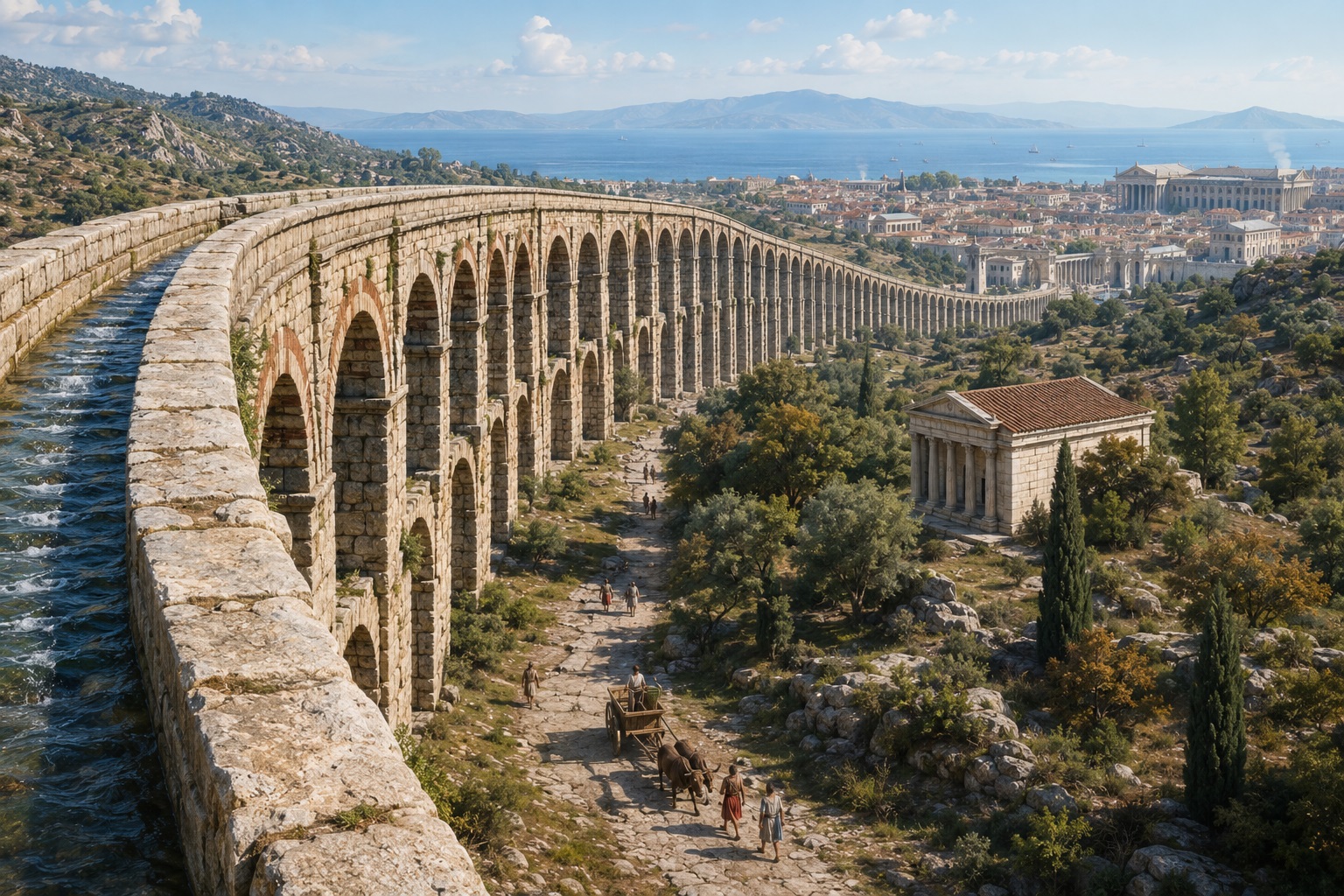
One of the most remarkable aspects of Roman engineering is that the entire water system worked without mechanical pumps.
Gravity did all the work.
Engineers carefully surveyed the landscape before construction began.
Using simple measuring instruments and exceptional mathematical knowledge, they ensured the aqueduct maintained a nearly perfect slope for its entire length.
Some sections descended only a few centimeters every hundred meters.
Even small mistakes could have caused the entire system to fail.
More than two thousand years later, engineers still admire the accuracy achieved with such limited technology.
Once water reached Ephesus, another impressive network took over.
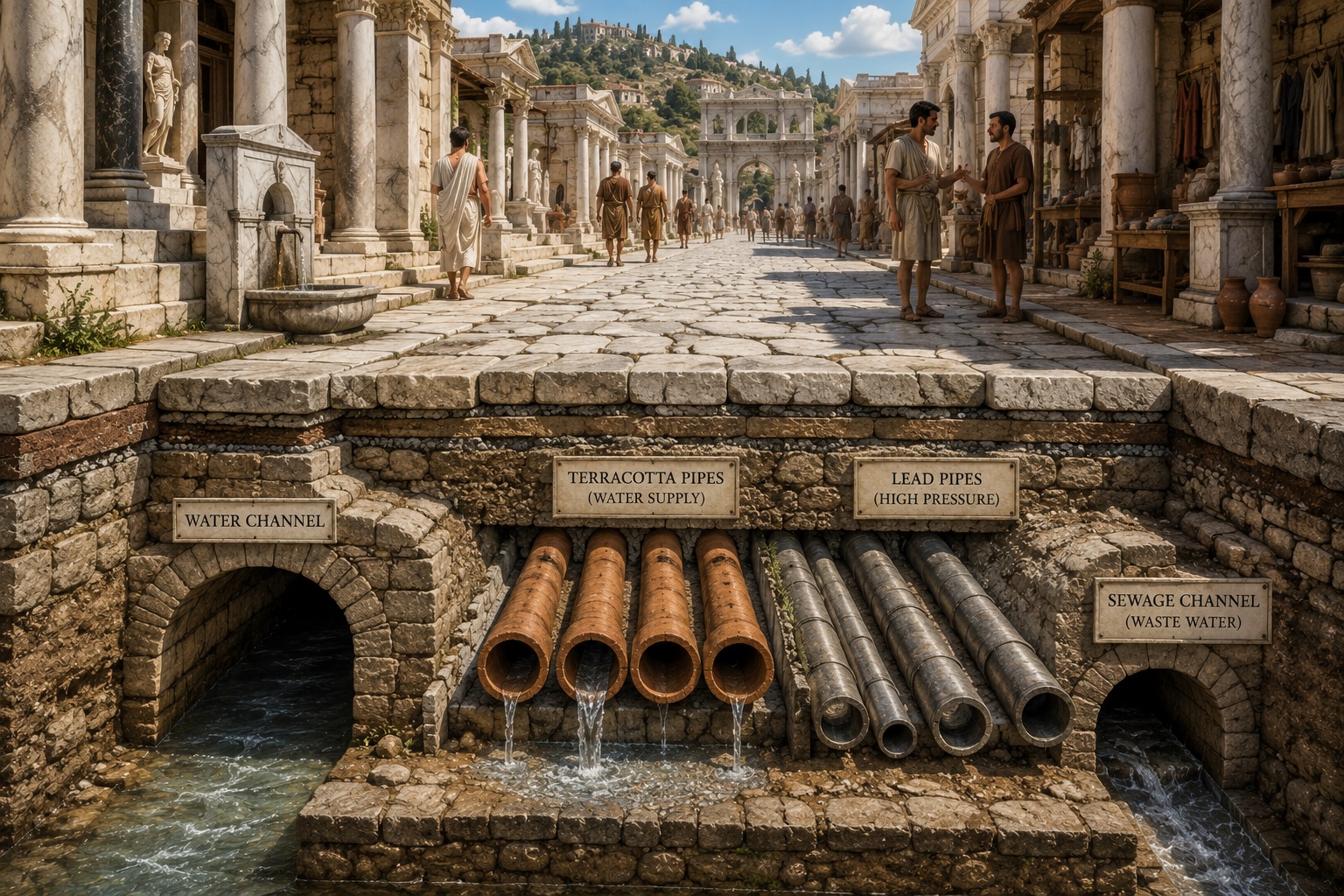
Beneath the marble streets lay an intricate system of underground pipes.
Most were made from terracotta (baked clay), while certain high-pressure sections used lead pipes.
These underground channels distributed water throughout the city, connecting fountains, bathhouses, public buildings, and wealthy private homes.
Many visitors walk across Curetes Street without realizing that an advanced plumbing network once operated beneath their feet.
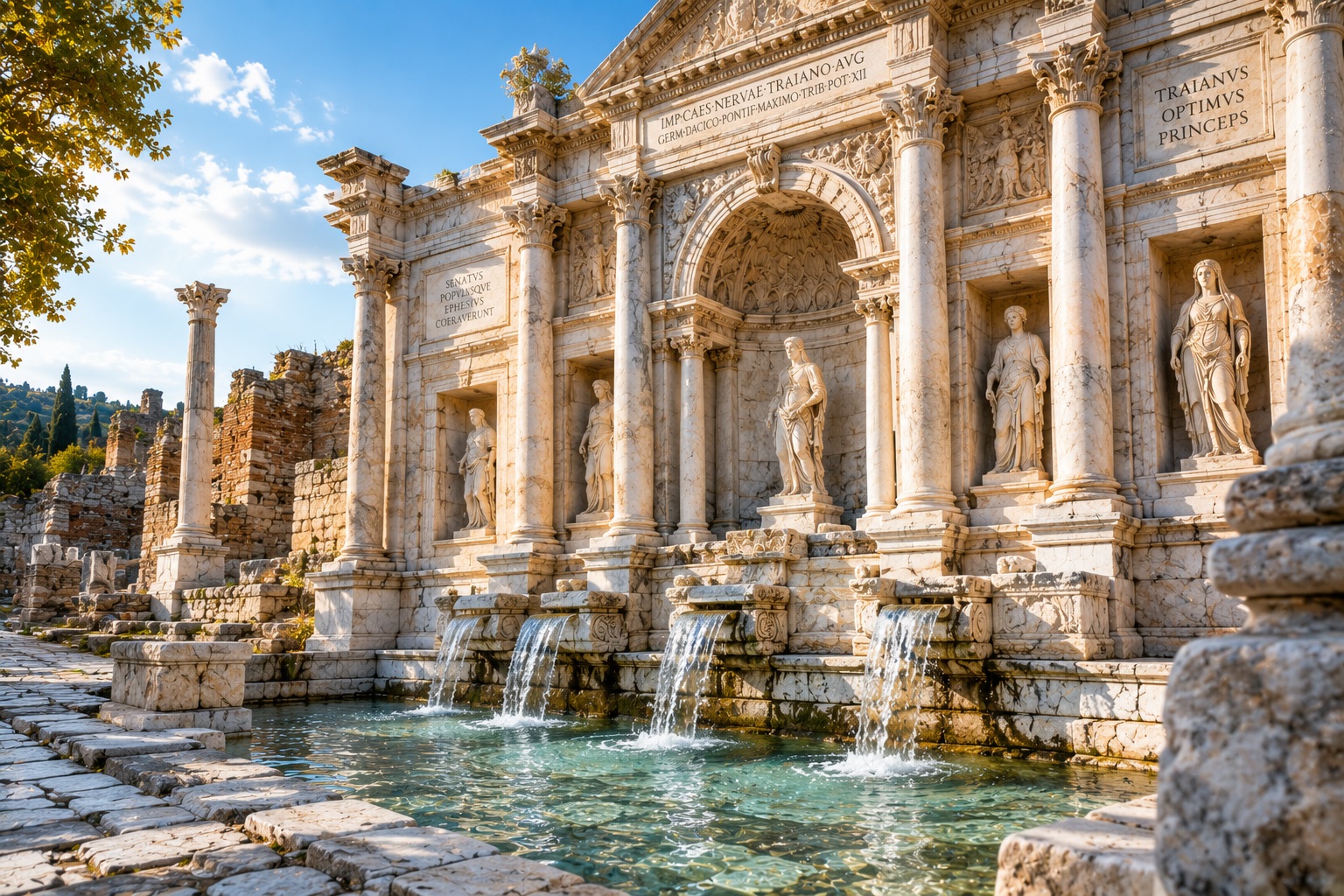
Visitors often admire the beautiful fountains of Ephesus without realizing they played a vital role in the city's infrastructure.
These impressive monuments were not simply built to impress travelers.
They acted as distribution hubs for fresh water.
Among the most famous was the magnificent Fountain of Trajan, whose large basin continuously received fresh water before distributing it through nearby channels.
Another important structure, the Pollio Fountain, also helped supply parts of the city while serving as a symbol of Roman generosity and civic pride.
The sound of flowing water would have echoed through Ephesus throughout the day, providing drinking water, cooling the surrounding air, and reminding everyone of the city's prosperity.
The Romans believed water should never be wasted.
Instead, it moved through the city in carefully planned stages.
A typical journey looked something like this:
This continuous cycle ensured that fresh water entered the city while wastewater was safely removed.
It was one of the earliest examples of integrated urban water management in history.
Some historians estimate that certain Roman cities supplied more fresh water per person than many European cities did nearly 1,500 years later. Roman engineering wasn't simply advanced for its time—it remained unmatched for centuries.
Today, civil engineers continue to study Roman aqueducts to understand how ancient builders achieved such remarkable precision using only simple tools.
Many sections of Roman water systems survived earthquakes, invasions, and centuries of abandonment.
The remains around Ephesus stand as lasting evidence that Roman engineering was built not only for efficiency but also for durability.
In the next section, we'll follow the water after it entered the city, discover how it supplied the famous Roman baths and public toilets, explore the sophisticated sewer system beneath Ephesus, and learn why modern engineers still admire this extraordinary achievement.
Once fresh water entered Ephesus, it transformed every aspect of city life.
Magnificent fountains provided clean drinking water for residents and travelers.
Bathhouses depended on a constant supply to fill pools, create steam, and maintain comfortable bathing temperatures.
Even the city's elegant homes, especially those in the Terrace Houses, enjoyed running water through carefully engineered plumbing systems.
The availability of fresh water wasn't simply a convenience—it was one of the reasons Ephesus became one of the wealthiest and most advanced cities in the Roman Empire.
If you've read our article about the Roman Baths of Ephesus, you'll already know that enormous quantities of water were required every single day to keep the bath complexes operating.
Perhaps the most surprising part of the entire system was where the water went next.
After serving fountains and public buildings, it continued flowing into the famous Roman public latrines.
Continuous water beneath the marble seats carried waste into the city's underground drainage network, while a second channel supplied clean water for washing.
This remarkable design made the public toilets of Ephesus among the most advanced sanitation facilities of the ancient world.
If you haven't already, be sure to read our guide:
How Romans Went to the Toilet: The Surprisingly Advanced Public Toilets of Ephesus
Understanding the water system makes those extraordinary toilets even more impressive.
Clean water was only half of the story.
Removing wastewater was equally important.
Beneath the marble streets of Ephesus, an underground sewer network collected used water from baths, fountains, homes, and public toilets before safely carrying it away from the city.
This protected drinking water supplies while improving hygiene throughout the urban environment.
Many visitors walk along Curetes Street without realizing that an invisible network of underground engineering once operated beneath every step.
The famous Terrace Houses reveal another remarkable achievement.
These luxurious residences weren't simply decorated with mosaics and frescoes.
Many also featured private water supplies, fountains, bathrooms, and sophisticated drainage systems.
For wealthy families living in Ephesus, running water was already becoming part of everyday life nearly two thousand years ago.
It was an extraordinary level of comfort for the ancient world.
Some Roman aqueducts transported water for more than 80 kilometers before reaching their destination. They achieved this entirely through gravity, without pumps, electricity, or modern machinery.
Although much of the underground system is hidden, visitors can still discover many impressive remains inside Ephesus.
Each of these monuments tells part of the story of how water made one of the Roman Empire's greatest cities possible.
Ephesus received fresh water from mountain springs through an extensive network of Roman aqueducts built with carefully calculated gradients.
Yes. Fresh water flowed continuously through fountains, bathhouses, wealthy homes, and public toilets using gravity-powered aqueducts and underground pipes.
The baths received water through the city's aqueduct and pipe network, allowing pools, steam rooms, and fountains to operate every day.
Visitors can still see fountains, bath complexes, water channels, and other remains that formed part of Ephesus' remarkable water infrastructure.
It combined aqueducts, underground pipelines, public fountains, baths, toilets, and sewer systems into one integrated urban network—an engineering achievement centuries ahead of its time.
When people think of Ephesus, they usually picture magnificent monuments like the Library of Celsus or the Great Theatre.
Yet without fresh water, none of those buildings could have supported a thriving city.
The aqueducts, fountains, underground pipes, baths, and sewers formed an invisible network that kept Ephesus alive every single day.
It was an extraordinary achievement of Roman engineering—one that continues to inspire historians, archaeologists, and engineers nearly two thousand years later.
The next time you walk along the marble streets of Ephesus, remember that beneath your feet once flowed the lifeblood of one of the greatest cities in the ancient world.
If you're ready to experience this remarkable engineering firsthand, explore our guided Ephesus Tours. From the Fountain of Trajan and the Roman Baths to the famous public toilets and the elegant Terrace Houses, our expert local guides reveal the stories and hidden details that transform ancient ruins into an unforgettable journey through history.
```

I graduated from Istanbul University with a degree in Radio, Television, and Cinema. During my academic journey, I focused on storytelling, visual communication, and cultural content creation, while my personal interests led me toward exploration and discovery.
Traveling, discovering new places, and experiencing different cultures are at the heart of my life. My strong interest in mythology allows me to see destinations not only as physical locations but as narratives shaped by history and meaning. My passion for reading continuously enriches and deepens this perspective.
I truly enjoy meeting new people and learning about diverse ways of life. With this mindset, I aim to share my experiences in a sincere, clear, and engaging way.
I love following the traces of stories wherever I go.
Disclosure Notice
By filling out this form, you agree that the personal data you provide to us will be processed in accordance with the Personal Data Protection Law No. 6698 and related legislation.
Your personal data will be processed solely for responding to your application, evaluating your requests, and fulfilling legal obligations; it will not be shared with third parties.
For detailed information, you can review our Privacy Policy.
By submitting the form, you acknowledge and consent to the processing of your personal data for the purposes specified above.

