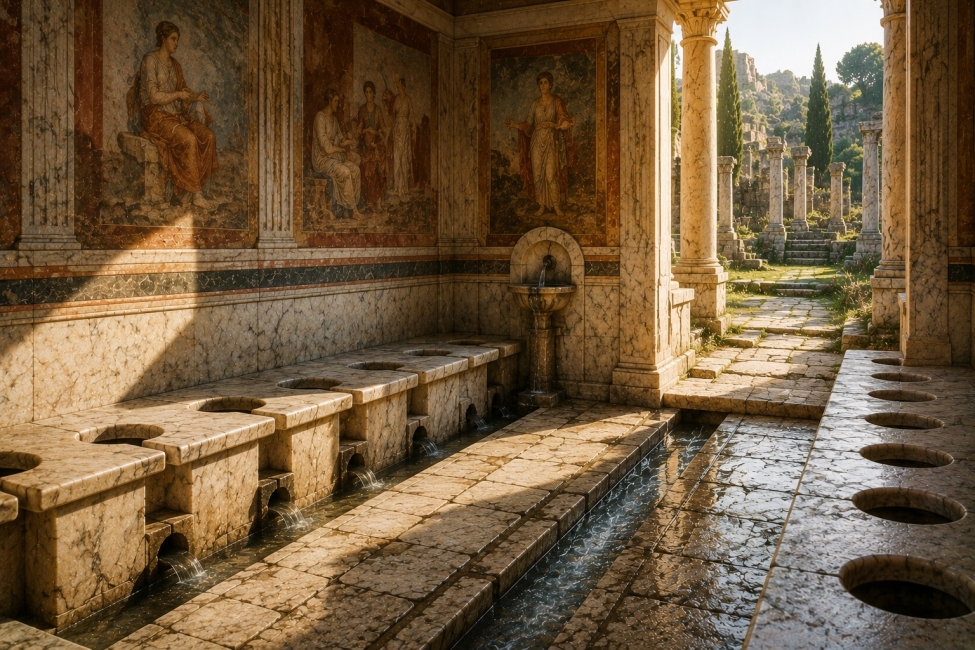
Imagine spending a morning in Ephesus nearly 2,000 years ago.
The marble streets are already crowded. Merchants are opening their shops along Curetes Street, philosophers debate beneath shaded porticoes, and travelers from across the Roman Empire fill the bustling Agora.
You finish breakfast.
You greet a friend.
And before starting your day, you head to one of the city's busiest gathering places.
Not the marketplace.
Not the Great Theatre.
The public toilet.
It may sound surprising today, but in Ancient Rome, public toilets were much more than places to answer nature's call. They were social spaces where politicians discussed public affairs, merchants negotiated business deals, neighbors exchanged gossip, and friends simply enjoyed conversation.
In fact, the remarkably well-preserved public latrines of Ephesus remain one of the city's most fascinating attractions, offering an unexpected glimpse into daily Roman life.
So, how did Romans go to the toilet—and why were they centuries ahead of their time?
Modern flush toilets feel like an everyday convenience.
Two thousand years ago, however, they were an extraordinary achievement.
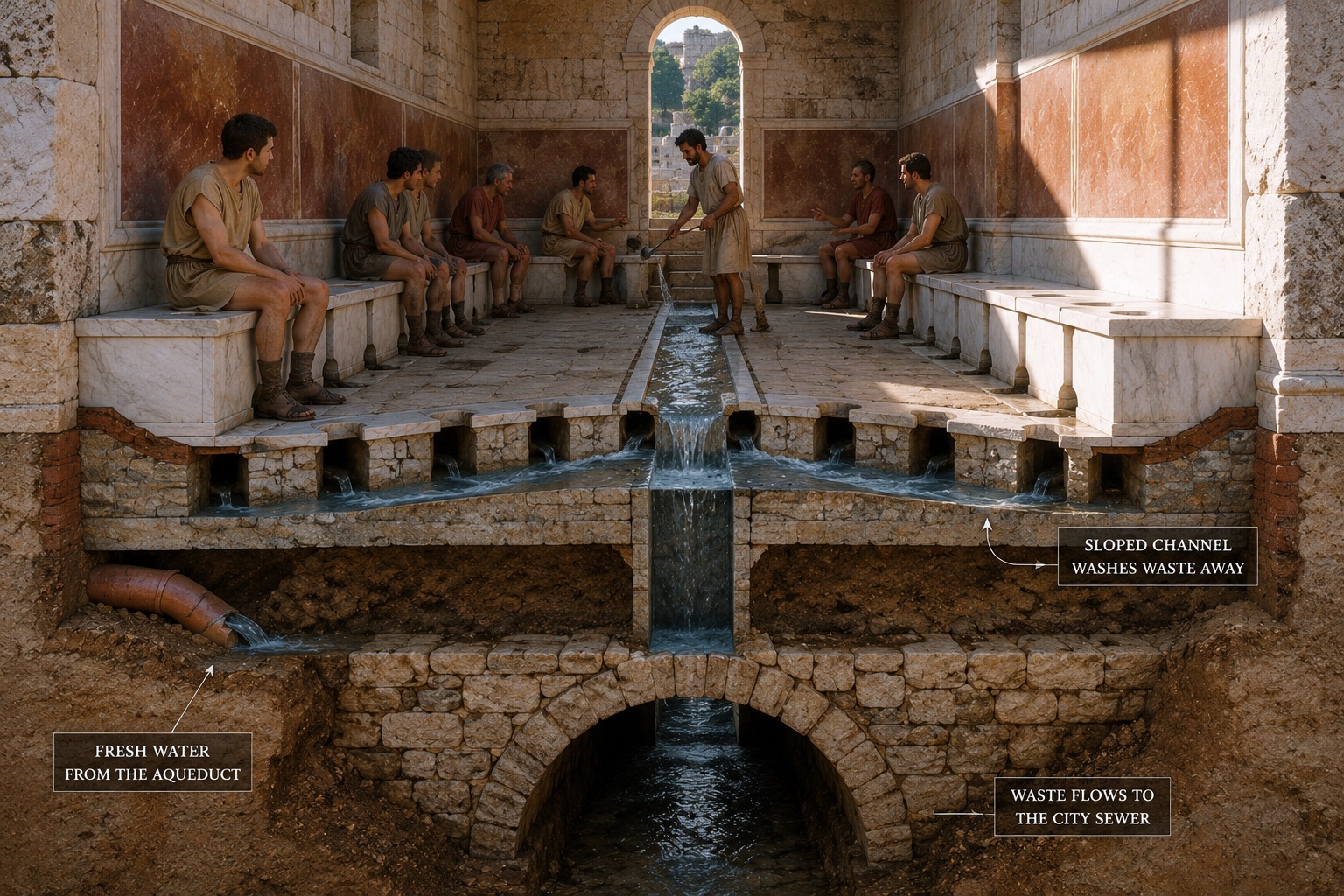
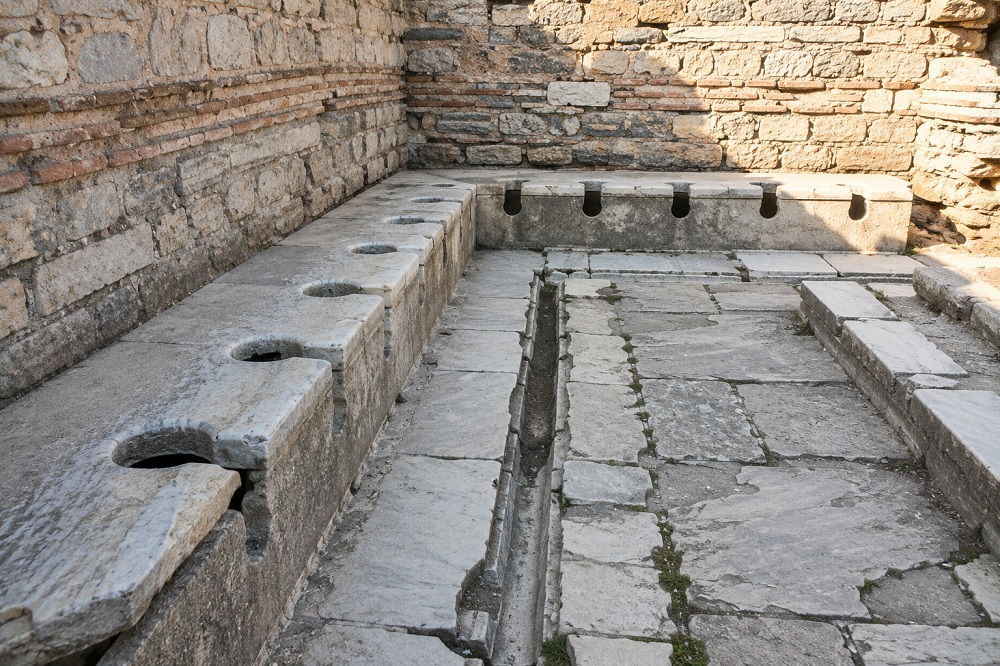
The public toilets—or latrines—of Ephesus were connected to an advanced water and drainage system that continuously carried waste away from the seating area.
Unlike simple pit toilets used elsewhere in the ancient world, Roman engineers designed these facilities with flowing water beneath the marble seats, helping to keep the area cleaner and reduce unpleasant odors.
Another narrow channel of fresh water flowed in front of the seats, allowing visitors to rinse the cleaning sponge used after each visit.
For an ancient civilization, this represented remarkably sophisticated urban planning.
One detail surprises almost every modern visitor.
There were no private stalls.
No doors.
No partitions.
Instead, long marble benches lined the room, each carefully carved with evenly spaced openings.
Visitors sat shoulder to shoulder.
Privacy, as we understand it today, simply wasn't part of Roman culture.
The public latrine functioned almost like a modern café.
People chatted while conducting business.
Friends caught up on local news.
Politicians discussed important decisions.
Merchants negotiated prices before heading to the Agora.
For wealthy citizens especially, a visit to the latrine could be surprisingly social.
This is perhaps the question every visitor secretly wants answered.
After all...
Toilet paper didn't exist.
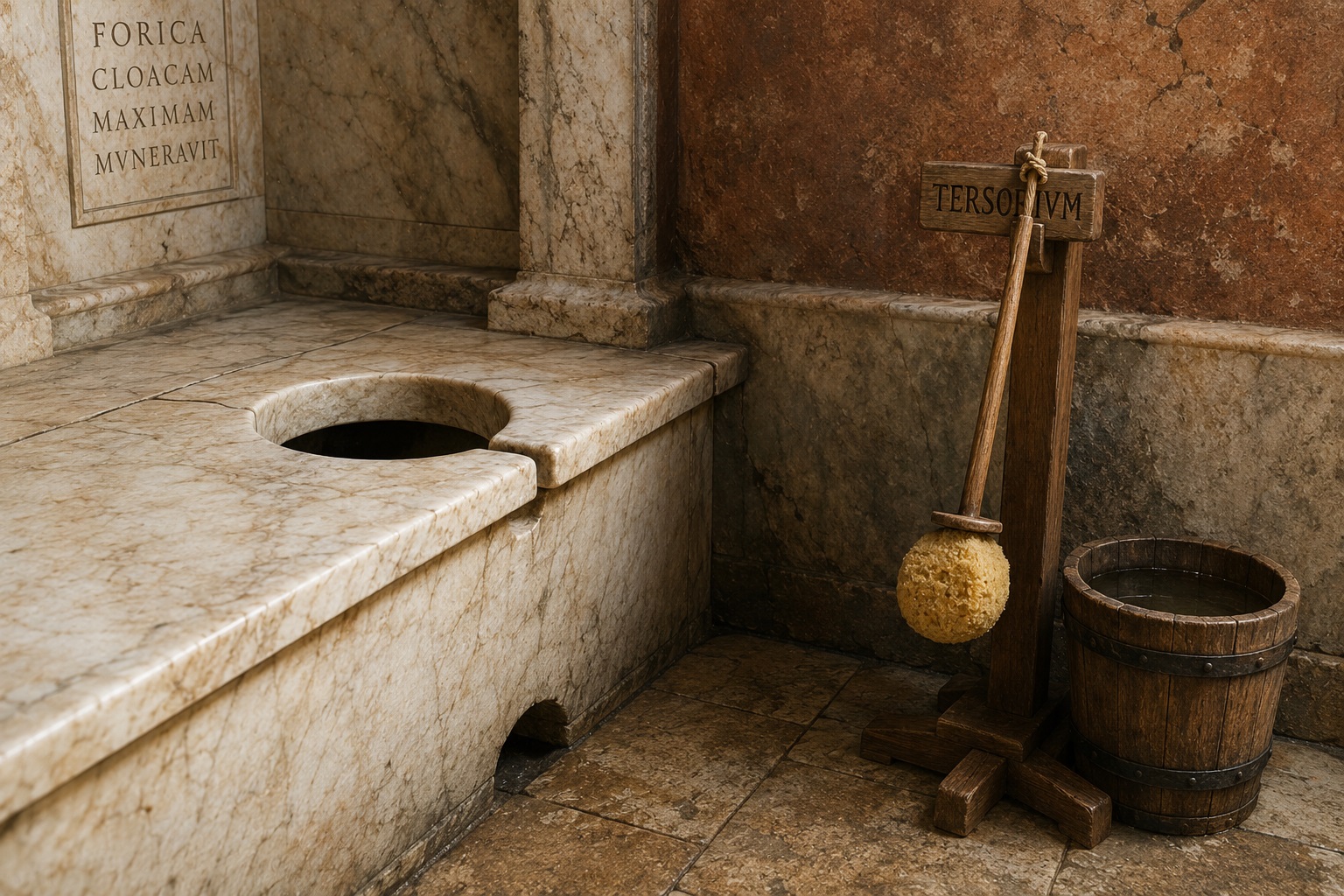
Instead, Romans used a tool called a tersorium.
The tersorium consisted of a natural sea sponge attached to the end of a wooden stick.
After use, it was rinsed in flowing water—often mixed with vinegar or saltwater—to clean and disinfect it before the next person used it.
While this may seem unhygienic by today's standards, it was considered an effective and practical solution in the Roman world.
Combined with the constantly flowing water system, it represented one of the earliest examples of organized public sanitation.
The genius of Roman engineering wasn't limited to aqueducts and monumental fountains.
Even their public toilets demonstrated remarkable innovation.
Beneath every marble seat, a continuous stream of water carried waste into the city's underground drainage system.
This constant flow reduced odors, improved cleanliness, and minimized maintenance compared with many other ancient sanitation systems.
Fresh water channels positioned in front of the benches supplied water for cleaning the tersorium.
Without realizing it, visitors to Ephesus were benefiting from one of the most advanced urban sanitation systems in the ancient world.
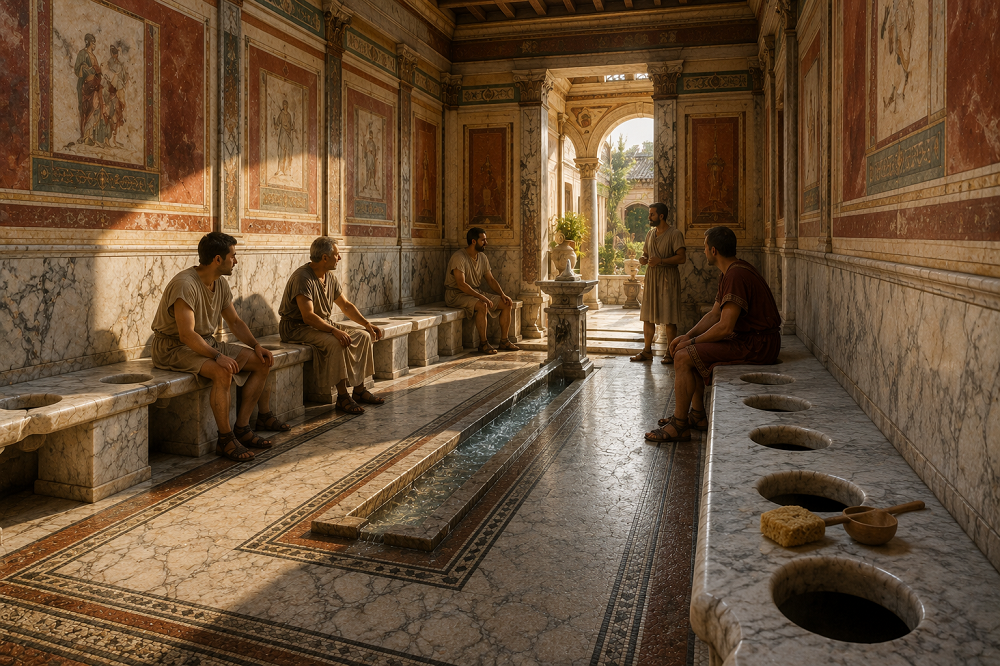
Although the public toilets were technically accessible to many citizens, the beautifully preserved latrines seen in Ephesus today were located beside the famous Scholastica Baths.
This prestigious location suggests that many of their regular users belonged to the city's wealthier classes.
After relaxing in the baths, visitors could continue their conversations in the adjoining latrine before returning to work, shopping, or political meetings.
The experience was far removed from today's idea of a quick visit.
In many ways, it was another chapter in the social life of Ancient Rome.
Roman public toilets were heated during winter.
Some historians believe warm air from nearby bathhouse heating systems helped reduce the cold inside luxury public latrines, making them surprisingly comfortable places to visit—even during cooler months.
Today, we tend to think of toilets as purely functional spaces.
For the Romans, they reflected something much greater.
They showcased engineering, public hygiene, urban planning, and even social culture.
The latrines of Ephesus remind us that one of the world's greatest ancient cities wasn't remarkable only because of its temples, theaters, and libraries.
It was also extraordinary because of the way ordinary people lived their everyday lives.
And perhaps nowhere tells that story better than a place most visitors never expect to find fascinating.
By modern standards, probably not.
Sharing a single sponge among multiple users certainly doesn't sound appealing today.
However, it's important to judge Roman sanitation within the context of its own time.
Compared with many other ancient civilizations, Roman cities were remarkably clean.
Continuous running water, underground drainage systems, public baths, fresh water supplied by aqueducts, and organized waste management all contributed to healthier urban living.
Archaeologists often point out that Roman sanitation represented one of the greatest engineering achievements of the ancient world.
While diseases certainly existed, the overall infrastructure was centuries ahead of its time.
The public toilets of Ephesus are among the best surviving examples of this remarkable system.
The more historians learn about Roman public toilets, the more fascinating they become.
It's a reminder that everyday life in Ancient Rome could be surprisingly sophisticated—and sometimes surprisingly familiar.
One of the reasons Ephesus is considered one of the world's greatest archaeological sites is that visitors can still walk through spaces where ordinary Romans lived their daily lives.
The public latrines remain remarkably well preserved.
You can still see:
Standing inside the structure, it's surprisingly easy to imagine conversations that took place here nearly two thousand years ago.
Unlike statues or temples, these toilets reveal something deeply human.
They remind us that despite the passing of centuries, people in ancient Ephesus worried about many of the same everyday needs we do today.
The Roman Emperor Vespasian introduced a tax on collecting urine from public toilets because it was used in leather tanning and textile production.
When criticized for taxing something so unpleasant, he famously replied:
"Pecunia non olet."
"Money doesn't stink."
The phrase is still used today in many languages.
Many visitors arrive at Ephesus expecting to be impressed by the Library of Celsus or the Great Theatre.
Those monuments are certainly unforgettable.
But for many travelers, it's the unexpected places—the marble streets, ancient shops, and even the public toilets—that make Ephesus feel real.
These everyday spaces help us understand how one of the greatest cities of the Roman Empire actually functioned.
If you'd like to discover fascinating details that many independent visitors simply walk past, explore one of our guided Ephesus tours. An experienced local guide can bring these remarkable stories to life and reveal the hidden side of the ancient city.
No. Ancient Romans typically used a tersorium—a natural sea sponge attached to a wooden stick—which was rinsed in running water between uses.
Privacy was viewed differently in Roman society. Public toilets were designed as communal spaces where people often talked, socialized, and even conducted business.
Yes. The public latrines of Ephesus are among the best-preserved Roman toilets in the world and can still be visited inside the archaeological site.
Absolutely. Continuous running water, underground drainage, marble seating, and organized sanitation made Roman toilets far more advanced than many people imagine.
The famous public latrines are located beside the Scholastica Baths along Curetes Street, one of the most important roads in the ancient city.
When people think of Ephesus, they usually picture magnificent temples, towering libraries, and grand theaters.
Yet sometimes the most fascinating discoveries are the most unexpected ones.
The public toilets of Ephesus reveal a city that valued engineering, cleanliness, innovation, and community.
They remind us that history isn't only about emperors and monuments.
It's also about ordinary people and the surprisingly modern ways they lived their everyday lives.
The next time you visit Ephesus, don't rush past the ancient latrines.
Pause for a moment.
Look around.
Imagine the conversations that echoed between those marble seats nearly two thousand years ago.
You may discover that one of the most memorable places in Ephesus isn't the biggest monument at all.
It's the place where Roman daily life becomes astonishingly real.

I graduated from Istanbul University with a degree in Radio, Television, and Cinema. During my academic journey, I focused on storytelling, visual communication, and cultural content creation, while my personal interests led me toward exploration and discovery.
Traveling, discovering new places, and experiencing different cultures are at the heart of my life. My strong interest in mythology allows me to see destinations not only as physical locations but as narratives shaped by history and meaning. My passion for reading continuously enriches and deepens this perspective.
I truly enjoy meeting new people and learning about diverse ways of life. With this mindset, I aim to share my experiences in a sincere, clear, and engaging way.
I love following the traces of stories wherever I go.
Disclosure Notice
By filling out this form, you agree that the personal data you provide to us will be processed in accordance with the Personal Data Protection Law No. 6698 and related legislation.
Your personal data will be processed solely for responding to your application, evaluating your requests, and fulfilling legal obligations; it will not be shared with third parties.
For detailed information, you can review our Privacy Policy.
By submitting the form, you acknowledge and consent to the processing of your personal data for the purposes specified above.

