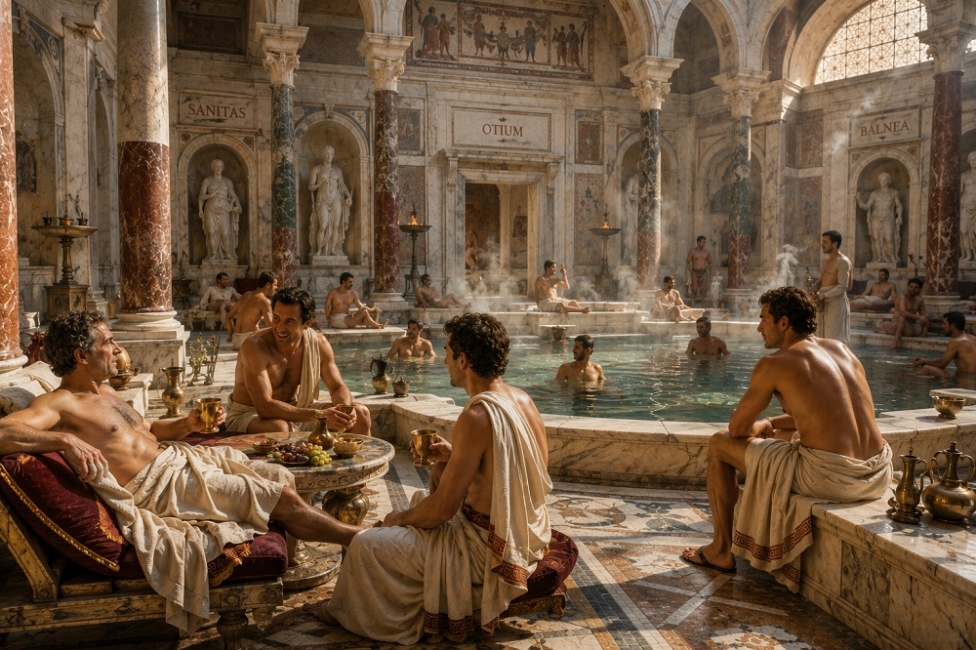
It's late afternoon in Ephesus.
The marble streets still radiate the heat of the Anatolian sun. Merchants are closing their shops in the Agora after another busy day, travelers continue strolling past the magnificent Library of Celsus, and the scent of freshly baked bread drifts through the city.
A wealthy Roman merchant finishes his business.
Does he go straight home?
Not yet.
Instead, he heads to one of the most important places in the city—not the theatre, not the temple, but the public baths.
For the Romans, bathing was never just about getting clean.
It was a daily ritual, a social gathering, a business meeting, a fitness center, and sometimes even a place to read, relax, and discuss politics.
To understand life in ancient Ephesus, you first need to step inside one of its remarkable bathhouses.
Modern spas are places where people relax for an hour before heading home.
Roman baths were entirely different.
They were among the busiest public spaces in every major Roman city.
People didn't simply arrive to wash.
They came to exercise, socialize, conduct business, meet friends, receive massages, and enjoy several hours away from work.
For many citizens, the baths were the center of daily life.
In Ephesus, several impressive bath complexes once served thousands of residents every day.
Among them, the Scholastica Baths remain one of the most fascinating places visitors can still explore today.
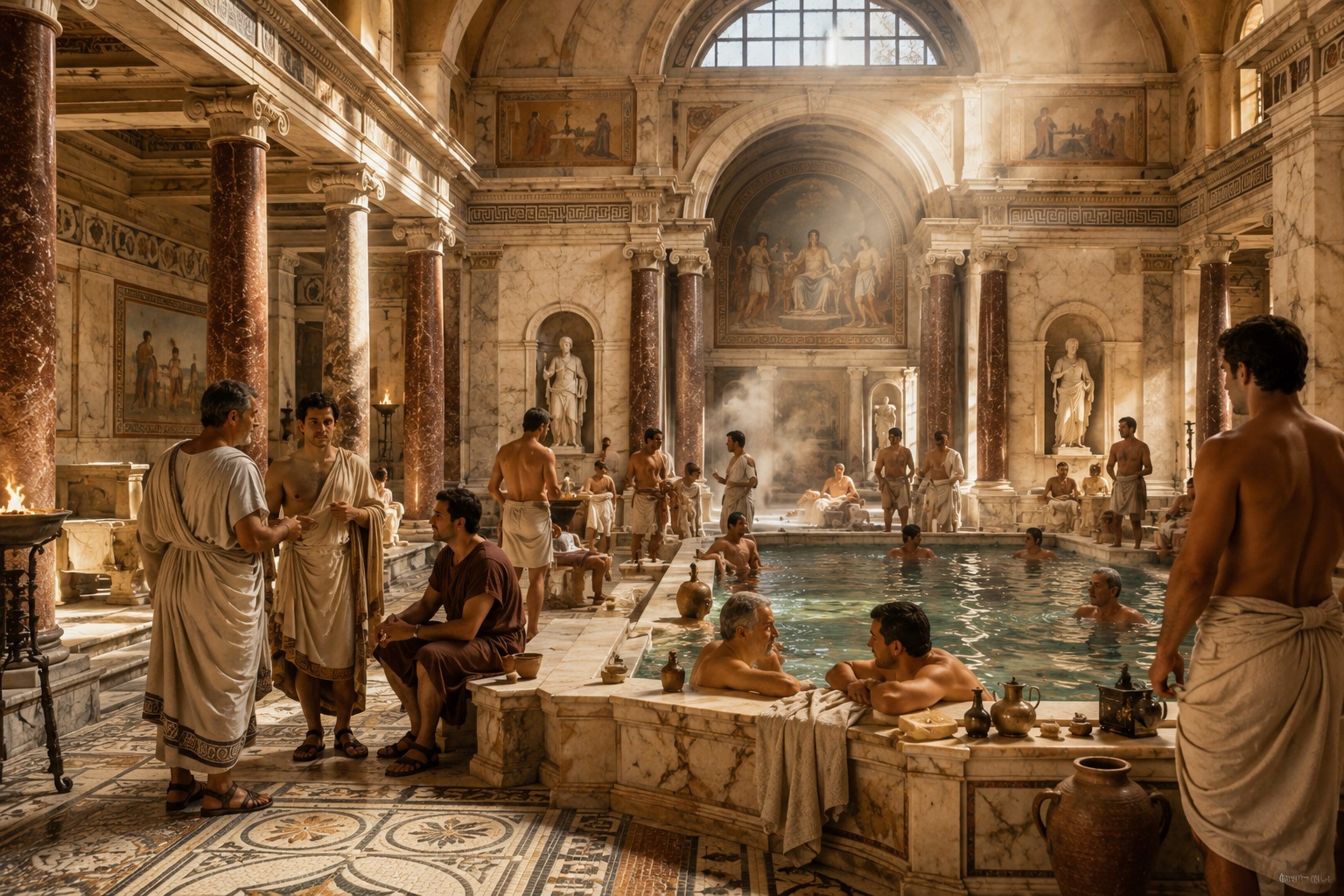
The best-preserved public bath complex in Ephesus is known today as the Scholastica Baths.
Originally constructed during the Roman period and later restored by a wealthy Christian woman named Scholastica in the fourth century AD, the baths became one of the city's most important public buildings.
Located beside Curetes Street, they occupied a prime position in the heart of Ephesus.
Visitors could easily combine a trip to the baths with shopping in the Agora, attending performances at the Great Theatre, or visiting nearby public toilets.
This convenient location made the baths an essential part of everyday urban life.
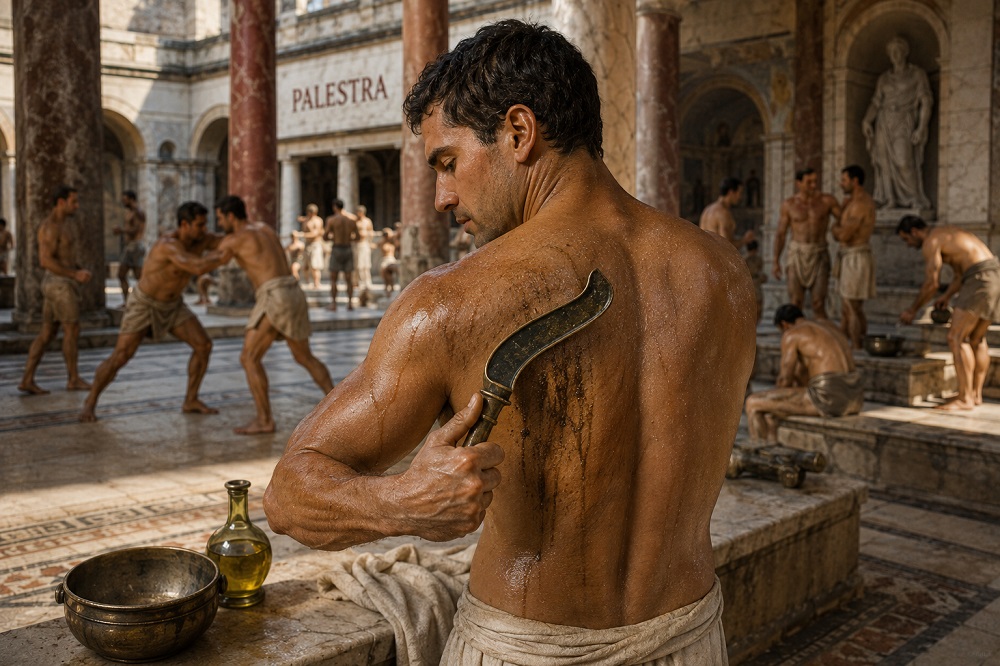
Bathing followed a surprisingly organized routine.
Rather than jumping directly into hot water, visitors moved through several carefully designed rooms.
Each room served a specific purpose.
| Room | Purpose |
|---|---|
| Apodyterium | Changing room where visitors left their clothes. |
| Palaestra | Open courtyard used for exercise and wrestling. |
| Tepidarium | Warm room preparing the body for higher temperatures. |
| Caldarium | The hottest room, filled with steam and hot baths. |
| Frigidarium | Cold plunge pool used to cool the body before leaving. |
Rather than rushing through the experience, Romans often spent several hours moving gradually from one room to another.
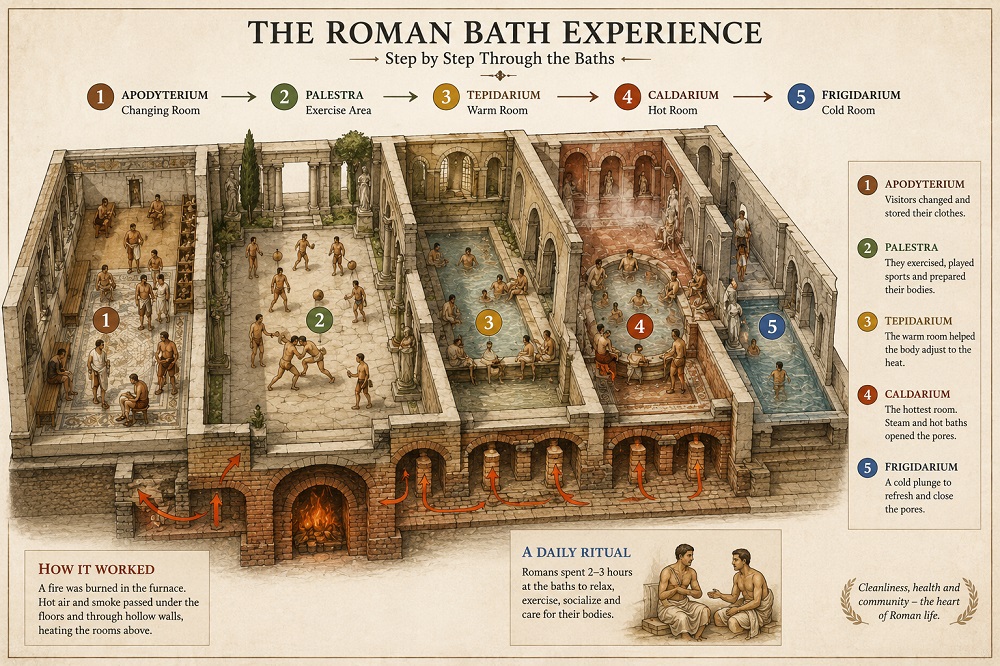
One surprising fact about Roman baths is that bathing usually wasn't the first activity.
Visitors often began by exercising in the Palaestra.
Here they:
Only after working up a sweat did they enter the bathing rooms.
In many ways, the Roman bath complex functioned much like a modern gym combined with a luxury spa.
Modern visitors are often surprised to learn that the Romans rarely used soap as we know it today.
Instead, they covered their skin with fragrant olive oil.
After exercising, servants—or sometimes the bathers themselves—used a curved metal tool called a strigil to scrape away the oil, dust, sweat, and dirt from the body.
The process was remarkably effective.
Only then did visitors continue into the warm and hot bathing rooms.
Perhaps the most extraordinary feature of Roman bathhouses wasn't the pools.
It was what lay beneath them.
The Romans invented an underfloor heating system known as the hypocaust.
Large furnaces burned continuously beneath the building.
Hot air circulated through empty spaces under the floors and inside hollow walls.
This ingenious system heated rooms evenly, produced steam, and kept the bathhouse comfortable even during winter.
Centuries before central heating became common, Roman engineers had already mastered the concept.
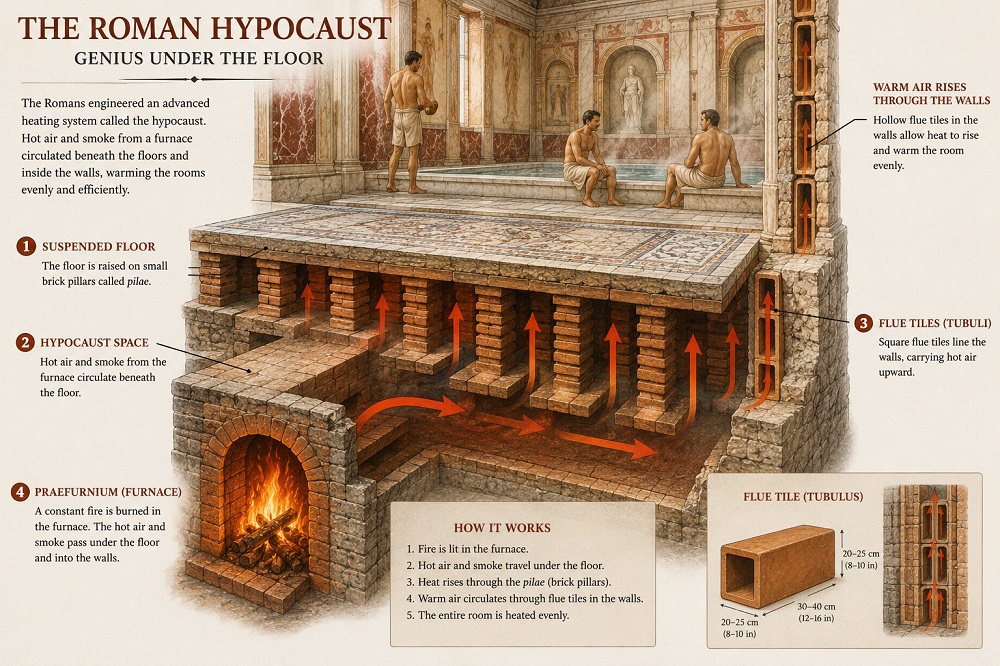
Many historians consider the Roman hypocaust one of the greatest engineering achievements of antiquity. The same basic idea—circulating heated air beneath floors—is still used in many modern underfloor heating systems today.
The baths echoed with conversation.
Friends discussed politics.
Merchants negotiated contracts.
Philosophers debated ideas.
Athletes relaxed after training.
Doctors offered health advice.
For wealthy citizens especially, visiting the baths was as much about networking as it was about personal hygiene.
Leaving without speaking to anyone would have been almost as unusual as leaving today without checking your phone.
In the next section, we'll explore who was allowed to use the baths, whether men and women bathed together, the surprisingly luxurious services available, and why the Roman baths of Ephesus remain one of the city's most fascinating places to visit today.
This is one of the questions visitors ask most often.
The answer is: sometimes—but not always.
During different periods of the Roman Empire, customs varied from city to city.
In many bathhouses, men and women visited at different hours of the day.
Some larger bath complexes featured separate sections for each gender, while others scheduled different bathing times.
Roman society placed great importance on public bathing, but it also adapted its customs according to local traditions and changing social attitudes.
Regardless of the arrangement, the baths welcomed people from nearly every level of society.
A visit to the baths could last several hours.
Visitors didn't simply wash and leave.
Instead, they enjoyed an experience that combined relaxation, health, beauty, and entertainment.
A typical afternoon might include:
For wealthy Romans, visiting the baths was one of the highlights of the day.
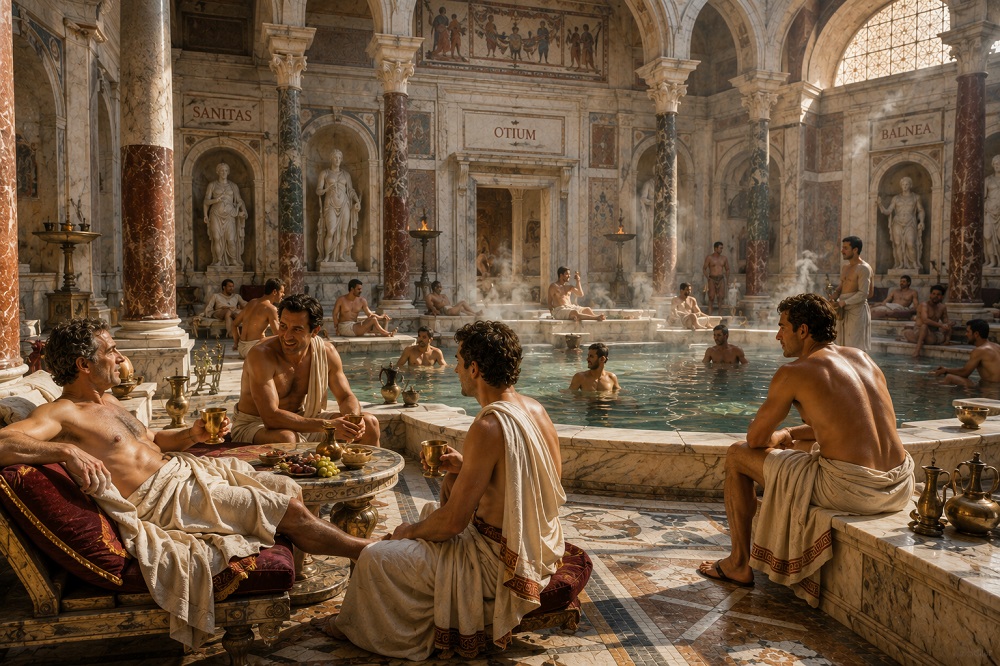
Although thousands of people used the baths every week, they were far from unpleasant places.
Visitors often applied perfumed oils made from olive oil mixed with herbs, flowers, and spices.
Popular fragrances included:
Combined with steam and flowing water, these aromas helped create an atmosphere that many ancient writers described as luxurious and relaxing.
If you've already explored the famous Roman public toilets of Ephesus, you'll notice something interesting.
The bathhouses and the public latrines were often connected.
After several hours of exercising, bathing, and socializing, visitors could conveniently continue to the nearby public toilets before returning home.
Together, these facilities formed part of one of the most advanced sanitation systems in the ancient world.
Want to learn more about Roman public toilets?
Read our guide:
How Romans Went to the Toilet: The Surprisingly Advanced Public Toilets of Ephesus
Although the roofs disappeared centuries ago, the remains of the Scholastica Baths still tell an incredible story.
Walking through the ruins today, you can still identify:
With a little imagination, it's easy to picture hundreds of Romans gathering here every afternoon to relax after a busy day.
Some historians describe Roman bathhouses as the social media platforms of antiquity.
People exchanged news, discussed politics, made business deals, met new friends, and even looked for marriage opportunities while spending hours inside the baths.
If you wanted to know what was happening in Ephesus, this was one of the best places to be.
When visitors imagine Ephesus, they usually think about magnificent monuments like the Library of Celsus or the Great Theatre.
Yet places such as the Scholastica Baths reveal something even more valuable.
They show us how ordinary people actually lived.
Every marble floor, heated room, and bathing pool reminds us that Ephesus wasn't simply a collection of temples—it was a vibrant, sophisticated city where daily life revolved around innovation, comfort, and community.
If you'd like to discover these fascinating stories with an experienced local guide, explore our Ephesus Tours. Many visitors walk past the bath complex without realizing it was once one of the busiest places in the entire city.
The Roman baths were public spaces where people exercised, bathed, relaxed, socialized, received massages, and conducted business meetings.
Yes. The remains of the famous Scholastica Baths can still be visited inside the Ancient City of Ephesus.
Not in the modern sense. Instead, they used olive oil and cleaned their skin with a curved metal tool called a strigil.
Roman engineers developed the hypocaust system, which circulated hot air beneath the floors and inside the walls to heat the building.
Because they combined hygiene, fitness, healthcare, business, entertainment, and social life under one roof, making them one of the most important institutions in every Roman city.
The Roman baths of Ephesus were far more than impressive buildings.
They reflected the values of an entire civilization.
Innovation.
Community.
Health.
Comfort.
Long before modern spas, gyms, and wellness centers existed, the people of Ephesus had already created places where body, mind, and society came together.
Today, the marble walls stand silent.
The steam has disappeared.
The conversations have faded.
Yet as you walk through the Scholastica Baths, it's remarkably easy to imagine the laughter, discussions, and daily routines that once filled these halls nearly two thousand years ago.
Sometimes, the greatest monuments of history aren't the ones built to impress—they're the ones built for everyday life.
If you're planning to experience Ephesus for yourself, don't just admire its famous landmarks. Explore the ancient city with an experienced local guide who can bring places like the Scholastica Baths, the Roman public toilets, the Library of Celsus, and countless hidden stories to life.
Browse our Ephesus Tours and discover why this remarkable UNESCO World Heritage Site continues to captivate travelers from around the world.

I graduated from Istanbul University with a degree in Radio, Television, and Cinema. During my academic journey, I focused on storytelling, visual communication, and cultural content creation, while my personal interests led me toward exploration and discovery.
Traveling, discovering new places, and experiencing different cultures are at the heart of my life. My strong interest in mythology allows me to see destinations not only as physical locations but as narratives shaped by history and meaning. My passion for reading continuously enriches and deepens this perspective.
I truly enjoy meeting new people and learning about diverse ways of life. With this mindset, I aim to share my experiences in a sincere, clear, and engaging way.
I love following the traces of stories wherever I go.
Disclosure Notice
By filling out this form, you agree that the personal data you provide to us will be processed in accordance with the Personal Data Protection Law No. 6698 and related legislation.
Your personal data will be processed solely for responding to your application, evaluating your requests, and fulfilling legal obligations; it will not be shared with third parties.
For detailed information, you can review our Privacy Policy.
By submitting the form, you acknowledge and consent to the processing of your personal data for the purposes specified above.

