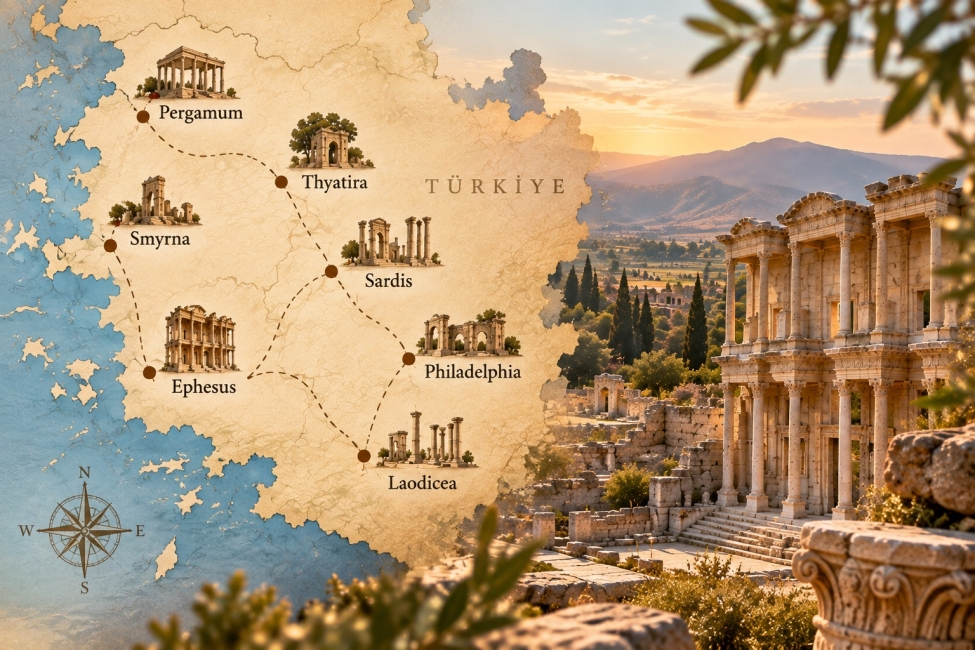
When people read the Book of Revelation, one question often comes to mind: Where are the Seven Churches of Revelation today?
The answer may be surprising. The seven churches mentioned in Revelation were not fictional places or purely symbolic locations. They were real Christian communities in ancient Asia Minor, and all seven can be located in modern-day Türkiye.
The churches were Ephesus, Smyrna, Pergamum, Thyatira, Sardis, Philadelphia and Laodicea. They are named together in Revelation 1:11, while individual messages to each church appear in Revelation chapters 2 and 3.
Today, these ancient cities are found across western Türkiye. Some have extensive archaeological remains, while others survive beneath or alongside modern towns.
So, where exactly are the Seven Churches of Revelation today?
Let's follow the route one church at a time.
The seven biblical churches are located in western Türkiye:
| Biblical Church | Modern Location | Modern Province |
|---|---|---|
| Ephesus | Selçuk | İzmir |
| Smyrna | İzmir | İzmir |
| Pergamum | Bergama | İzmir |
| Thyatira | Akhisar | Manisa |
| Sardis | Sart, near Salihli | Manisa |
| Philadelphia | Alaşehir | Manisa |
| Laodicea | Near Denizli | Denizli |
These locations are not all preserved in the same way.
Ephesus, Pergamum, Sardis and Laodicea, for example, are major archaeological sites where visitors can walk through substantial remains of the ancient cities. Smyrna, meanwhile, is partly incorporated into the modern city of İzmir.
This difference is important. When we ask whether the Seven Churches are "still there," we should not imagine seven perfectly preserved church buildings from the first century.
Instead, what survives today is a combination of ancient cities, archaeological remains, later Christian structures and the landscapes in which these early Christian communities lived.
Ancient Ephesus is located near the modern town of Selçuk in İzmir Province.
Of all the Seven Churches, Ephesus is perhaps the most famous destination for international travelers.
The ancient city contains some of the most impressive Roman remains in the region, including the Library of Celsus, the Great Theatre and monumental streets.
Ephesus is also particularly significant for Christian travelers.
The city is associated with the ministry of Paul and with the development of early Christianity in Asia Minor. The Christian heritage around Ephesus also includes the House of the Virgin Mary and the Basilica of Saint John.
The church addressed in Revelation is no longer functioning as the same first-century congregation.
However, the ancient city remains remarkably important for understanding the environment in which the Christian community existed.
The message to Ephesus in Revelation is particularly memorable because the church is praised for its perseverance but criticized for having lost its first love.
For visitors, this creates a powerful connection between the biblical text and the physical city.
Read next: Ephesus in Revelation: What the Bible Says About the Church of Ephesus
Ancient Smyrna corresponds to modern İzmir.
This makes Smyrna one of the most interesting answers to the question, "Where are the Seven Churches today?"
You do not need to travel to a completely abandoned archaeological landscape to find Smyrna. Instead, ancient Smyrna exists beneath and alongside the modern city.
One of the most important surviving archaeological areas is the Agora of Smyrna, located in central İzmir.
The church of Smyrna receives one of the more encouraging messages in Revelation. Unlike some of the other churches, it is not criticized for spiritual compromise. Instead, the message focuses on suffering, perseverance and faithfulness.
Smyrna is also strongly associated with Polycarp, an important figure in early Christianity who is traditionally connected with the city.
Yes.
Visitors can explore the archaeological remains of ancient Smyrna while experiencing modern İzmir around them.
This makes Smyrna different from Ephesus or Sardis. The ancient and modern cities exist side by side, offering a fascinating example of how an ancient Christian center became part of a living modern city.
Ancient Pergamum is located near the modern town of Bergama in İzmir Province.
Pergamum is one of the most dramatic archaeological destinations on the Seven Churches route.
The ancient city rises above the Bakırçay Plain, with its famous Acropolis overlooking the surrounding landscape.
Pergamum was an important political, religious and intellectual center and later became associated with one of the Seven Churches of Asia.
Pergamum is especially famous among readers of Revelation because the message to the church refers to the place "where Satan's throne is."
The expression has generated considerable discussion among biblical scholars and historians.
For travelers, however, the archaeological setting helps explain the complexity of the religious environment in which the early Christian community existed.
The Red Basilica is particularly interesting from a Christian heritage perspective because the Roman structure was later associated with Christian use.
Read next: Pergamum in Revelation: What Does "Satan's Throne" Mean?
Ancient Thyatira is located in the modern town of Akhisar in Manisa Province.
Thyatira is one of the lesser-known destinations among international visitors following the Seven Churches route.
Unlike Ephesus or Pergamum, there is no enormous archaeological landscape waiting outside the modern town.
Instead, the remains of ancient Thyatira are found within and around modern Akhisar.
This makes Thyatira an important reminder that the Seven Churches were once living cities, not isolated archaeological attractions.
The message to Thyatira in Revelation praises qualities including love, faith, service and perseverance, while also warning against teachings and practices considered dangerous to the community.
Thyatira also has an important New Testament connection through Lydia of Thyatira, mentioned in Acts.
For travelers interested in the broader story of early Christianity, this makes the city particularly worthwhile.
Yes, especially if your goal is to understand the complete Seven Churches route rather than simply visiting the most impressive ruins.
The significance of Thyatira lies partly in understanding the historical geography of the early Christian communities.
Ancient Sardis is located near the modern village of Sart, close to Salihli in Manisa Province.
Sardis was much more than a Christian city.
It was the ancient capital of the Lydian Kingdom and remained an important center during Persian, Hellenistic, Roman and Byzantine periods.
Today, the archaeological site contains substantial remains of the ancient city.
These include the monumental Bath-Gymnasium complex, the ancient synagogue, the Temple of Artemis and other structures.
The message to the church of Sardis contains one of the most recognizable warnings in Revelation.
The community is described as having a reputation for being alive while being spiritually dead, followed by a call to wake up.
That message takes on an interesting dimension when experienced in the ruins of a city that had once been extraordinarily wealthy and powerful.
Sardis demonstrates how the Seven Churches route is not only about Christianity. It also takes travelers through thousands of years of Anatolian history.
Ancient Philadelphia is located in the modern town of Alaşehir in Manisa Province.
Philadelphia should not be confused with the American city of Philadelphia.
The ancient city was located in western Anatolia and became one of the Christian communities addressed in Revelation.
The church of Philadelphia receives a notably positive message. The community is praised for keeping the faith despite having limited strength.
The imagery of an open door is central to the message.
Today, much of the ancient city has been incorporated into the modern settlement, meaning that Philadelphia does not offer the same extensive archaeological experience as Ephesus or Pergamum.
Philadelphia demonstrates an important characteristic of the Seven Churches journey:
Not every biblical site has to have spectacular ruins to be historically significant.
Sometimes the importance lies in understanding where an ancient community existed and how that place developed through later centuries.
Ancient Laodicea is located near modern Denizli.
Laodicea is the final church in the sequence of the Seven Churches of Revelation.
It is also one of the most extensive archaeological sites on the route.
The ancient city developed into a major commercial and urban center and contained monumental streets, theaters, baths, agoras, a stadium and other large public structures.
Laodicea also became an important Christian center and was one of the Seven Churches named in Revelation.
The message to Laodicea famously uses the imagery of being neither hot nor cold.
This is one of the best-known passages associated with the Seven Churches.
The historical setting is particularly interesting because Laodicea was a wealthy city with an extensive urban infrastructure.
Walking through the ruins today allows visitors to see the scale and sophistication of the city that existed behind the biblical text.
This is perhaps the most important question to answer correctly.
Yes and no.
The cities are still identifiable and their archaeological remains can be visited, but the original seven first-century Christian congregations are not preserved as continuously functioning churches in the same form.
The Seven Churches were communities within ancient cities.
Over the centuries, those cities changed, declined, were rebuilt, moved or became incorporated into new settlements.
This is why a visit to the Seven Churches is best understood as a journey through:
Biblical history + archaeology + early Christianity + ancient Anatolian history.
In some locations, later Christian structures survive. In others, the main attraction is the ancient city itself.
The Seven Churches are concentrated in western Türkiye.
Their modern locations can be summarized as:
This concentration makes it possible to visit all seven as part of a multi-day journey.
However, the distances between the sites mean that careful route planning is important.
This is one reason the Seven Churches are particularly well suited to a private guided tour rather than trying to fit all seven into an ordinary Turkey sightseeing itinerary.
A dedicated itinerary can visit all seven churches in approximately three days, although travelers who want more time at the archaeological sites may prefer a longer journey.
For travelers specifically interested in the biblical route, Apasas Travel offers a dedicated Seven Churches of Revelation Tour covering all seven locations as a three-day, two-night private journey.
For travelers who want to combine the Seven Churches with a broader journey through Türkiye, the 8-Day Seven Churches of Revelation Tour adds more time and additional destinations to the experience.
Yes, it is possible to travel between the sites independently.
However, there are several practical considerations.
The churches are spread across different modern provinces, and the archaeological sites vary greatly in size.
Ephesus and Pergamum can require several hours to explore. Sardis and Laodicea also contain extensive remains. Other locations are much more integrated into modern towns.
Travelers planning an independent journey should consider:
For travelers primarily interested in Christian heritage and biblical history, a knowledgeable guide can also help connect the archaeological remains with the passages in Revelation.
The Seven Churches route involves considerable time outdoors, particularly at Ephesus, Pergamum, Sardis and Laodicea.
For this reason, spring and autumn are generally comfortable seasons for exploring the archaeological sites.
Summer is also possible, but temperatures can be high, particularly during the middle of the day.
Comfortable walking shoes, sun protection and plenty of water are important regardless of the season.
There is something unique about reading a biblical passage and then standing in the landscape where its original audience lived.
The Seven Churches route allows travelers to do exactly that.
At Ephesus, you can walk along monumental Roman streets.
At Pergamum, you can look across the ancient landscape from the Acropolis.
At Sardis, you can explore the remains of one of the ancient world's great kingdoms.
At Laodicea, you can walk through the ruins of a city whose Christian community received one of the most memorable messages in Revelation.
And at Smyrna, Thyatira and Philadelphia, you can see how ancient Christian centers became part of modern Turkish towns and cities.
The result is not simply an archaeological tour.
It is a journey through the geography of early Christianity.
The Seven Churches of Revelation are not seven perfectly preserved buildings waiting unchanged for modern visitors.
They are something much more interesting.
They are ancient cities with layers of history, places where Christianity developed alongside Greek, Roman, Jewish and Anatolian traditions.
Their remains allow modern travelers to explore the historical world behind the Book of Revelation and to understand how early Christian communities lived within the cities of Asia Minor.
Today, all seven locations can be visited in Türkiye:
Ephesus. Smyrna. Pergamum. Thyatira. Sardis. Philadelphia. Laodicea.
For Christian travelers, pilgrims, history enthusiasts and anyone interested in the origins of Christianity, following this route offers an extraordinary opportunity to connect Scripture, archaeology and the landscape of ancient Anatolia.
If you are planning to visit all seven sites, explore our Seven Churches of Revelation Tour or consider the longer 8-Day Seven Churches of Revelation Tour for a more extensive journey through Türkiye.
They are located in western Türkiye. Ephesus is near Selçuk, Smyrna is modern İzmir, Pergamum is near Bergama, Thyatira is in Akhisar, Sardis is near Sart and Salihli, Philadelphia is in Alaşehir, and Laodicea is near Denizli.
Yes. All seven ancient locations can be visited today, although the archaeological remains vary significantly from site to site.
The original first-century communities addressed in Revelation do not survive as seven continuously functioning churches in their original form. What visitors can explore today are the ancient cities, archaeological remains and, in some locations, later Christian structures.
Ephesus, Pergamum, Sardis and Laodicea have particularly substantial archaeological remains. Smyrna, Thyatira and Philadelphia are more closely connected with modern urban settlements.
A focused three-day itinerary can cover all seven locations, while a longer trip allows more time for archaeology, Christian heritage and additional destinations.
Ephesus is probably the best-known internationally because of its extraordinary archaeological remains and its importance in early Christian history. However, each of the seven churches has a distinct biblical and historical significance.
Yes. Revelation 1:11 names Ephesus, Smyrna, Pergamum, Thyatira, Sardis, Philadelphia and Laodicea, while Revelation chapters 2 and 3 contain the individual messages addressed to these churches.
Yes. The route is particularly meaningful for Christian travelers because it combines biblical passages, early Christian history and archaeological sites throughout western Türkiye.
Yes. The route can be combined with destinations such as Istanbul, Pamukkale, Hierapolis, Ephesus and the House of the Virgin Mary. An extended itinerary is particularly useful for international travelers who want to combine Christian heritage with Türkiye's broader cultural and historical attractions.
If you are planning a Christian pilgrimage or historical journey through Türkiye, the Seven Churches provide an excellent starting point.
For a focused experience, the Seven Churches of Revelation Tour offers a three-day route covering all seven biblical cities.
If you want to spend more time exploring Türkiye and include additional historical and Christian sites, the 8-Day Seven Churches of Revelation Tour provides a more extensive itinerary.
Whichever option you choose, the journey is more than a list of archaeological sites. It is a chance to explore the landscapes, cities and communities that form an important part of the history of Christianity.
The Seven Churches of Revelation are among the most remarkable biblical destinations in Türkiye.
Ephesus, Smyrna, Pergamum, Thyatira, Sardis, Philadelphia and Laodicea were once important cities of the ancient world. Their Christian communities received messages that have survived for nearly two thousand years, and their names remain familiar to millions of Christians around the world.
Today, travelers can follow their route through western Türkiye and experience the connection between Scripture, archaeology and history firsthand.
The journey is not simply about seeing ancient ruins. It is about understanding the world of the early Christian communities and considering why their messages continue to resonate today.
For anyone interested in Christian pilgrimage, biblical history, early Christianity or the ancient civilizations of Türkiye, the Seven Churches of Revelation offer a journey unlike any other.

I graduated from Istanbul University with a degree in Radio, Television, and Cinema. During my academic journey, I focused on storytelling, visual communication, and cultural content creation, while my personal interests led me toward exploration and discovery.
Traveling, discovering new places, and experiencing different cultures are at the heart of my life. My strong interest in mythology allows me to see destinations not only as physical locations but as narratives shaped by history and meaning. My passion for reading continuously enriches and deepens this perspective.
I truly enjoy meeting new people and learning about diverse ways of life. With this mindset, I aim to share my experiences in a sincere, clear, and engaging way.
I love following the traces of stories wherever I go.
Disclosure Notice
By filling out this form, you agree that the personal data you provide to us will be processed in accordance with the Personal Data Protection Law No. 6698 and related legislation.
Your personal data will be processed solely for responding to your application, evaluating your requests, and fulfilling legal obligations; it will not be shared with third parties.
For detailed information, you can review our Privacy Policy.
By submitting the form, you acknowledge and consent to the processing of your personal data for the purposes specified above.

