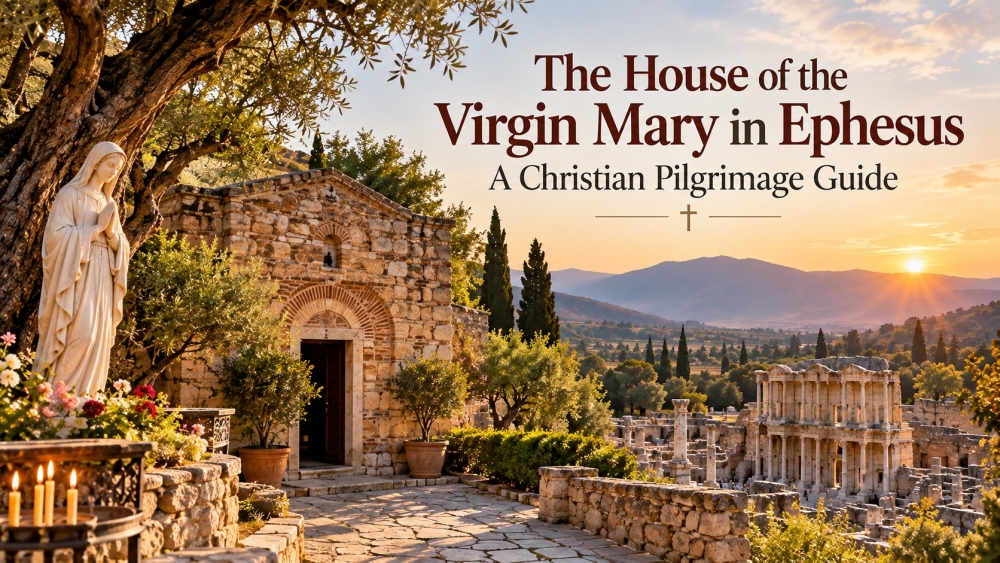
High on Mount Koressos, overlooking the ancient landscape of Ephesus, stands a small stone chapel known as the House of the Virgin Mary. For centuries, this quiet site near Selçuk has attracted Christian pilgrims who come to pray, reflect and connect with one of the most important traditions associated with the final years of the Virgin Mary.
Located only a few kilometers from the ancient city of Ephesus, the House of the Virgin Mary can easily be combined with a visit to Ephesus, the Basilica of St. John and other important Christian heritage sites in the region.
But what is the story behind this sacred place? Why is it associated with Mary? And what can travelers expect when they visit today?
The House of the Virgin Mary, known locally as Meryem Ana Evi, is located on Mount Koressos, also known as Bülbüldağı, near Selçuk in İzmir Province.
The site is approximately seven kilometers from the ancient city of Ephesus and sits in a peaceful wooded landscape surrounded by olive, pine and other Mediterranean vegetation.
Its location makes it particularly easy to include in an Ephesus itinerary. Many visitors combine the House of the Virgin Mary with the ancient city, the Basilica of St. John and the Temple of Artemis during the same day.
The connection between Mary and Ephesus comes from an ancient Christian tradition that holds that Mary spent the final years of her life in the area together with the Apostle John.
According to this tradition, John brought Mary to Ephesus after the death of Jesus, where she lived until the end of her life.
However, it is important to understand the nature of this tradition. The exact historical location of Mary's final residence cannot be established with absolute archaeological certainty. The House of the Virgin Mary is therefore best understood as a traditional Christian pilgrimage site rather than a location whose identification has been definitively proven.
This distinction does not diminish the site's importance for pilgrims. For many visitors, the spiritual significance of the place comes from centuries of Christian devotion and the belief that this is where Mary lived during the final period of her earthly life.
Ephesus has a particularly important place in Christian history.
The ancient city became one of the major centers of early Christianity in Asia Minor. The Apostle Paul preached in Ephesus, and the city later became one of the Seven Churches of Revelation.
Ephesus also became closely connected with the history of Marian devotion. The Council of Ephesus in 431 AD was an important event in the development of Christian teaching concerning Mary.
The Church of Mary in the ancient city is associated with the Council, while the Basilica of St. John on nearby Ayasuluk Hill reflects the continuing importance of Ephesus as a Christian center.
This wider Christian history helps explain why the House of the Virgin Mary became such an important pilgrimage destination.
The modern history of the House of the Virgin Mary is connected with the visions of Anne Catherine Emmerich, a German Augustinian nun whose reported visions described the location where Mary was believed to have lived.
In the late nineteenth century, Lazarist priests investigated the area described in connection with these visions and identified the remains of a small structure on Mount Koressos.
Local Christian traditions also played a role in the story of the site. According to accounts surrounding the discovery, Christian communities in the nearby region had maintained traditions connected with Mary's Dormition.
The modern identification of the house therefore brings together several elements: Christian tradition, local memory, religious devotion and archaeological investigation.
The building visitors see today is a small, simple stone structure rather than a grand church.
Its modest appearance is part of what makes the site feel different from the monumental ruins of Ephesus below.
Inside, visitors enter a quiet chapel where religious images, candles and devotional objects reflect the site's continuing importance to Christian pilgrims.
The atmosphere is deliberately peaceful, encouraging visitors to slow down and spend time in reflection.
Near the House of the Virgin Mary is a spring traditionally regarded as sacred.
Many visitors stop here during their pilgrimage, and the water has long been associated with religious traditions surrounding the site.
As with the house itself, the spiritual significance of the spring belongs primarily to religious tradition and pilgrimage practice.
One of the most recognizable features outside the House of the Virgin Mary is the Wall of Wishes.
Visitors traditionally attach small pieces of cloth, paper or other offerings to the wall as a symbolic way of expressing their wishes and prayers.
The tradition has become an important part of the visitor experience and creates a visual reminder of the many people who have come here seeking hope, comfort or spiritual connection.
For Christian pilgrims, the importance of the site goes beyond the physical structure itself.
The House represents a tradition connecting Mary, the mother of Jesus, with Ephesus and the earliest centuries of Christianity.
For Catholic visitors in particular, the site has become an important pilgrimage destination. Several popes have visited Ephesus and the House of the Virgin Mary, further strengthening its international religious significance.
The site is also visited by travelers of different backgrounds who are interested in biblical history, Christian heritage, archaeology and the religious traditions of Ephesus.
One of the best ways to experience the House of the Virgin Mary is to visit it as part of a wider Ephesus Christian heritage itinerary.
A typical day can include:
Each location represents a different chapter of the region's history.
The House of the Virgin Mary represents Christian pilgrimage and Marian tradition. Ephesus reveals the world in which early Christians lived and preached. The Church of Mary connects the city with the early councils of Christianity, while the Basilica of St. John reflects the later development of Christian worship in the region.
The House itself is relatively small, so most visitors do not need a long period to explore the physical structure.
However, a meaningful visit can take longer if you want time for prayer, reflection or quiet observation.
If you are visiting Ephesus on the same day, it is better to plan the House of the Virgin Mary as one part of a broader itinerary rather than treating it as an isolated attraction.
Spring and autumn are generally comfortable seasons for exploring the Ephesus area, particularly if you are combining the House of the Virgin Mary with extensive walking through the ancient city.
During the summer months, temperatures around Ephesus can become very high, especially during the middle of the day. Visiting earlier in the day can provide a more comfortable experience.
The site can also become busier during important Christian religious dates and pilgrimage periods, so travelers seeking a quieter experience may prefer less crowded periods.
The House of the Virgin Mary is a religious site, so modest and respectful clothing is appropriate.
Comfortable shoes are also recommended because the visit is often combined with walking around the archaeological areas of Ephesus.
During summer, a hat, sunscreen and drinking water are useful additions to your day-trip essentials.
No. The Bible does not identify a specific house in Ephesus as Mary's final residence.
The association between Mary and Ephesus comes from Christian tradition rather than a direct biblical statement identifying this particular building.
This is an important distinction for travelers interested in biblical tourism. Some locations in Turkey are directly mentioned in the New Testament, while others are connected with later Christian traditions that developed over centuries.
The tradition connecting Mary with Ephesus is closely linked to the Apostle John.
Christian tradition holds that John came to Ephesus and that Mary accompanied him. Ephesus subsequently became an important center of Christian activity.
The nearby Basilica of St. John, built centuries later on Ayasuluk Hill, reflects the continuing importance of John in the Christian history of the region.
When visiting the House of the Virgin Mary, the Basilica of St. John and ancient Ephesus together, travelers can therefore explore several layers of Christian tradition within a relatively small geographical area.
Christian pilgrimage to Ephesus did not disappear with the decline of the ancient city.
UNESCO recognizes the continuity of pilgrimage at Ephesus, noting the importance of the House of the Virgin Mary and other Christian monuments in the wider archaeological landscape.
Today, pilgrims continue to visit the site for prayer and reflection, while cultural travelers come to understand its history and significance.
This combination of faith, tradition and history is what makes the House of the Virgin Mary different from a conventional archaeological attraction.
For travelers interested in Christianity, Ephesus offers an unusually rich concentration of sites connected with different periods of Christian history.
You can begin at the House of the Virgin Mary, continue to the ancient city where Paul preached, visit the Church of Mary associated with the Council of Ephesus, and finish at the Basilica of St. John on Ayasuluk Hill.
Together, these locations reveal how Ephesus evolved from a major ancient religious and commercial center into one of the most important Christian destinations of the ancient world.
The site is traditionally identified as the final residence of the Virgin Mary, but the identification cannot be established as an archaeological certainty. Its importance today comes from longstanding Christian tradition and pilgrimage.
It is located on Mount Koressos, near Selçuk in İzmir Province, approximately seven kilometers from the ancient city of Ephesus.
Yes. The two sites are close to each other and are commonly combined in the same Ephesus itinerary.
Nearby Christian heritage sites include the ancient city of Ephesus, the Church of Mary, the Basilica of St. John and the Cave of the Seven Sleepers.
Yes. It is recognized as an important Christian pilgrimage site and continues to receive visitors who come for prayer, reflection and religious devotion.
The House of the Virgin Mary is one of the most meaningful places to visit around Ephesus for travelers interested in Christian heritage.
Its importance is not based solely on the small stone building standing on Mount Koressos. The site's significance comes from the centuries of tradition, pilgrimage and devotion that have connected Mary with Ephesus.
Whether you visit as a Christian pilgrim, a traveler interested in biblical history or someone exploring the cultural heritage of Ephesus, the House of the Virgin Mary offers a quieter and more contemplative experience alongside the monumental ruins of the ancient city.
Planning a Christian journey through Ephesus? Combine the House of the Virgin Mary with Ephesus, the Basilica of St. John and other important sites to experience the many layers of Christian history surrounding Selçuk.
One of the advantages of visiting the House of the Virgin Mary is its location within a much larger Christian heritage landscape. Several important sites can be visited in the same area, allowing travelers to understand the religious history of Ephesus from different perspectives.
After visiting the House of the Virgin Mary, the natural next stop is the ancient city of Ephesus.
Ephesus was one of the most important cities of the ancient Mediterranean and became a major center of early Christianity. The Apostle Paul spent an extended period here, preaching and teaching, while the Christian community continued to develop in the following centuries.
Walking along Marble Street, seeing the Library of Celsus and exploring the ancient theaters and public spaces gives visitors a sense of the enormous scale of the city in antiquity.
For Christian travelers, Ephesus also provides an opportunity to connect the archaeological remains with the New Testament and the later history of the Ephesian church.
Another important Christian site inside the ancient city is the Church of Mary, also known as the Council Church.
The building is traditionally associated with the Council of Ephesus in 431 AD, an important event in the history of Christianity.
The council discussed theological questions concerning the nature of Christ and the role of Mary. The title Theotokos, meaning "God-bearer" or "Mother of God," became particularly significant in this context.
For visitors interested in the history of Marian devotion, the Church of Mary provides an important connection between the religious traditions surrounding Mary and the historical development of Christianity in Ephesus.
Just outside the ancient city, on Ayasuluk Hill in modern Selçuk, stands the remains of the Basilica of St. John.
The basilica was built centuries after the New Testament period and reflects the continuing importance of Ephesus as a Christian center.
According to Christian tradition, the Apostle John spent his final years in the region and was buried at Ephesus. The basilica was constructed around the traditional location of his tomb.
From the hill, visitors also have a remarkable view over Selçuk and the surrounding landscape, including the area of ancient Ephesus.
The House of the Virgin Mary is not one of the Seven Churches mentioned in the Book of Revelation. However, its location near Ephesus makes it an important addition to a broader Christian journey through western Turkey.
Ephesus itself is one of the seven churches addressed in Revelation.
This creates an interesting connection for travelers. A visit to the House of the Virgin Mary can be combined with a journey through the Seven Churches, allowing visitors to explore both Marian tradition and the biblical history of the early Christian communities of Asia Minor.
The other six churches are:
If the Seven Churches are an important part of your journey, you can explore our 3-day Seven Churches of Revelation tour, which connects these ancient Christian communities across western Turkey.
A pilgrimage to Ephesus can mean different things to different travelers.
For some, the journey is primarily religious. They come to pray, visit places associated with Christian tradition and reflect on the history of the early Church.
For others, the journey is historical. Ephesus provides an opportunity to explore the world in which the first Christian communities lived and developed.
For many travelers, these two perspectives naturally come together.
The House of the Virgin Mary is especially suited to quiet reflection. The ancient city of Ephesus provides a much larger archaeological experience, while the Basilica of St. John and Church of Mary reveal different chapters of the region's Christian past.
Yes. The site welcomes travelers with different interests and backgrounds.
Visitors who are not traveling for religious reasons may still find the location interesting because of its history, traditions and connection with the wider archaeological landscape of Ephesus.
The site also provides an opportunity to learn how religious traditions can shape landscapes and pilgrimage destinations over many generations.
If you have one full day available, the following route can provide a comprehensive introduction to Christian heritage around Ephesus.
Begin your day at the House of the Virgin Mary. Take time to visit the chapel, see the Holy Spring and spend a few quiet moments at the Wall of Wishes.
Continue to the ancient city and explore its main monuments and streets. Allow enough time to understand Ephesus not only as an archaeological site but also as an important center of early Christianity.
Explore the Church of Mary and learn about the Council of Ephesus and the development of Christian theology in the fifth century.
Finish your Christian heritage journey at the Basilica of St. John on Ayasuluk Hill. The site offers both historical context and panoramic views over the region.
This itinerary can also be expanded to include the Temple of Artemis and the Ephesus Archaeological Museum.
The House of the Virgin Mary is different from many of the archaeological sites around Ephesus because the experience is not centered on monumental architecture.
The house is small and simple. Its significance comes from the tradition surrounding it and from the people who have traveled there over generations.
For a visitor, this creates a different kind of experience. Instead of spending the visit imagining the scale of an ancient city, you can take a quieter moment to reflect on the history and beliefs associated with the place.
Because the House of the Virgin Mary is located close to Ephesus, it is practical to combine the two visits rather than making a separate trip.
An early start can help you avoid the strongest heat during the summer and can provide a more comfortable experience at both the House of the Virgin Mary and Ephesus.
Walking around Ephesus requires more time and energy than visiting the House itself. Carry water, particularly during the warmer months.
Remember that the House of the Virgin Mary is an active religious and pilgrimage site. Modest clothing and respectful behavior are appropriate.
Do not feel that you need to rush through the visit. The House is small, but many visitors value the opportunity to spend a few quiet minutes there.
The House of the Virgin Mary can be particularly meaningful for Christian groups, church communities and pilgrimage groups traveling through western Turkey.
A group itinerary can combine the site with Ephesus, the Basilica of St. John and the Church of Mary, creating a program that covers different periods of Christian history.
For groups with additional time, the itinerary can be extended to include the Seven Churches of Revelation, Hierapolis, Laodicea and other Christian heritage sites in western Turkey.
Ephesus can be the beginning rather than the end of a Christian journey through Turkey.
Travelers with more time can continue toward the other Seven Churches of Revelation and explore the ancient communities of Smyrna, Pergamum, Thyatira, Sardis, Philadelphia and Laodicea.
A longer itinerary can also include sites connected with Paul, John and other important figures in early Christian history.
Our 8-day Seven Churches of Revelation tour is designed for travelers who want to explore the biblical churches while also experiencing Ephesus, Pamukkale and other important destinations in Turkey.
Yes. The site has become an important Catholic pilgrimage destination, although Christians and visitors from different backgrounds also come to the House because of its historical and cultural significance.
The tradition identifies Ephesus as the place where Mary spent her final years, but there is no definitive archaeological evidence proving that the house at the site was Mary's residence.
The site is a place of Christian prayer and pilgrimage. Visitors should follow the site's current rules and guidance while inside the chapel.
The House is located only a short drive from the ancient city of Ephesus, making it convenient to visit both sites during the same day.
The Basilica of St. John, the Church of Mary, the Cave of the Seven Sleepers and the Ephesus Archaeological Museum can all be considered when planning a Christian heritage itinerary.
The House of the Virgin Mary occupies a unique place in the Christian heritage of Turkey.
It is a small building surrounded by a peaceful landscape, yet its religious significance extends far beyond its physical size. For generations, Christians have traveled to this hillside near Ephesus to pray, reflect and remember Mary.
Whether you approach the site as a pilgrim, a history enthusiast or a traveler interested in the Christian heritage of Anatolia, visiting the House provides an opportunity to experience a different side of Ephesus.
Combined with the ancient city, the Church of Mary and the Basilica of St. John, it becomes part of a much larger story about Christianity, pilgrimage and the history of Ephesus.
Planning your visit to Ephesus? Include the House of the Virgin Mary in your itinerary and discover the Christian heritage surrounding one of Turkey's most remarkable ancient cities.

I graduated from Istanbul University with a degree in Radio, Television, and Cinema. During my academic journey, I focused on storytelling, visual communication, and cultural content creation, while my personal interests led me toward exploration and discovery.
Traveling, discovering new places, and experiencing different cultures are at the heart of my life. My strong interest in mythology allows me to see destinations not only as physical locations but as narratives shaped by history and meaning. My passion for reading continuously enriches and deepens this perspective.
I truly enjoy meeting new people and learning about diverse ways of life. With this mindset, I aim to share my experiences in a sincere, clear, and engaging way.
I love following the traces of stories wherever I go.
Disclosure Notice
By filling out this form, you agree that the personal data you provide to us will be processed in accordance with the Personal Data Protection Law No. 6698 and related legislation.
Your personal data will be processed solely for responding to your application, evaluating your requests, and fulfilling legal obligations; it will not be shared with third parties.
For detailed information, you can review our Privacy Policy.
By submitting the form, you acknowledge and consent to the processing of your personal data for the purposes specified above.

