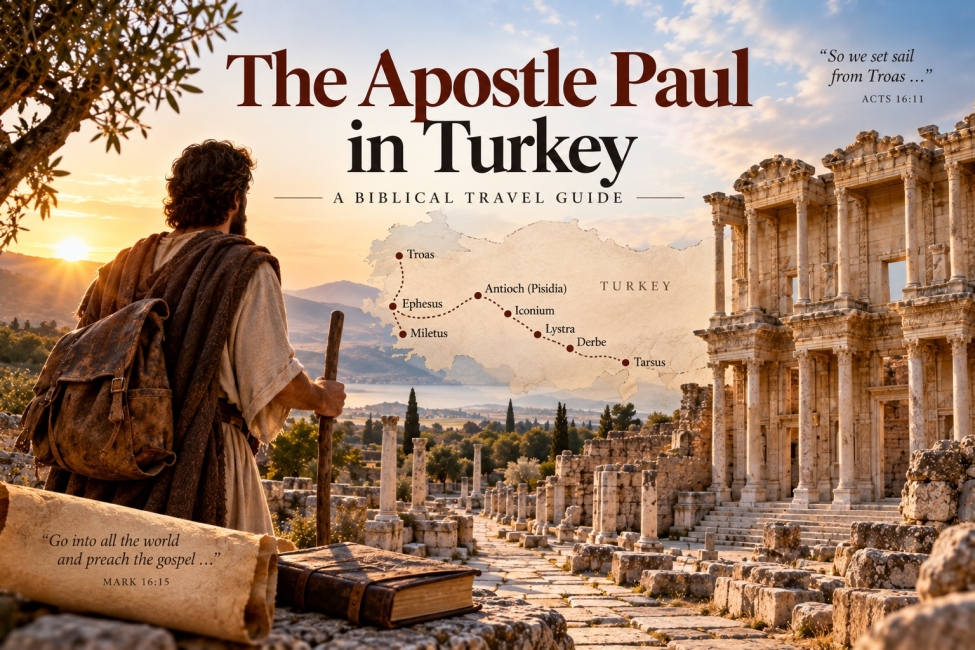
Long before Turkey became a modern country, the region of Anatolia was one of the most important landscapes in the expansion of early Christianity. Cities, ports and communities across Asia Minor became places where the message of Christianity was preached, discussed and carried from one community to another.
Among the most important figures in this story was the Apostle Paul. His missionary journeys took him through many parts of the ancient Roman world, including numerous cities located in what is now modern-day Turkey.
Today, travelers can follow parts of Paul's journey through ancient ruins, archaeological sites and historic landscapes. From his birthplace in Tarsus to Ephesus, where he spent a significant period of his ministry, these destinations offer a fascinating way to explore the history of early Christianity in Anatolia.
Paul's journeys through Asia Minor were part of a much larger missionary movement during the first century AD. The region was home to important Greek and Roman cities, established trade routes and diverse religious communities.
Many of the places Paul visited later became important Christian centers. Several are also connected with the Seven Churches of Revelation, including Ephesus, Smyrna, Pergamum, Sardis, Philadelphia, Thyatira and Laodicea.
Although the New Testament does not describe every location in modern geographical terms, Paul's journeys allow modern travelers to connect biblical narratives with the landscapes of present-day Turkey.
Our journey begins in Tarsus, in modern-day Mersin Province in southern Turkey.
The Book of Acts identifies Paul as a native of Tarsus. In Acts 22:3, Paul describes himself as a Jew born in Tarsus of Cilicia and educated in Jerusalem.
Tarsus was an important ancient city situated in the region of Cilicia. Its location along important routes connecting Anatolia and the eastern Mediterranean helped make it a significant center in antiquity.
Today, visitors can explore the historic area of Tarsus and see sites traditionally associated with Paul, including St. Paul's Well. The association is based on longstanding Christian tradition, making it an interesting stop for travelers following Paul's story.
Another important city in Paul's story is Antioch, ancient Antioch on the Orontes, located near modern-day Antakya.
Antioch became one of the most important early Christian communities outside Jerusalem. According to Acts, the followers of Jesus were first called Christians in Antioch.
The city also played an important role in Paul's missionary activity. Paul and Barnabas were sent from the Christian community at Antioch for missionary work, beginning a series of journeys that would take them across Asia Minor and beyond.
Modern Antakya has long been associated with this early Christian heritage. One of its best-known Christian landmarks is the Church of St. Peter, a cave church traditionally connected with the early Christian community of Antioch.
It is important to distinguish between biblical references and later traditions. The New Testament provides evidence for the importance of Antioch's Christian community, while the specific association of the cave with Peter comes from Christian tradition.
One of the most important archaeological sites connected with Paul's missionary journeys is Pisidian Antioch, near the modern town of Yalvaç in Isparta Province.
This city should not be confused with Antioch on the Orontes. Pisidian Antioch was a different ancient settlement located in the interior of Asia Minor.
According to Acts 13, Paul and Barnabas arrived at Pisidian Antioch during their first missionary journey. Paul preached in the synagogue, presenting a message centered on the history of Israel and the life, death and resurrection of Jesus.
The account in Acts describes a significant response to Paul's preaching, followed by opposition from some members of the community.
Today, visitors can walk among the remains of the ancient city and imagine the urban environment in which Paul's message was first heard by the local population.
Paul and Barnabas continued from Pisidian Antioch to Iconium, an ancient city located at modern-day Konya.
According to Acts 14, Paul and Barnabas preached in the synagogue at Iconium. Their message attracted both Jewish and Gentile listeners, but it also generated opposition.
Iconium was an important settlement in the ancient region of Lycaonia and later became one of the major cities of central Anatolia.
Modern Konya has changed dramatically since the first century, but the city's connection with Paul's missionary journeys makes it an interesting destination for travelers interested in biblical history.
From Iconium, Paul's journey continued toward Lystra, another ancient city in the region of Lycaonia.
Lystra is particularly interesting because it is connected with Timothy, one of Paul's most important companions and a figure who appears frequently in the New Testament.
Acts describes Paul meeting Timothy at the beginning of his later travels. Timothy had a Jewish mother who was a believer and a Greek father.
The precise location of ancient Lystra has been associated with a site near modern-day Hatunsaray, south of Konya. Archaeological remains in the area provide a glimpse into the ancient landscape through which Paul traveled.
Paul and Barnabas also traveled to Derbe, another city in ancient Lycaonia.
Acts 14 records that they preached the gospel there and made many disciples before returning through the cities they had previously visited.
Derbe is especially interesting for travelers because its archaeological remains are less monumental than those of famous destinations such as Ephesus. Its importance comes primarily from its place in the biblical narrative and the history of Paul's missionary journeys.
The location traditionally identified with ancient Derbe is near modern-day Kerti Hüyük in Karaman Province.
Among all the places associated with Paul in modern Turkey, Ephesus is perhaps the most significant destination for visitors.
Paul spent an extended period in Ephesus during his missionary activity. The Book of Acts describes his preaching in the city and the growth of the Christian community there.
Ephesus was one of the largest and most influential cities of the Roman world. It was also an important religious center, famous for the Temple of Artemis.
According to Acts 19, Paul's preaching challenged existing religious practices and contributed to a major disturbance involving people whose livelihoods were connected with the city's cult of Artemis.
The Christian community at Ephesus continued to develop after Paul's time. Centuries later, Ephesus became one of the Seven Churches of Revelation, receiving a message in the Book of Revelation.
Today, the ruins of Ephesus offer one of the clearest opportunities to connect Paul's biblical story with a surviving ancient city.
Paul's time in Ephesus was considerably more than a brief visit.
Acts describes Paul teaching there for an extended period, allowing his message to spread throughout the surrounding region. Ephesus became an important base for his missionary activity in Asia Minor.
The city also provides an important connection between several different periods of Christian history. Visitors can explore the ancient city associated with Paul, the later Christian community mentioned in Revelation, and monuments connected with Christianity's development in the centuries that followed.
For travelers interested in Paul's story, Ephesus is therefore much more than an archaeological attraction. It is one of the places where the biblical narrative, ancient urban history and later Christian heritage come together.
When following Paul's story through modern Turkey, it helps to think of the journey geographically.
His travels connected cities across southern, central and western Anatolia, including:
These cities were connected by ancient roads, trade routes and maritime networks. Paul's journeys were therefore part of the movement of people, ideas and communities throughout the Roman Empire.
Traveling through Paul's ancient destinations offers a different perspective on Turkey. Instead of seeing each archaeological site as an isolated ruin, travelers can understand it as part of a much larger network of cities and communities.
You can walk through the streets of Ephesus, stand among the ruins of Pisidian Antioch, explore the region associated with ancient Lystra and Derbe, and visit Tarsus, traditionally regarded as Paul's birthplace.
Together, these destinations create a journey through one of the most important chapters in the history of early Christianity.
Paul's story does not end with Ephesus. His journeys through Anatolia connect with the development of early Christian communities across the region, many of which later became the cities mentioned in Revelation.
In Part 2, we will continue following Paul's journey through Turkey, exploring Troas, Miletus and Ephesus in greater detail, while also looking at the connection between Paul, the Seven Churches of Revelation and the Christian heritage that can still be experienced across Turkey today.
Another important location in Paul's travels through modern Turkey is Troas, an ancient city located near the northwestern coast of Anatolia.
Troas was strategically positioned close to the Dardanelles and the Aegean Sea, making it an important connection between Asia Minor and Macedonia. For Paul, this location became particularly significant because it was from Troas that he crossed toward Europe during his missionary journeys.
Acts 16 describes Paul's vision of a man from Macedonia asking him to come and help. Following this experience, Paul and his companions traveled from Troas across the Aegean toward Macedonia.
This makes Troas an important geographical point in the story of the expansion of Christianity. Paul's journeys were not confined to Anatolia. From cities such as Troas, the movement of early Christianity extended across the Aegean and into Europe.
Another important location on the western coast of Turkey is Miletus, an ancient Greek city near modern-day Balat in Aydın Province.
Miletus appears in the Book of Acts in connection with one of Paul's later journeys. Rather than returning to Ephesus, Paul met the elders of the Ephesian church at Miletus.
Acts 20 records Paul's emotional farewell to the elders. He reminded them of his ministry among them and spoke about the difficulties he expected to face as he continued his journey toward Jerusalem.
For visitors today, Miletus provides another opportunity to understand the geographical network connecting the early Christian communities of western Anatolia.
Ephesus occupies a special place in the story of Paul and early Christianity.
Paul's extended ministry in Ephesus helped establish the city as an important Christian center. The Book of Acts describes his teaching there, while later New Testament writings demonstrate the continuing importance of the Ephesian Christian community.
Centuries after Paul's ministry, Ephesus became one of the Seven Churches of Revelation. The Book of Revelation addresses the church at Ephesus directly, praising its perseverance while also warning that it had abandoned its first love.
This creates a remarkable historical connection. When you walk through Ephesus today, you are exploring a city connected with both Paul's missionary activity and the later Christian community addressed in Revelation.
Paul did not personally establish all seven churches mentioned in Revelation, and the New Testament does not describe his relationship with every one of them in the same way.
However, Paul's missionary activity in western Anatolia forms part of the broader Christian history of the region where these communities later developed.
The Seven Churches are:
Several of these cities were already important urban centers during the period of Paul's missionary activity. Their later appearance in Revelation demonstrates how Christianity continued to develop in the region over the following decades.
Following Paul's journey through Turkey can therefore provide a useful introduction to the wider story of Christianity in ancient Anatolia.
The timeline is important. Paul's missionary journeys belong primarily to the first century, while the Book of Revelation was written later. The Christian communities of Asia Minor continued to evolve during this period.
This means that a journey through these locations is not simply a journey through the life of one person. It is a journey through several generations of early Christian history.
If your main interest is following Paul's footsteps, several destinations deserve particular attention.
Begin with the city traditionally identified as Paul's birthplace. Tarsus provides the geographical starting point for understanding Paul's background and identity.
Explore the city that became one of the most important centers of early Christianity and the community from which Paul and Barnabas were sent on missionary work.
Visit the archaeological remains associated with Paul's preaching during his first missionary journey.
These ancient cities form an important sequence in the account of Paul's travels through central Anatolia.
Allow extra time here. Ephesus is one of the most significant archaeological and Christian heritage sites connected with Paul's ministry in Turkey.
Visit the ancient city associated with Paul's crossing toward Macedonia and the continuation of his missionary journey into Europe.
Explore the ancient city where Paul met the elders of the Ephesian church during his journey toward Jerusalem.
Because Paul's destinations are spread across different parts of modern Turkey, it is useful to divide the journey into geographical sections.
A western Turkey itinerary can focus on Ephesus, Miletus and Troas, while a southern and central Anatolian route can include Tarsus, Pisidian Antioch, Iconium, Lystra and Derbe.
Travelers interested in a broader Christian heritage experience can then connect these destinations with the Seven Churches of Revelation.
This approach allows you to experience both the biblical narrative and the archaeological remains that survive today.
One of the most fascinating aspects of following Paul's journey is that many of the ancient cities are archaeological sites that can still be visited.
At Ephesus, visitors can walk along ancient streets and see monumental buildings that help recreate the scale of the Roman city.
At Pisidian Antioch, the remains provide a different perspective on urban life in the interior of Anatolia.
At Miletus and Troas, the archaeological landscape illustrates the importance of coastal cities and their connections to the wider Mediterranean world.
In Tarsus and Antakya, modern cities have grown over and around ancient settlements, meaning that the experience is different from visiting a completely preserved archaeological site.
Following Paul through Turkey is not only about finding places mentioned in the Bible. It is also an opportunity to understand the world in which the early Christian movement developed.
Ancient Anatolia was a region of major cities, trade routes, ports and cultural exchange. Greek traditions, Roman political structures, Jewish communities and local religious practices existed alongside one another.
Paul traveled through this complex environment, speaking to different communities and crossing cultural and geographical boundaries.
That historical context helps explain why cities such as Ephesus, Antioch and Tarsus became so important in the story of early Christianity.
According to Acts 22:3, Paul identified himself as being born in Tarsus of Cilicia. Tarsus is located in modern-day Mersin Province, Turkey.
The New Testament associates Paul with numerous cities in ancient Anatolia, including Tarsus, Pisidian Antioch, Iconium, Lystra, Derbe, Troas, Ephesus and Miletus.
The New Testament does not establish that Paul personally visited all seven churches mentioned in Revelation. Ephesus is strongly connected with Paul's ministry, while the seven churches represent Christian communities in western Anatolia addressed later in Revelation.
Acts describes Paul spending an extended period in Ephesus during his ministry. The city became one of the major centers of his activity in Asia Minor.
Yes. Several destinations associated with Paul's journeys can be visited today as archaeological or historic sites. A private itinerary can combine these locations according to your available time and interests.
A Paul-themed trip can be designed around different levels of biblical and historical interest.
If you have only a few days, Ephesus, Miletus and the surrounding Aegean region offer an accessible introduction to Paul's connection with western Anatolia.
With additional time, you can travel farther east and south to include Tarsus, Antioch, Pisidian Antioch, Iconium, Lystra and Derbe.
For travelers who want to go beyond Paul's life and explore the wider history of Christianity in Turkey, combining these locations with the Seven Churches of Revelation creates a much broader journey through early Christian Anatolia.
The story of Paul in Turkey does not exist in isolation. His journeys form part of the much larger history of Christianity in Anatolia, a history that continued long after the first generation of apostles.
Today, travelers can follow this history from Tarsus to Ephesus, from Pisidian Antioch to Troas, and from the ancient cities of Paul's journeys to the Seven Churches mentioned in Revelation.
For those interested in biblical travel, these places offer something rare: the opportunity to read an ancient story and then stand in the landscapes where parts of that story unfolded.
If you would like to explore the Seven Churches as part of this wider Christian heritage journey, you can discover our 3-day Seven Churches of Revelation tour, or choose the more extensive 8-day Seven Churches of Revelation tour.
From his birthplace in Tarsus to the ancient streets of Ephesus, Paul's story is deeply connected with the history and geography of modern Turkey.
Following his journey offers travelers a chance to explore ancient cities, biblical narratives and the landscapes of Anatolia while gaining a deeper understanding of how early Christianity spread across the Roman world.
Whether you are traveling for faith, history, archaeology or simply a desire to see the places described in the New Testament, Turkey offers an extraordinary landscape for following the footsteps of the Apostle Paul.

I graduated from Istanbul University with a degree in Radio, Television, and Cinema. During my academic journey, I focused on storytelling, visual communication, and cultural content creation, while my personal interests led me toward exploration and discovery.
Traveling, discovering new places, and experiencing different cultures are at the heart of my life. My strong interest in mythology allows me to see destinations not only as physical locations but as narratives shaped by history and meaning. My passion for reading continuously enriches and deepens this perspective.
I truly enjoy meeting new people and learning about diverse ways of life. With this mindset, I aim to share my experiences in a sincere, clear, and engaging way.
I love following the traces of stories wherever I go.
Disclosure Notice
By filling out this form, you agree that the personal data you provide to us will be processed in accordance with the Personal Data Protection Law No. 6698 and related legislation.
Your personal data will be processed solely for responding to your application, evaluating your requests, and fulfilling legal obligations; it will not be shared with third parties.
For detailed information, you can review our Privacy Policy.
By submitting the form, you acknowledge and consent to the processing of your personal data for the purposes specified above.

