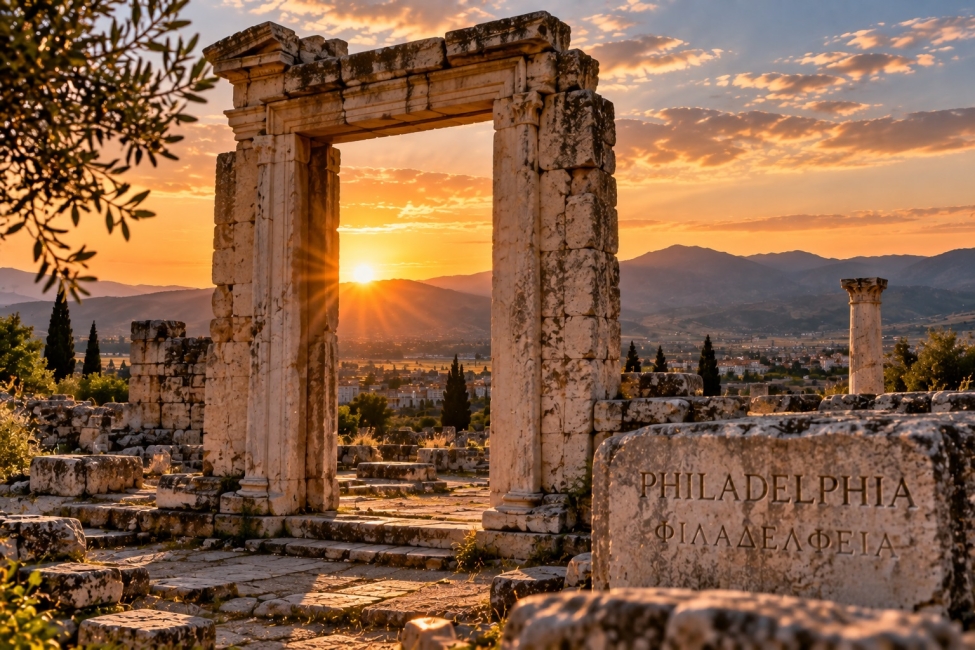
Among the Seven Churches of Revelation, Philadelphia received one of the most encouraging messages.
Unlike several of the other churches addressed in the Book of Revelation, Philadelphia was not strongly condemned for false teaching, spiritual compromise, or moral failure. Instead, it was praised for remaining faithful despite having little strength.
At the center of the message is one of the most memorable images in Revelation:
“See, I have placed before you an open door that no one can shut.”
What did this open door mean? Why was Philadelphia praised despite having “little strength”? And what can travelers discover today at the ancient site of Philadelphia in western Turkey?
Ancient Philadelphia was located in the region of Lydia in western Asia Minor and corresponds to the modern Turkish city of Alaşehir. Although much of the ancient city has disappeared beneath the modern settlement, important remains survive and continue to connect today's visitors with one of the Christian communities mentioned in Revelation.
Philadelphia was one of the seven churches addressed in the Book of Revelation, alongside Ephesus, Smyrna, Pergamum, Thyatira, Sardis, and Laodicea.
The message to Philadelphia is found in Revelation 3:7–13.
Ancient Philadelphia stood in a strategically important location in western Anatolia. The city was founded in the Hellenistic period and developed as a gateway between the Aegean region and the interior of Asia Minor.
Today, the ancient city is associated with Alaşehir in Manisa Province, Turkey.
For travelers following the Seven Churches of Revelation route, Philadelphia is particularly interesting because its biblical message is one of encouragement and perseverance.
The letter begins with a distinctive description of Christ:
“These are the words of him who is holy and true, who holds the key of David.”
The image of the key of David is immediately followed by the image of the open door.
Christ tells the church:
“See, I have placed before you an open door that no one can shut.”
The church is then praised for having only “a little strength,” yet keeping Christ's word and not denying His name.
This combination is important.
Philadelphia was not praised because it was powerful. It was praised because it remained faithful despite its limitations.
The phrase “open door” is the central image of the Philadelphia letter.
Revelation does not explicitly provide a single definition of the phrase, which is why scholars and readers have discussed its meaning in different ways.
The open door can be understood as an image of opportunity, access, divine authority, and mission.
The important point in the passage is that the door is opened by Christ and cannot be shut by others.
This gives the image a strong sense of divine sovereignty. The church may have little earthly power, but its opportunities and future are not ultimately controlled by its opponents.
The open door therefore stands in contrast to the church's “little strength.”
Philadelphia may appear weak from a human perspective, but Revelation presents it as having access to something that no earthly authority can take away.
The letter does not explain exactly what “little strength” meant in practical terms.
It may refer to the relatively small size or limited influence of the Christian community, but the text itself does not provide enough information to establish one specific explanation.
What is clear is that the church's limited strength did not prevent it from remaining faithful.
This is one of the most encouraging themes in the letter.
Philadelphia demonstrates that spiritual faithfulness does not necessarily depend on wealth, political influence, or numerical strength.
A community can be small and still have an important role in the biblical story.
The church of Philadelphia is praised because it kept Christ's word and did not deny His name.
This is significant when compared with some of the other Seven Churches.
While Ephesus was warned about abandoning its first love, Sardis was told to wake up because of its spiritual condition, and Laodicea was criticized for being lukewarm, Philadelphia receives a message emphasizing perseverance.
The church had remained faithful despite opposition.
Its strength was therefore not measured by how impressive it appeared to the surrounding world. Its strength was demonstrated through its endurance.
The letter contains a promise concerning the “hour of trial” that is coming upon the world.
Philadelphia is told that because it has kept the command to endure patiently, it will be kept from this coming trial.
The exact interpretation of this passage has been debated among Christian traditions.
For the purpose of understanding the letter itself, however, the central theme is clear: faithful endurance is recognized and rewarded.
The church is encouraged to hold on to what it has so that no one will take its crown.
The message continues with an important warning and encouragement:
“I am coming soon. Hold on to what you have.”
The emphasis is on perseverance.
Philadelphia is not instructed to become powerful or influential. It is told to continue holding firmly to its faith.
This makes the message particularly different from the modern idea that success requires constant growth and expansion.
For Philadelphia, faithfulness itself was the measure of success.
One of the most memorable promises in the letter is given to those who overcome.
They are promised that they will be made a pillar in the temple of God.
The imagery is especially striking when considered in the context of Philadelphia's history.
The city was located in an earthquake-prone region, and earthquakes repeatedly affected settlements in western Asia Minor.
Buildings could collapse and cities could be rebuilt. In such an environment, the image of becoming a permanent pillar carries a powerful sense of stability and permanence.
However, the biblical text does not explicitly state that the pillar imagery was chosen because of Philadelphia's earthquakes. The connection is best understood as a historical and symbolic parallel rather than a proven explanation for the wording of Revelation.
Philadelphia was located in a region known for seismic activity.
The city experienced major earthquakes during the Roman period, including the devastating earthquake of 17 AD that affected several cities in western Asia Minor.
Historical sources indicate that Philadelphia was among the cities affected by this earthquake.
Repeated seismic activity shaped life in the region and contributed to the rebuilding and transformation of ancient cities.
Against this background, the promise that the faithful believer would become a permanent pillar is an especially evocative image for modern readers.
The ancient city's name is connected with the relationship between two rulers of the Hellenistic period.
Philadelphia was associated with Attalus II Philadelphus, king of Pergamon, who was known for his loyalty and affection toward his brother, Eumenes II.
The name Philadelphia is generally understood in connection with this relationship and can be translated as something like “brotherly love.”
This is an interesting detail when reading the Christian message addressed to the city.
The modern word “Philadelphia” is widely recognized because of the American city of the same name, whose name was also chosen to mean “brotherly love.”
By the time of the early Christian period, Philadelphia had become part of the Roman world.
Its location made it an important settlement between the Aegean coast and the interior of Anatolia.
The city also played a role in the spread of Greek culture and language into the surrounding regions.
This wider cultural setting helps explain why Philadelphia was part of the network of Christian communities addressed in Revelation.
The churches of western Asia Minor were not isolated communities. They existed within major cities connected by roads, trade, politics, religion, and communication.
Before mentioning the open door, Revelation introduces the image of the key of David.
The imagery comes from the biblical tradition surrounding the house and authority of David.
A key represents authority and access. In the context of the letter, the one who holds the key has the authority to open and shut.
This makes the following statement about the open door even more significant.
The church does not need to create its own door.
The door has already been opened.
And according to the message, no one has the authority to shut it.
Philadelphia is one of the most encouraging churches in Revelation.
Its message does not ignore difficulties, but it emphasizes what the church has done well: it has persevered, kept Christ's word, and remained faithful despite having little strength.
Its story provides an important contrast with Sardis, where the church had a reputation for being alive but was told to wake up.
Philadelphia, by contrast, is encouraged to hold on to what it already has.
The two messages demonstrate why studying all seven churches together is so valuable. Each letter addresses a different spiritual condition and provides a different perspective on Christian life in the ancient world.
Philadelphia survived for centuries after the period of the New Testament and continued to exist through the Roman and Byzantine periods.
Its location in a region of frequent earthquakes meant that the city experienced repeated destruction and rebuilding. These natural disasters shaped the physical appearance and history of Philadelphia over time.
The city nevertheless remained an important settlement in western Anatolia and maintained its Christian identity for centuries.
Eventually, the ancient city was transformed into the settlement that developed into modern Alaşehir.
Today, visitors can see only limited remains of ancient Philadelphia compared with some of the other Seven Churches. Much of the ancient city lies beneath the modern town.
This makes Philadelphia different from destinations such as Ephesus or Sardis, where enormous archaeological sites remain visible across a large landscape.
Although the archaeological remains are relatively limited, several important structures survive in and around modern Alaşehir.
Among the most significant are the remains traditionally identified with an early Christian basilica. The surviving walls and architectural elements provide a tangible connection to the city's long Christian history.
Visitors can also explore parts of the ancient settlement and observe how the modern city has developed around the remains of Philadelphia.
The experience is therefore different from visiting a completely preserved ancient city. In Alaşehir, ancient and modern history exist side by side.
The importance of Philadelphia did not disappear after the Book of Revelation was written.
Christianity continued to have a strong presence in the region during the Byzantine period. The city's location helped maintain its importance as part of the Christian landscape of western Anatolia.
This long continuity is one of the most fascinating aspects of Philadelphia.
The letter in Revelation represents only one moment in the city's Christian history. The Christian community continued to develop for centuries afterward.
For visitors interested in biblical history, this makes Philadelphia more than an archaeological reference. It represents a living historical connection between the world of the New Testament and the later Christian history of Asia Minor.
The expression “the Church of the Open Door” has become closely associated with Philadelphia because of Revelation 3:8.
The image has also influenced Christian thought far beyond the ancient city.
For many Christians, the open door represents an opportunity provided by God—an opportunity for service, witness, faith, or mission.
The important feature of the biblical image is that the door is not opened by the church's own strength.
Philadelphia has “little strength,” yet the door is open.
This creates a powerful theological message: limited human resources do not necessarily limit what God can accomplish through a faithful community.
The seven letters contain very different messages.
Some churches are strongly criticized, while others receive encouragement. Philadelphia belongs among the most positively described communities.
The church is praised for its perseverance and faithfulness.
It demonstrates that a Christian community does not need to be large, wealthy, or politically powerful to remain significant.
Its “little strength” did not prevent it from keeping Christ's word.
This is one of the reasons Philadelphia continues to attract Christian pilgrims and travelers interested in biblical history.
The message to Philadelphia repeatedly emphasizes endurance.
The believers are encouraged to hold on to what they have and not allow anyone to take their crown.
In this sense, Philadelphia presents a different model of strength from the one usually celebrated by society.
Its strength was not military power, economic wealth, or political influence.
Its strength was the ability to remain faithful.
This theme connects Philadelphia with Smyrna, another church that was praised for faithfulness under difficult circumstances.
While Smyrna was specifically warned about suffering, Philadelphia was encouraged because it had already demonstrated perseverance.
For travelers interested in the biblical geography of Revelation, Philadelphia is an important stop on the Seven Churches of Revelation route through western Turkey.
The journey can connect Philadelphia with Ephesus, Smyrna, Pergamum, Thyatira, Sardis, and Laodicea, allowing travelers to explore the different historical and biblical contexts of each community.
Because the seven churches are spread across western Anatolia, visiting them together creates a much deeper understanding of the world in which the Book of Revelation was written.
Travelers who want to experience the complete route can explore Apasas Travel's Seven Churches of Revelation Tour.
This private journey follows the biblical route through the seven ancient cities and is designed for travelers interested in Christian heritage, biblical history, and the archaeology of western Turkey.
For those who would like to combine the Seven Churches with a broader exploration of Turkey, the 8-Day Seven Churches of Revelation Tour offers a longer itinerary incorporating the seven biblical churches with destinations such as Istanbul, Ephesus, Pamukkale, and Hierapolis.
One of the best ways to understand Philadelphia is to compare its message with those of the other churches.
| Church | Main Message |
|---|---|
| Ephesus | Return to your first love. |
| Smyrna | Remain faithful through suffering. |
| Pergamum | Resist compromise and false teaching. |
| Thyatira | Remain faithful and reject corruption. |
| Sardis | Wake up and strengthen what remains. |
| Philadelphia | Hold on to your faith and walk through the open door. |
| Laodicea | Do not remain lukewarm. |
Together, these messages provide a remarkably diverse picture of early Christian communities in Asia Minor.
The “open door” in Revelation 3:8 is generally understood as an image of opportunity, access, authority, or mission granted by Christ. The passage emphasizes that the door opened by Christ cannot be shut by others.
Philadelphia was praised because it had kept Christ's word and had not denied His name. Although it had “little strength,” it had remained faithful and persevered.
The Philadelphia mentioned in Revelation was an ancient city in western Asia Minor. It corresponds to modern Alaşehir in Manisa Province, Turkey.
No. They are two different cities. The ancient Philadelphia in Asia Minor was located in what is now Turkey. The American city of Philadelphia was founded much later and was given the same name, referring to the idea of brotherly love.
Philadelphia was located in a seismically active region of western Anatolia and experienced significant earthquakes throughout its history. The city was repeatedly rebuilt after natural disasters.
Only limited archaeological remains survive because much of ancient Philadelphia lies beneath modern Alaşehir. However, important remains of ancient and Byzantine structures can still be seen in the city.
Yes. Philadelphia is one of the seven churches addressed in Revelation chapters 2 and 3. It is especially remembered for the promise of the “open door.”
Yes. Philadelphia is included in Apasas Travel's Seven Churches of Revelation Tour.
For travelers looking for a longer Christian heritage experience, the 8-Day Seven Churches of Revelation Tour also includes Philadelphia as part of a broader journey through biblical Turkey.
Philadelphia's message is one of hope.
The church did not have great earthly strength. Yet Revelation describes it as faithful.
Its reward was not a promise of wealth or political influence. Instead, it was given an image that has remained one of the most memorable in the New Testament:
“I have placed before you an open door that no one can shut.”
Today, modern Alaşehir stands where ancient Philadelphia once flourished. The remains may be less spectacular than those of Ephesus or Sardis, but the biblical importance of the city remains considerable.
For Christian travelers following the Seven Churches of Revelation, Philadelphia offers an opportunity to reflect on perseverance, faithfulness, and the idea that spiritual strength does not always come from outward power.
The church of Philadelphia reminds us that sometimes the most important thing a believer can do is simply to remain faithful to what has already been entrusted to them.
Its message still resonates today: when a door is opened by God, no earthly power can close it.

I graduated from Istanbul University with a degree in Radio, Television, and Cinema. During my academic journey, I focused on storytelling, visual communication, and cultural content creation, while my personal interests led me toward exploration and discovery.
Traveling, discovering new places, and experiencing different cultures are at the heart of my life. My strong interest in mythology allows me to see destinations not only as physical locations but as narratives shaped by history and meaning. My passion for reading continuously enriches and deepens this perspective.
I truly enjoy meeting new people and learning about diverse ways of life. With this mindset, I aim to share my experiences in a sincere, clear, and engaging way.
I love following the traces of stories wherever I go.
Disclosure Notice
By filling out this form, you agree that the personal data you provide to us will be processed in accordance with the Personal Data Protection Law No. 6698 and related legislation.
Your personal data will be processed solely for responding to your application, evaluating your requests, and fulfilling legal obligations; it will not be shared with third parties.
For detailed information, you can review our Privacy Policy.
By submitting the form, you acknowledge and consent to the processing of your personal data for the purposes specified above.

