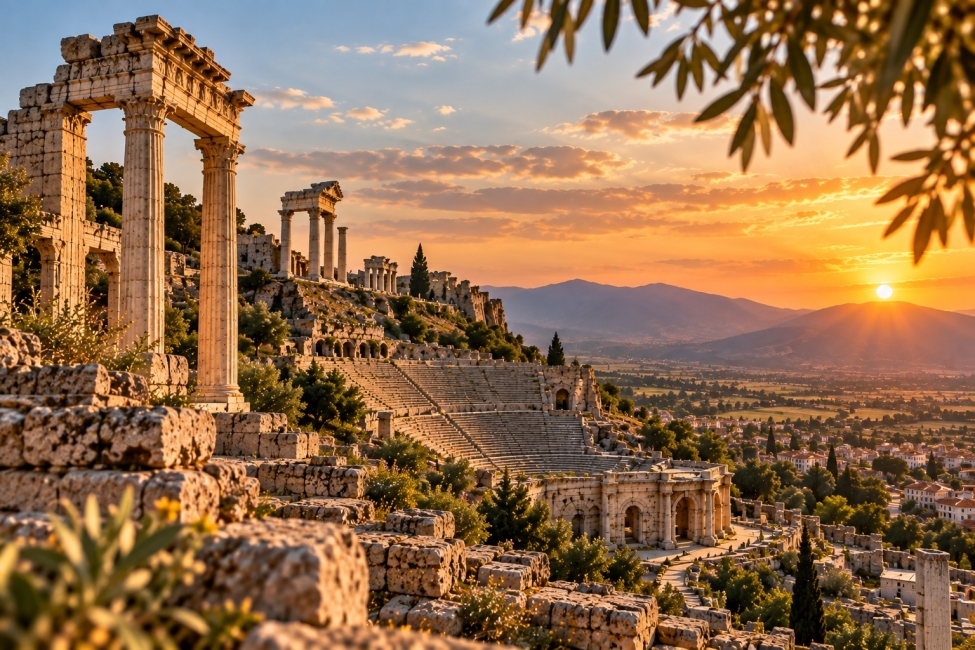
Few phrases in the Book of Revelation are as mysterious and memorable as the description of Pergamum as the place “where Satan's throne is.”
Why would Revelation describe an ancient city in western Anatolia in such dramatic terms? Was the writer referring to a specific monument? Was it connected with the city's pagan temples, Roman imperial worship, or the persecution of Christians?
Today, ancient Pergamum can be visited near the modern town of Bergama in İzmir Province, Türkiye. Its spectacular Acropolis, temples, theater and other archaeological remains provide an extraordinary setting for exploring the historical world behind the message to the Church of Pergamum.
But one important point should be made from the beginning: the Bible does not explicitly identify a particular monument as “Satan's throne.” Several interpretations have been proposed by scholars and commentators.
To understand the phrase, we need to look at both Revelation 2 and the religious and political environment of ancient Pergamum.
Ancient Pergamum was located in northwestern Asia Minor, near the modern town of Bergama in İzmir Province.
The city was one of the most important political and cultural centers of the ancient world. Its Acropolis was built on a dramatic hill overlooking the surrounding plain, while the lower city and the Asklepion formed important parts of the wider urban landscape.
Pergamum became one of the seven cities addressed in the Book of Revelation. Its message appears in Revelation 2:12–17.
The church is praised for remaining faithful despite living in a difficult environment, but it is also criticized for tolerating teachings associated with compromise and pagan practices.
The message to Pergamum begins with a striking description of Christ as the one who has the sharp two-edged sword.
The church is then told:
“I know where you live—where Satan has his throne.”
The passage continues by praising the believers for remaining faithful, even during the time when Antipas, described as a faithful witness, was killed in the city.
However, the church is criticized because some of its members are accused of following the teaching of Balaam and the teaching of the Nicolaitans.
The message therefore contains both praise and warning.
This is the central question surrounding the passage.
The expression “Satan's throne” has been interpreted in several ways. There is no single explanation universally accepted as the definitive answer.
Several features of Pergamum's religious and political landscape have been proposed as possible background for the phrase.
One of the most famous interpretations connects the phrase with the monumental Altar of Zeus that once stood on the Acropolis of Pergamum.
The enormous altar was constructed during the Hellenistic period and was one of the most impressive monuments of ancient Pergamum.
Its monumental staircase, sculptural decoration and elevated position gave it a striking throne-like appearance when viewed from the ancient city.
Because of its scale and religious importance, some Christian interpreters have suggested that the altar could lie behind the imagery of “Satan's throne.”
However, the Bible itself does not say that the phrase refers specifically to the Altar of Zeus.
This distinction is important when discussing the site with historical accuracy.
Another interpretation focuses on Roman imperial worship.
Pergamum was an important center of the Roman imperial cult in Asia Minor. Temples dedicated to Roman emperors formed part of the city's religious and political environment.
For early Christians, participation in imperial worship could create a direct conflict between loyalty to Christ and the expectations of Roman society.
From this perspective, “Satan's throne” may have referred more broadly to Pergamum's role as a center of political and religious power that challenged Christian belief.
Another possible background is the cult of Asklepios, the ancient Greek god of healing.
Pergamum was home to the famous Asklepion, one of the most important healing centers of the ancient world.
The serpent was closely associated with Asklepios, and the symbolism of the serpent could have carried particular significance for early Christians familiar with biblical imagery surrounding Satan and the serpent.
Some commentators therefore connect the phrase with the religious environment created by the Asklepios cult.
Again, however, this should be treated as an interpretation rather than a proven identification.
Revelation specifically mentions Antipas, describing him as a faithful witness who was killed in Pergamum.
Very little is known about Antipas from independent historical sources, and the Book of Revelation is the primary New Testament reference to him.
His mention is nevertheless important because it shows that the Christian community in Pergamum was facing serious pressure.
The phrase “where Satan lives” may therefore have been connected not only with the city's religious institutions but also with the persecution experienced by Christians there.
This is one of the most common questions visitors ask when they see images of ancient Pergamum.
The short answer is: we cannot say with certainty.
The Altar of Zeus is certainly one of the strongest visual candidates behind the later interpretation of “Satan's throne.” Its monumental form, prominent location and association with the religious power of Pergamum make the connection understandable.
But Revelation does not explicitly name the altar.
Other interpretations focus on the imperial cult, the city's collection of pagan sanctuaries, the Asklepios cult or the broader religious environment of Pergamum.
Rather than presenting one theory as established fact, it is more accurate to say that the phrase reflects the intense religious and political environment in which the Christians of Pergamum lived.
To understand why Revelation singled out Pergamum, it is important to understand the city itself.
Pergamum was the capital of the Attalid Kingdom and developed into an important center of Hellenistic culture.
The city became famous for its architecture, sculpture, library and religious monuments.
Its Acropolis was particularly impressive. Built on a steep hill, it contained monumental structures arranged across different terraces.
The city's cultural influence continued after the Kingdom of Pergamum became part of the Roman world.
By the time of the early Christian community, Pergamum was already a city with a long history of political, religious and intellectual importance.
Pergamum was also renowned for its library.
The library became one of the great intellectual institutions of the Hellenistic world and contributed to the city's reputation as a center of learning.
Pergamum's association with parchment is also famous. The ancient word pergamēnē became associated with parchment, although the history of writing materials is more complicated than the popular story that parchment was simply “invented” in Pergamum.
This intellectual reputation adds another dimension to the city described in Revelation.
Pergamum was not simply a religious center. It was a major political, cultural and intellectual city.
The Christian community in Pergamum existed within this highly diverse environment.
The message in Revelation praises the believers because they continued to hold firmly to their faith even while living in a city described as the place where Satan's throne was.
This makes the message particularly interesting.
The church was not criticized simply for existing in a pagan city. Instead, some members were criticized for allowing teachings and practices that Revelation considered incompatible with Christian faith.
The central issue was therefore not simply living among other religions, but the danger of compromising Christian identity.
Revelation connects some members of the Pergamum church with the teaching of Balaam.
The reference comes from the Old Testament story of Balaam and Balak, particularly the tradition surrounding Israel's participation in practices associated with idolatry and sexual immorality.
In Revelation, Balaam becomes a symbol of religious compromise.
The message suggests that some Christians in Pergamum were participating in practices that conflicted with the community's understanding of Christian faith.
This theme fits the wider message to Pergamum: the challenge was not simply persecution from outside the church, but also compromise from within.
The Nicolaitans are mentioned both in the message to Pergamum and in the earlier message to Ephesus.
Very little is known with certainty about this group.
Revelation presents their teachings negatively, associating them with practices that the early Christian communities were expected to reject.
The reference demonstrates that early Christians were already dealing with questions about how they should participate in the religious and social life of the wider Roman world.
Modern visitors can explore an extraordinary archaeological landscape at Pergamum.
The Acropolis rises dramatically above the surrounding plain and contains some of the city's most impressive remains.
The combination of temples, public buildings, religious monuments and Christian heritage makes Pergamum one of the most fascinating stops on the Seven Churches route.
The Red Basilica is particularly interesting for travelers following the Christian history of Pergamum.
The monumental red-brick structure was constructed during the Roman period and was originally associated with Egyptian deities.
It was later adapted for Christian use and became an important part of the city's later religious history.
This transformation reflects the broader religious changes that took place in the Roman world as Christianity gradually became established.
For visitors, the Red Basilica provides an opportunity to see how the religious landscape of Pergamum changed across different periods.
Absolutely.
Pergamum is especially valuable because it allows visitors to explore the historical environment behind one of the most striking passages in Revelation.
You can stand on the Acropolis, look across the landscape of the ancient city and consider why Revelation described Pergamum as the place “where Satan's throne” was.
The archaeological evidence does not provide a simple answer, but it does reveal a city filled with powerful religious, political and cultural institutions.
That context makes the biblical message much easier to understand.
Pergamum is the third of the Seven Churches of Revelation when they are listed in the order given in Revelation.
The journey continues south through Thyatira, Sardis, Philadelphia and Laodicea, before reaching Ephesus if following a complete western Türkiye itinerary.
If you want to explore all seven biblical cities rather than visiting Pergamum alone, Apasas Travel offers a dedicated Seven Churches of Revelation Tour.
For travelers looking for a longer Christian heritage journey through Türkiye, the 8-Day Seven Churches of Revelation Tour combines the Seven Churches route with additional historical and cultural destinations.
One of the most famous monuments of ancient Pergamum is the monumental Altar of Zeus. Built on the Acropolis, the altar was one of the most impressive structures of the Hellenistic world. Its enormous scale and elevated position made it a powerful symbol of the city’s religious and political importance.
Because Revelation describes Pergamum as the place “where Satan has his throne,” some scholars and Christian traditions have connected this phrase with the Altar of Zeus. However, the Bible does not explicitly identify the altar as Satan’s throne. The expression may instead refer more broadly to the concentration of pagan religious power, imperial authority, and persecution that characterized Pergamum.
For modern visitors, this distinction is important. Rather than viewing one monument as the definitive answer, it is more meaningful to understand the wider religious environment of Pergamum during the Roman period.
Pergamum was much more than an ordinary ancient city. It became one of the most important political, cultural, and religious centers of western Anatolia.
The city was famous for its monumental Acropolis, impressive theater, temples, library, and medical center. Under Roman rule, Pergamum continued to hold considerable importance and became closely associated with the imperial cult.
This combination of political authority and religious influence helps explain why the imagery in Revelation is particularly striking. The Christians of Pergamum were living in a city where public life and religion were deeply connected.
Another important interpretation of the “throne of Satan” concerns the Roman imperial cult. During the Roman period, emperors could be honored through temples, ceremonies, and public rituals. Pergamum was an important center for this imperial worship in the province of Asia.
For Christians who believed that worship belonged to God alone, participation in such practices could create a serious conflict. Refusing to honor the emperor could potentially make Christians appear disloyal to Roman society and authority.
This historical background gives additional meaning to Revelation 2. The message to the church of Pergamum is not simply about avoiding pagan beliefs. It addresses the challenge of remaining faithful while living within a powerful political and religious system.
Revelation specifically mentions a Christian named Antipas:
“Antipas, my faithful witness, who was put to death in your city.”
Although little historical information about Antipas survives, his mention in Revelation makes him one of the earliest named Christian martyrs associated with the Seven Churches.
His story gives the passage a personal dimension. The message was not merely theological. It was addressed to a Christian community that had experienced real pressure and, according to Revelation, the death of one of its members.
For visitors following the Seven Churches of Revelation today, Antipas is an important reminder that these were communities of real people living in the cities of Roman Asia.
Revelation also criticizes members of the Pergamum church who followed the teachings associated with Balaam and the Nicolaitans.
The reference to Balaam comes from the Old Testament story of Israel and describes the danger of leading God's people toward practices considered incompatible with their faith. In Revelation, this becomes a warning against compromising Christian beliefs with surrounding religious and social practices.
The Nicolaitans are another group mentioned in Revelation. Their exact beliefs remain uncertain, but the text associates their teaching with practices that the church was expected to reject.
The central theme is therefore clear even when some historical details remain debated: the church in Pergamum was being challenged to remain faithful rather than adapt its beliefs to the religious environment around it.
Modern Bergama preserves some of the most remarkable archaeological remains connected with ancient Pergamum. The ancient city rises dramatically above the modern town, making the Acropolis one of the most memorable archaeological landscapes in Turkey.
Visitors can explore the remains of the ancient theater, temples, monumental structures, and other parts of the Acropolis. The steep theater, built into the hillside, offers a particularly striking view across the surrounding landscape.
The archaeological site also helps visitors understand why Pergamum was such an influential city in antiquity. Its architecture was designed to impress, and its elevated monuments created a powerful visual statement of religious and political authority.
Not far from the Acropolis stands the Red Basilica, a massive Roman-period building in modern Bergama.
The structure was originally associated with Egyptian deities and was later converted into a Christian basilica. Its transformation reflects the major religious changes that took place in the Roman world over the centuries.
Although the Red Basilica was built after the period described in Revelation, it adds another layer to the religious history of Pergamum. The city continued to be an important place of worship long after the first Christian communities emerged.
Pergamum is particularly meaningful for travelers interested in the biblical history of Turkey because the ancient city allows visitors to place the words of Revelation into a real geographical and historical setting.
Standing on the Acropolis, it becomes easier to appreciate the scale of the city and the religious environment in which the Christian community lived. Temples, political monuments, public spaces, and Christian traditions existed within the same urban landscape.
This is one of the strengths of visiting the Seven Churches of Revelation in person. Instead of reading the names of the cities only in the Bible, travelers can see the landscapes and archaeological remains that help bring the historical context to life.
Pergamum and Ephesus were both major cities of Roman Asia and both received messages in Revelation, but the concerns addressed to their churches were different.
The church at Ephesus was praised for its perseverance and discernment but criticized for abandoning its first love. Pergamum, meanwhile, was commended for remaining faithful despite living in a difficult environment, yet warned against compromising with teachings and practices considered unacceptable.
Visiting both cities provides a fascinating way to understand the different challenges faced by early Christian communities across Asia Minor.
Today, Pergamum is located near the modern town of Bergama in İzmir Province. The ancient Acropolis is situated on a hill above the town and requires walking on uneven archaeological surfaces.
Comfortable shoes are strongly recommended, particularly if you plan to explore the Acropolis and its steep areas. Depending on the season, sun protection and water are also important because many parts of the archaeological site are exposed.
Pergamum can be visited as part of a wider journey through the Seven Churches of Revelation. A private itinerary can make it easier to combine Pergamum with Thyatira, Sardis, Philadelphia, Laodicea, Smyrna, and Ephesus without having to organize each transfer independently.
For travelers who want to explore all seven biblical sites in a single journey, the 3-day Seven Churches of Revelation tour offers a compact route through western Turkey.
For a longer pilgrimage experience beginning in Istanbul, the 8-day Seven Churches of Revelation itinerary combines the biblical sites with Istanbul, Ephesus, Pamukkale, Hierapolis, and other important destinations.
The exact meaning is debated. Possible interpretations include Pergamum's pagan religious institutions, the imperial cult, the city's major temples, and the persecution faced by Christians. Some traditions connect the phrase with the Altar of Zeus, but Revelation does not explicitly identify the altar as Satan's throne.
It is one proposed interpretation, but it should not be presented as a definitive biblical identification. The phrase may describe the broader religious and political environment of Pergamum rather than one specific monument.
Antipas is identified in Revelation as a faithful witness who was put to death in Pergamum. He is traditionally remembered as an early Christian martyr associated with the city.
Ancient Pergamum is located near the modern town of Bergama in İzmir Province, western Turkey. The archaeological site of the Acropolis stands on a prominent hill overlooking the modern town.
Yes. Pergamum is one of the seven churches addressed in Revelation and is included in organized Seven Churches of Revelation itineraries. It can be combined with the other six sites as part of a dedicated biblical journey through western Turkey.
Pergamum offers one of the most powerful settings for understanding the Book of Revelation. Its monumental temples, imperial connections, ancient theater, Christian history, and the story of Antipas all help explain why this city received such a memorable message.
Yet the most important question is not simply which monument was “Satan's throne.” Revelation challenges the church to remain faithful in a city where religious and political power were deeply intertwined.
Today, travelers can walk through the remains of Pergamum and continue to the other six churches, creating a journey that connects biblical texts with the landscapes of ancient Asia Minor.
Ready to explore the Seven Churches of Revelation in Turkey? Discover the ancient cities, biblical history, and Christian heritage of western Turkey with Apasas Travel's Seven Churches of Revelation journey.

I graduated from Istanbul University with a degree in Radio, Television, and Cinema. During my academic journey, I focused on storytelling, visual communication, and cultural content creation, while my personal interests led me toward exploration and discovery.
Traveling, discovering new places, and experiencing different cultures are at the heart of my life. My strong interest in mythology allows me to see destinations not only as physical locations but as narratives shaped by history and meaning. My passion for reading continuously enriches and deepens this perspective.
I truly enjoy meeting new people and learning about diverse ways of life. With this mindset, I aim to share my experiences in a sincere, clear, and engaging way.
I love following the traces of stories wherever I go.
Disclosure Notice
By filling out this form, you agree that the personal data you provide to us will be processed in accordance with the Personal Data Protection Law No. 6698 and related legislation.
Your personal data will be processed solely for responding to your application, evaluating your requests, and fulfilling legal obligations; it will not be shared with third parties.
For detailed information, you can review our Privacy Policy.
By submitting the form, you acknowledge and consent to the processing of your personal data for the purposes specified above.

