Among the Seven Churches of Revelation, Laodicea may have received the most memorable warning. The church was described as neither hot nor cold, but lukewarm—a condition so unacceptable that Christ says He is about to spit it out of His mouth.
But what did “lukewarm” actually mean?
Was the expression connected to Laodicea’s water supply? Was it a criticism of the city’s wealth and self-confidence? Or was Revelation using the image of lukewarm water as a powerful metaphor for spiritual indifference?
To understand the message to Laodicea, it is important to look beyond the famous phrase. The letter in Revelation 3:14–22 connects the church’s lukewarm condition with wealth, self-sufficiency, spiritual blindness, and the need for repentance.
Ancient Laodicea was located in the Lycus Valley of southwestern Anatolia, near modern-day Denizli in Turkey. The archaeological site lies relatively close to Hierapolis and Pamukkale, making Laodicea an important stop for travelers exploring the ancient Christian communities of Asia Minor.
Laodicea was one of the Seven Churches of Revelation, along with Ephesus, Smyrna, Pergamum, Thyatira, Sardis, and Philadelphia.
The city became particularly prosperous during the Hellenistic and Roman periods. It developed into an important commercial center with large public buildings, theaters, a stadium, baths, and an extensive urban infrastructure.
Laodicea was also connected with the neighboring cities of Hierapolis and Colossae, forming an important network of settlements in the Lycus Valley.
The message to Laodicea appears in Revelation 3:14–22, the final of the seven letters addressed to the churches of Asia.
The passage begins with a direct statement about the spiritual condition of the church:
“You are neither cold nor hot.”
The message continues by describing the church as lukewarm and warns that its spiritual condition is unacceptable. The church then makes an important claim about itself: it believes that it is rich, prosperous, and in need of nothing.
But Christ's assessment is completely different.
The church is described as poor, blind, and naked despite believing that it possesses everything it needs. This contrast between what the church thinks it is and what it actually is lies at the heart of the letter.
The simplest explanation is that “lukewarm” describes a church that had become spiritually complacent.
Laodicea was not condemned for openly rejecting Christianity. Instead, the criticism focuses on a lack of meaningful spiritual commitment. The church had become comfortable, self-satisfied, and confident in its own condition.
This makes the message particularly powerful. The problem was not necessarily hostility toward Christianity. It was the absence of the kind of passionate faith and dependence on God that the church was expected to demonstrate.
In this sense, the contrast between hot, cold, and lukewarm is a picture of spiritual response. The church had settled into a state of comfortable indifference.
The letter does not simply say that the Laodiceans lacked enthusiasm. It begins with their deeds.
This is important because Revelation repeatedly emphasizes the actions and faithfulness of the churches. The message to Laodicea is therefore not simply about having stronger emotions or religious feelings. It concerns the way the church was actually living out its faith.
The church had become satisfied with its circumstances while failing to recognize its spiritual need.
That is why the language of wealth, poverty, blindness, and nakedness becomes so important later in the passage.
One of the most striking features of the letter is the contrast between the city's reputation and Christ's assessment of the church.
The Laodiceans say:
“I am rich; I have acquired wealth and do not need a thing.”
Yet the response tells them that they do not realize that they are actually “wretched, pitiful, poor, blind and naked.”
This contrast would have been especially meaningful in Laodicea because the city was known for its prosperity.
Laodicea developed into a wealthy commercial center and was known for industries and products associated with the region. Its prosperity contributed to a strong sense of independence and civic confidence.
The message of Revelation turns that confidence into a spiritual warning: material wealth does not necessarily mean spiritual wealth.
The statement “I need nothing” is one of the most revealing parts of the letter.
The issue was not simply that the Christians of Laodicea possessed money. Wealth itself is not presented as the sole problem. Instead, the problem was the attitude that accompanied it.
The church believed that it was self-sufficient.
It did not recognize its dependence on God.
This makes the message to Laodicea different from some of the other letters in Revelation. The church was not primarily being challenged because of external persecution. Instead, it was being confronted with a much more subtle danger: comfort and self-satisfaction.
Revelation uses three striking images when describing what the Laodiceans actually need: gold refined by fire, white clothing, and eye salve.
These images are particularly interesting because they can be understood against the background of Laodicea itself.
Christ tells the church to obtain gold refined by fire so that it may become truly rich.
The image contrasts spiritual wealth with the material prosperity of Laodicea. The city may have been wealthy, but the church needed a different kind of wealth—one that could not be measured by commercial success.
The church is also told to obtain white clothes to cover its nakedness.
In Revelation, white garments are frequently associated with purity, victory, and faithful living. The image therefore moves the discussion away from physical appearance and toward spiritual condition.
The final image is particularly interesting because Laodicea was associated with medicine and an eye-treatment tradition.
Revelation uses the image of eye salve to create another contrast: the city may have had remedies associated with physical eyesight, but the church itself was described as spiritually blind.
The message is therefore deeply ironic. A city known for wealth and medical expertise is told that its church cannot see its own spiritual condition.
This is one of the most popular explanations of the Laodicea passage.
Laodicea was located near two important neighboring cities. Hierapolis was famous for its thermal waters, while Colossae was associated with cooler water sources. A traditional interpretation suggests that water traveling to Laodicea through its ancient water system may have arrived at an unpleasant temperature.
This has led many Christian travelers and commentators to connect the words “hot,” “cold,” and “lukewarm” with the region's water systems.
It is an attractive explanation because the metaphor would have been immediately understandable to people familiar with the local environment.
However, this interpretation should be presented carefully.
Modern archaeological and hydrological research has questioned whether the traditional hot-cold-lukewarm water explanation accurately describes Laodicea's ancient water situation. The connection between the city's water supply and Revelation's metaphor remains a matter of interpretation rather than an established historical fact.
For that reason, it is safer to say that the water imagery may have resonated with the geographical and hydraulic environment of the Lycus Valley, rather than claiming that the Bible definitively refers to Laodicea's aqueduct.
This is one of the most interesting questions raised by the passage.
If being hot represents spiritual enthusiasm, why would being cold be preferable to being lukewarm?
The answer depends on how the metaphor is understood.
The contrast emphasizes the value of being genuine and useful rather than remaining in an ineffective middle state. The problem with Laodicea was its lack of meaningful commitment and its false confidence that everything was already fine.
The passage is therefore not simply saying that Christianity requires emotional excitement at all times. Instead, it challenges a faith that has become passive, complacent, and disconnected from genuine dependence on Christ.
The word “lukewarm” has become one of the most recognizable descriptions of religious indifference in Christian language.
But in the context of Revelation, the warning goes deeper.
The Laodicean church had lost the ability to recognize its own need. It considered itself rich, successful, and independent, while Christ described it as spiritually poor and blind.
That contrast is perhaps the most important lesson in the entire passage.
A church can appear successful from the outside while still needing spiritual renewal.
Laodicea therefore represents not only a historical Christian community but also a warning about what can happen when comfort becomes more important than faithfulness.
The letter to Laodicea becomes even more meaningful when compared with the other six churches.
Ephesus was praised for perseverance but criticized for abandoning its first love. Smyrna was encouraged to remain faithful during suffering. Pergamum was challenged over compromise with surrounding religious practices. Thyatira was warned about false teaching, while Sardis was told that it had a reputation for being alive but was actually spiritually dead.
Philadelphia, meanwhile, received an encouraging message because of its faithfulness despite having little strength.
Laodicea stands at the end of the sequence with a different problem: self-satisfied faith.
Its warning is therefore a fitting conclusion to the seven letters. The danger facing a Christian community is not always persecution or false teaching. Sometimes it is simply becoming too comfortable to recognize that change is needed.
For travelers following the Seven Churches of Revelation route, Laodicea provides an especially thought-provoking final chapter in the journey through these ancient Christian communities.
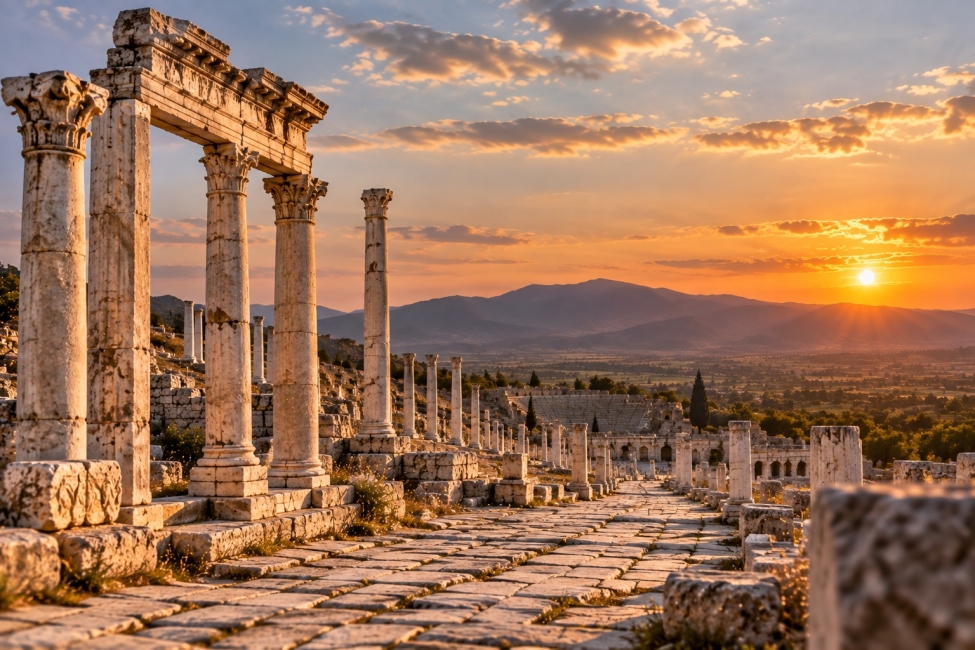
Today, the archaeological site of Laodicea provides an impressive glimpse into the scale and prosperity of the ancient city.
Visitors can see the remains of monumental streets, theaters, public buildings, baths, fountains, and other structures that reveal the importance of Laodicea during the Roman and early Byzantine periods.
The site also has particular importance for Christian history. Archaeological excavations have uncovered several churches, including the significant Laodicea Church, which dates to the early Byzantine period.
This means that the Christian history of Laodicea did not end with the letter in Revelation. The city continued to have an important role in the Christian world for centuries afterward.
Laodicea is one of the most fascinating stops on a Seven Churches of Revelation journey because the biblical message and the archaeological landscape create a powerful contrast.
Revelation describes a church that believed it was rich and needed nothing. The ruins surrounding modern visitors reveal a city that really was prosperous, monumental, and influential.
Yet the message to the church was not about preserving that wealth. It was about recognizing a deeper spiritual need.
Walking through Laodicea today allows travelers to reflect on that contrast while exploring one of the most important archaeological sites connected with early Christianity in Turkey.
For travelers who want to visit all seven churches in a shorter private itinerary, a private Seven Churches of Revelation tour can combine Laodicea with Ephesus, Smyrna, Pergamum, Thyatira, Sardis, and Philadelphia.
Those looking for a longer Christian heritage journey can also explore the 8-day Seven Churches of Revelation itinerary from Istanbul, which includes Laodicea together with Ephesus, Pamukkale, Hierapolis, and the other biblical sites.
One of the most famous passages in the letter to Laodicea comes near the end of the message:
“Here I am! I stand at the door and knock.”
This image is often used in Christian teaching as a picture of Christ inviting an individual to open the door of their heart. In the original context, however, the words are addressed to the church of Laodicea.
The message follows the strong criticism of the church's lukewarm condition. Christ calls the community to recognize its spiritual need, repent, and renew its relationship with Him.
The passage therefore ends not with condemnation alone, but with an invitation. The church that has become complacent is still being offered the opportunity to change.
Another important part of the Laodicean message is the statement that Christ rebukes and disciplines those He loves.
This changes the tone of the letter. Although the criticism is severe, its purpose is not simply to reject the church. The warning is intended to lead to repentance and restoration.
The Laodiceans are therefore encouraged to become earnest and repent. The letter presents spiritual correction as an expression of love rather than abandonment.
The message to Laodicea concludes with a promise to those who overcome.
Christ says that the one who overcomes will be given the opportunity to sit with Him on His throne, just as He overcame and sat down with His Father on His throne.
This follows the pattern found throughout the letters to the Seven Churches. Each message contains both a challenge and a promise, encouraging believers to remain faithful.
For Laodicea, the journey moves from complacency to repentance, and from self-sufficiency to dependence on Christ.
Laodicea's relationship with nearby Hierapolis is often mentioned when explaining the famous lukewarm-water metaphor.
Hierapolis, located close to Laodicea, was famous for its hot thermal waters. The modern travertines of Pamukkale are part of this remarkable landscape. Colossae, another nearby city, was associated with cooler water sources.
Because Laodicea lay between these settlements, some interpretations suggest that the imagery of hot, cold, and lukewarm water would have been especially familiar to people living in the region.
However, the popular explanation should not be treated as a proven fact. The exact relationship between the ancient water systems and the wording of Revelation remains debated.
What is certain is that the image of lukewarmness functions as a powerful criticism of the church's spiritual condition. Whether or not the metaphor was specifically inspired by Laodicea's water supply, the central message is clear: the church had become complacent.
Laodicea was part of the same Lycus Valley region as Colossae and Hierapolis. These three cities were relatively close to one another and formed an interconnected regional landscape.
Colossae is particularly important for students of the New Testament because the Letter to the Colossians refers directly to Laodicea.
Paul's letter mentions the believers at Laodicea and refers to a letter that was to be shared between the two Christian communities. This provides another indication that Laodicea was already part of an active Christian network during the first century.
The connection between Colossae and Laodicea also shows that Christianity in this region was not limited to a single city. Christian communities communicated with one another and formed part of a wider network across Asia Minor.
Modern Laodicea is an extensive archaeological site, and its ruins reveal the prosperity and importance of the ancient city.
Among the most impressive remains are the Syrian Street, the ancient theaters, monumental columns, baths, fountains, and large public buildings.
The site also contains remains associated with the city's water infrastructure, offering visitors a chance to understand the complex systems required to supply a large Roman city.
Walking through the ruins, it is easy to see why the city described in Revelation could consider itself prosperous and self-sufficient.
One of the most significant discoveries for Christian travelers is the large early Byzantine church located within the ancient city.
The church belongs to a later period than the letter in Revelation, but its existence demonstrates that Laodicea remained an important Christian center long after the first century.
Its monumental remains provide an important connection between the early Christian community mentioned in Revelation and the later development of Christianity in the region.
For visitors, the church is a reminder that the story of Laodicea did not end with the Book of Revelation. Christian life continued in the city for centuries.
A visit to Laodicea offers much more than a single biblical landmark. The archaeological site allows travelers to explore the urban environment of one of the most prosperous cities of ancient Asia Minor.
The combination of Roman architecture and later Christian remains makes Laodicea particularly valuable for travelers interested in both ancient history and Christian heritage.
Laodicea is an open archaeological site with significant walking, so the season can make a noticeable difference to the experience.
Spring and autumn are generally comfortable periods for exploring the ruins, with milder temperatures than the hottest part of summer.
If you visit during the warmer months, an early morning visit can be more comfortable. Comfortable walking shoes, water, a hat, and sun protection are recommended.
Laodicea is located close to Pamukkale and Hierapolis, making it relatively easy to combine the three sites during the same day.
This combination is especially interesting for travelers exploring the biblical history of southwestern Turkey. A day can include the archaeological remains of Laodicea, the ancient city of Hierapolis, and the famous white travertines of Pamukkale.
For travelers following the Seven Churches of Revelation, Laodicea can then be connected with the other churches farther west, including Philadelphia, Sardis, Thyatira, Pergamum, Smyrna, and Ephesus.
Laodicea is often one of the most meaningful stops on a biblical journey through Turkey because its message remains surprisingly relevant.
The church was not accused of openly rejecting Christ. Instead, it had become comfortable enough to believe that it did not need anything. Its greatest problem was therefore not external pressure, but internal complacency.
That makes Laodicea a powerful conclusion to the story of the Seven Churches. Across the seven letters, the churches face persecution, false teaching, loss of love, spiritual weakness, and compromise. Laodicea adds another warning: success and comfort can also become spiritual dangers.
Travelers who want to visit all seven biblical sites can explore Apasas Travel's private Seven Churches of Revelation tour, which follows a route through the major sites of western Turkey.
For a more extended pilgrimage experience, the 8-day Seven Churches of Revelation tour from Istanbul combines the biblical sites with Ephesus, Pamukkale, Hierapolis, Istanbul, and other important destinations.
The church was described as lukewarm because it had become spiritually complacent and self-satisfied. It believed that it was rich and needed nothing, while Revelation presents it as spiritually poor, blind, and naked.
In Revelation 3, “lukewarm” describes the spiritual condition of the Laodicean church. It represents a lack of meaningful commitment and dependence on Christ rather than simply a lack of religious emotion.
Laodicea was associated with medical traditions and an eye-treatment product in the ancient world. Revelation's reference to eye salve creates a striking contrast between the city's reputation for treating physical eyesight and the church's spiritual blindness.
Ancient Laodicea is located near modern Denizli in southwestern Turkey, close to Pamukkale and Hierapolis.
Yes. The two ancient cities are located close to one another and can be combined with Pamukkale. This makes the area particularly convenient for travelers interested in both biblical history and ancient Roman heritage.
Yes. Laodicea is the seventh and final church addressed in the letters of Revelation chapters 2 and 3.
The message to Laodicea remains one of the most memorable passages in Revelation because its warning is not limited to one ancient city.
The church had wealth, confidence, and a strong sense of independence. Yet it failed to recognize its own spiritual condition.
The lesson is therefore about more than being “hot” or “cold.” It is about recognizing the difference between outward success and genuine spiritual life.
Laodicea was encouraged to become earnest, repent, and open the door to Christ. Its story ends not simply with a warning, but with an invitation to renewal.
Today, the ruins of Laodicea allow visitors to walk through the physical remains of the city while reflecting on one of the most challenging messages in the Book of Revelation.
From Ephesus on the Aegean coast to Laodicea in the Lycus Valley, the Seven Churches of Revelation offer one of the most fascinating biblical journeys in Turkey.
Laodicea stands out because its message is centered on a danger that can be difficult to recognize: becoming so comfortable and self-sufficient that spiritual need is no longer visible.
Visiting the ancient city brings that message into a real historical setting, surrounded by Roman monuments, early Christian remains, and the remarkable landscapes of southwestern Turkey.
Want to follow the Seven Churches of Revelation in Turkey? Explore the ancient cities, biblical history, and Christian heritage of the region with Apasas Travel's Seven Churches of Revelation tour.

I graduated from Istanbul University with a degree in Radio, Television, and Cinema. During my academic journey, I focused on storytelling, visual communication, and cultural content creation, while my personal interests led me toward exploration and discovery.
Traveling, discovering new places, and experiencing different cultures are at the heart of my life. My strong interest in mythology allows me to see destinations not only as physical locations but as narratives shaped by history and meaning. My passion for reading continuously enriches and deepens this perspective.
I truly enjoy meeting new people and learning about diverse ways of life. With this mindset, I aim to share my experiences in a sincere, clear, and engaging way.
I love following the traces of stories wherever I go.
Disclosure Notice
By filling out this form, you agree that the personal data you provide to us will be processed in accordance with the Personal Data Protection Law No. 6698 and related legislation.
Your personal data will be processed solely for responding to your application, evaluating your requests, and fulfilling legal obligations; it will not be shared with third parties.
For detailed information, you can review our Privacy Policy.
By submitting the form, you acknowledge and consent to the processing of your personal data for the purposes specified above.

