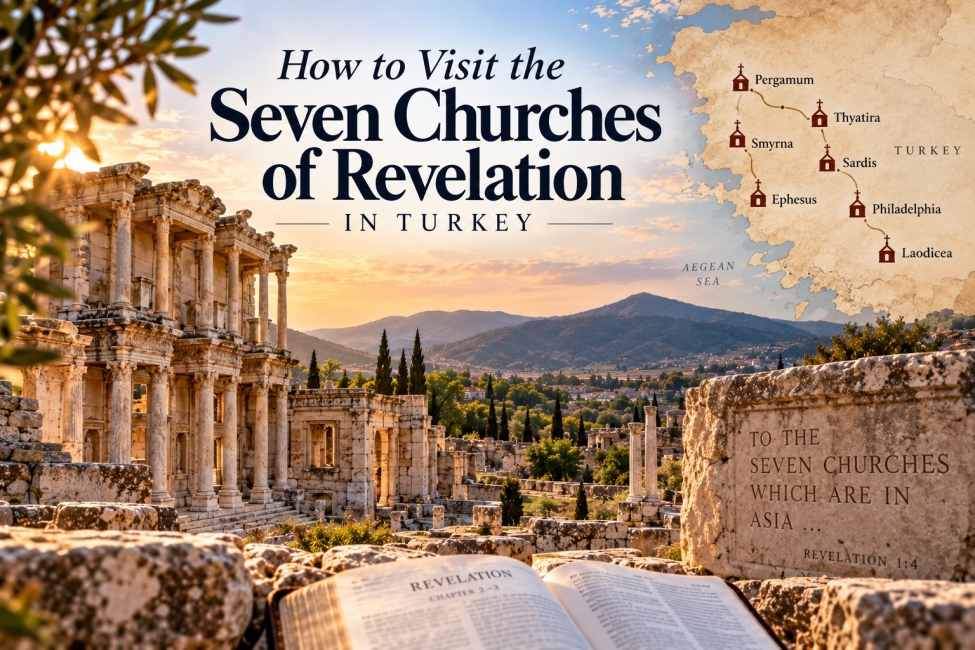
For Christians interested in biblical history, few journeys are as meaningful as following the footsteps of the Seven Churches of Revelation in Turkey.
Named in the Book of Revelation, Ephesus, Smyrna, Pergamum, Thyatira, Sardis, Philadelphia, and Laodicea were real Christian communities located in the ancient Roman province of Asia. Today, their ancient cities and archaeological remains can still be visited across western Turkey.
Visiting the Seven Churches is not simply a sightseeing trip. It is an opportunity to read the biblical passages in the places where these early Christian communities once lived, worshipped, worked, and faced the challenges of the ancient world.
But planning the journey requires some preparation. The seven locations are spread across western Turkey, and they vary considerably in size and accessibility. Some, such as Ephesus and Pergamum, are enormous archaeological sites, while others are located beneath or alongside modern towns.
So, how do you visit all Seven Churches of Revelation? How many days do you need? Where should you start? Can you travel independently? And what is the most practical route?
This guide explains everything you need to know before planning your Seven Churches of Revelation pilgrimage in Turkey.
The Seven Churches of Revelation were seven early Christian communities mentioned in the opening chapters of the Book of Revelation.
They are:
These were not seven church buildings in the modern sense. They were Christian communities located in important cities of ancient Asia Minor.
Their individual messages appear in Revelation chapters 2 and 3, with each church receiving a message reflecting its own circumstances, strengths, weaknesses, and challenges.
Today, all seven locations can be visited in modern-day Turkey.
The Seven Churches are located across western Turkey, primarily in the modern provinces of İzmir, Manisa, and Denizli.
| Ancient Church | Modern Location | Modern Province |
|---|---|---|
| Ephesus | Selçuk | İzmir |
| Smyrna | İzmir | İzmir |
| Pergamum | Bergama | İzmir |
| Thyatira | Akhisar | Manisa |
| Sardis | Sart, near Salihli | Manisa |
| Philadelphia | Alaşehir | Manisa |
| Laodicea | Near Denizli | Denizli |
The concentration of the sites in western Turkey makes it possible to visit all seven during one dedicated journey, but the distances between them mean that a carefully planned itinerary is essential.
Yes. All seven ancient locations can be visited today.
However, travelers should understand that the original Christian communities mentioned in Revelation do not survive as seven continuously functioning first-century churches.
Instead, visitors explore the ancient cities, archaeological remains, later Christian structures, and modern towns associated with these biblical locations.
The experience varies considerably from one church to another.
Ephesus and Pergamum, for example, offer extensive archaeological landscapes with monumental remains. Sardis also provides an impressive glimpse into the ancient city, while Philadelphia and Thyatira are much more closely integrated with modern settlements.
This variety is part of what makes the journey so interesting.
There is no single answer because the ideal duration depends on how deeply you want to explore the sites.
A focused itinerary can cover the seven churches in approximately three days. This is suitable for travelers whose main goal is to visit the biblical locations and who are comfortable with relatively long driving days.
A longer itinerary allows considerably more time for archaeology, Christian heritage, sightseeing, and other important destinations in western Turkey.
For travelers who want to focus specifically on the Seven Churches, Apasas Travel's Seven Churches of Revelation Tour offers a dedicated private journey covering all seven biblical locations.
For travelers who want to combine the Seven Churches with a broader Turkey experience, the 8-Day Seven Churches of Revelation Tour provides a longer itinerary including Istanbul, the Seven Churches, Pamukkale, Hierapolis, and other important historical destinations.
The order in which the churches are named in Revelation is:
This sequence follows a logical geographical progression through western Asia Minor.
However, travelers do not necessarily have to visit the sites in exactly this order.
The most practical route depends on your arrival airport, where you plan to stay, whether you are traveling by car or with a private driver, and which additional destinations you want to include.
For many travelers, İzmir is a convenient starting point because Smyrna is located within the modern city and Ephesus is relatively close by.
From there, the journey can continue toward Pergamum and then inland through Thyatira, Sardis, Philadelphia, and finally Laodicea near Denizli.
The distances are one of the most important things to consider when planning the journey.
The Seven Churches are not located next to one another. They cover a large area of western Anatolia, so visiting them requires several hours of driving across different regions.
This is why the journey works better as a dedicated multi-day itinerary rather than a series of day trips from one hotel.
Another important consideration is the amount of time required at each site.
Spending only a few minutes at Ephesus, for example, would not do justice to one of the largest and most significant archaeological sites in the region.
Travelers should therefore balance driving time with archaeological site time.
Yes. It is possible to visit the Seven Churches independently by renting a car and arranging your own accommodation.
Independent travel can be a good option for experienced travelers who are comfortable navigating western Turkey and researching the archaeological sites themselves.
However, there are several practical challenges.
For travelers whose primary goal is Christian heritage rather than simply sightseeing, having a knowledgeable guide can add considerable value.
A guide can explain how the archaeological remains relate to the biblical text and help distinguish historical evidence from later traditions and interpretations.
For many Christian pilgrims and small groups, a private tour can make the journey significantly easier.
The main advantage is not simply transportation. It is the ability to connect the seven locations into one coherent historical and biblical story.
Instead of worrying about navigation, hotel changes, parking, driving times, and route planning, travelers can concentrate on the sites themselves.
A private itinerary can also be adapted around the group's interests. Travelers particularly interested in the Apostle Paul, early Christianity, biblical archaeology, or Christian pilgrimage can spend more time at the locations that matter most to them.
Apasas Travel's dedicated Seven Churches of Revelation Tour is designed specifically around this biblical route.
A longer itinerary gives travelers the opportunity to experience the Seven Churches without treating them as isolated archaeological stops.
The 8-Day Seven Churches of Revelation Tour, for example, combines the Seven Churches with Istanbul, Ephesus, Pamukkale, and Hierapolis.
This approach can be particularly useful for international travelers who are making a dedicated trip to Turkey and want to combine their biblical pilgrimage with some of the country's most important historical destinations.
You do not need to be a biblical scholar to visit the Seven Churches.
However, reading Revelation chapters 1–3 before your trip can transform the experience.
These chapters introduce the seven churches and provide the messages that make each location significant.
It is also useful to read the relevant passages before arriving at each site.
For example, reading Revelation 2 before visiting Ephesus, Smyrna, Pergamum, and Thyatira can help you understand why each church received a different message.
Likewise, reading Revelation 3 before visiting Sardis, Philadelphia, and Laodicea allows you to experience the archaeological sites with their biblical context already in mind.
Because much of the journey takes place outdoors, the season can make a significant difference.
Spring and autumn are generally the most comfortable periods for exploring the archaeological sites, particularly if you plan to spend several hours walking through ancient cities.
Summer can be very hot in western and inland Turkey. Travelers visiting during the warmer months should plan for sun protection, comfortable walking shoes, water, and appropriate clothing.
Regardless of the season, it is worth checking the current opening hours of individual archaeological sites before traveling, as schedules can change.
A Seven Churches journey involves considerably more walking than a typical city sightseeing trip.
Some of the most useful items include:
Comfortable footwear is particularly important at larger archaeological sites such as Ephesus and Pergamum, where visitors can spend several hours walking over ancient streets and uneven surfaces.
One of the easiest ways to understand the route is to divide the Seven Churches into geographical sections.
A practical journey can begin around İzmir and continue eastward through western Anatolia before finishing around Denizli.
Begin your journey in modern İzmir, the location of ancient Smyrna.
Smyrna is particularly interesting because the ancient city has been incorporated into the modern urban landscape. The remains of the ancient Agora provide an opportunity to explore the history of the city that received a message of encouragement in Revelation.
From İzmir, continue south toward Ephesus near Selçuk.
Ephesus is one of the most spectacular archaeological sites in Turkey and deserves plenty of time. The ancient city preserves monumental streets, temples, theaters, public buildings, and other remains that demonstrate its importance in the Roman world.
Ephesus is also closely connected with early Christianity and the ministry of the Apostle Paul, making it one of the most significant stops on the entire journey.
Continue north toward Pergamum, modern Bergama.
Pergamum was one of the most important cultural and political centers of ancient Asia Minor. Its dramatic hilltop acropolis provides spectacular views and contains numerous monumental remains.
The city is also remembered in Revelation for the powerful phrase “where Satan's throne is.”
After exploring Pergamum, continue southeast toward Thyatira, modern Akhisar.
Thyatira is different from Pergamum and Ephesus because much of the ancient settlement lies beneath the modern city. Nevertheless, the biblical connection is significant.
Thyatira is the city associated with Lydia in Acts 16 and the church warned about the woman called Jezebel in Revelation 2.
The final part of the route can continue through Sardis and Philadelphia before reaching the area of Laodicea.
Sardis, near modern Sart, is one of the most impressive archaeological sites on the route. The ancient city was the capital of the powerful Lydian kingdom and later developed into an important Roman settlement.
The church at Sardis received the famous command to “wake up.”
From Sardis, continue toward Philadelphia, modern Alaşehir.
Philadelphia received one of the most encouraging messages among the seven churches. Revelation describes an “open door” that no one can shut and praises the church for remaining faithful despite having little strength.
Finally, continue toward the Denizli region and the ancient city of Laodicea.
Laodicea is famous for its message concerning spiritual lukewarmness. The ancient city also contains extensive archaeological remains that help visitors understand its wealth and importance during the Roman period.
The seven locations cover a considerable area, so travelers should not underestimate the distances involved.
The journey crosses modern cities, rural landscapes, mountain roads, archaeological zones, and busy urban areas.
This is one reason a dedicated multi-day itinerary is generally more practical than attempting to visit all seven as individual day trips from one base.
Another factor is that the sites require different amounts of time.
Ephesus and Pergamum can easily occupy several hours, while Philadelphia and Thyatira can be explored more briefly because fewer visible remains survive.
A good itinerary therefore considers both distance and archaeological importance.
Accommodation depends on the route and the length of your trip.
For a dedicated Seven Churches journey, travelers can stay in different cities along the route rather than returning to the same hotel every night.
Common bases include areas around İzmir, Selçuk, Bergama, Salihli, Alaşehir, and Denizli.
The best arrangement depends on your starting point and whether you are combining the Seven Churches with other destinations in Turkey.
Changing hotels during the journey may seem inconvenient, but it can save several hours of unnecessary driving.
You can, but you do not have to.
The order given in Revelation provides an excellent framework because it follows the general geographical progression of the churches.
However, modern travel logistics may make another order more practical.
Your arrival airport, departure airport, hotel preferences, and additional destinations can all influence the most efficient route.
The important thing is not simply checking seven names off a list. The real value comes from understanding the relationship between the biblical text, the ancient city, and the wider history of Christianity in Asia Minor.
There are several possibilities, including rental cars, private drivers, and organized tours.
A rental car provides flexibility and independence, but the traveler is responsible for navigation, parking, route planning, and driving between the archaeological sites.
A private driver and guide can make the experience considerably easier, particularly for international visitors unfamiliar with the region.
For Christian pilgrims, a knowledgeable guide can also add historical and biblical context that is difficult to obtain simply by following road signs and visiting the ruins independently.
Not all seven locations require the same amount of time.
| Site | Suggested Time |
|---|---|
| Ephesus | 2–4 hours |
| Smyrna | 1–2 hours |
| Pergamum | 2–3 hours |
| Thyatira | 30–60 minutes |
| Sardis | 1.5–2 hours |
| Philadelphia | 30–60 minutes |
| Laodicea | 1–2 hours |
These are approximate planning estimates rather than fixed requirements. Travelers particularly interested in archaeology may want considerably more time at Ephesus, Pergamum, or Sardis.
The Seven Churches journey is different from a conventional archaeological tour because the destinations are connected by a single biblical narrative.
When you visit Ephesus, you can read the message to the church that had lost its first love.
At Smyrna, you can reflect on a community praised for remaining faithful through suffering.
At Pergamum, the warning about compromise takes place against the backdrop of a major ancient religious center.
At Thyatira, the message raises questions about faith, commerce, and compromise.
At Sardis, the command is to wake up.
At Philadelphia, the church is encouraged to hold on to its faith and is promised an open door.
And at Laodicea, the famous warning against being lukewarm concludes the journey.
Seeing these places in person makes the seven messages much easier to visualize.
Absolutely.
The route is particularly meaningful for Christians interested in the New Testament, early Christianity, biblical archaeology, and the history of the church in Asia Minor.
It can also be adapted for church groups, Bible study groups, families, pastors, and travelers making a personal pilgrimage.
Because the journey combines biblical sites with archaeological and cultural destinations, it can also appeal to travelers who have a broader interest in ancient history.
If your main goal is to visit the seven biblical churches and understand their historical context, a dedicated private itinerary can simplify the planning process.
Apasas Travel's Seven Churches of Revelation Tour is designed around the seven ancient cities and offers a focused way to follow the biblical route through western Turkey.
Travelers who want more time and a broader experience can choose the 8-Day Seven Churches of Revelation Tour, which combines the biblical sites with other major destinations and allows more time to experience Turkey beyond the Seven Churches.
For groups with specific interests, a private itinerary also makes it possible to focus more heavily on biblical history, archaeology, Christian heritage, or the journeys of the Apostle Paul.
Yes. All seven ancient locations can be visited in modern-day Turkey. They are spread across western Anatolia and can be connected through a multi-day itinerary.
A focused trip can be completed in around three days, while a longer itinerary allows more time for archaeological sites and additional destinations in Turkey.
İzmir is a convenient starting point for many travelers because ancient Smyrna is located within the modern city and Ephesus is nearby. However, the best starting point depends on your overall itinerary and transportation arrangements.
The seven communities mentioned in Revelation were early Christian churches, but they are not seven continuously functioning first-century churches today. Travelers visit the ancient cities and archaeological remains associated with them.
The journey is manageable for most travelers, but it involves driving between several destinations and walking through archaeological sites. Comfortable footwear and sensible planning are recommended.
Yes. Independent travel is possible by rental car. However, a private guide can provide valuable biblical, historical, and archaeological context and can make route planning considerably easier.
Spring and autumn are generally comfortable seasons for visiting the outdoor archaeological sites. Summer is possible but can be very hot, particularly during extended walks through sites such as Ephesus and Pergamum.
Visiting the Seven Churches of Revelation is much more than traveling from one archaeological site to another.
It is a journey through the landscape of early Christianity in Asia Minor.
From the monumental ruins of Ephesus and Pergamum to the quieter remains of Thyatira and Philadelphia, each location offers a different perspective on the world described in the Book of Revelation.
The seven messages also create a remarkable sequence of themes: love, suffering, faithfulness, compromise, spiritual awakening, perseverance, and spiritual renewal.
For Christian travelers, reading Revelation while standing in the ancient cities can transform familiar passages into something much more tangible.
You are not simply reading about places on an ancient map. You are walking through the landscapes where these communities once lived.
Whether you choose a focused three-day journey or a longer itinerary combining the Seven Churches with other destinations, western Turkey offers an extraordinary opportunity to explore the biblical and historical roots of Christianity.
If you are ready to follow the route yourself, explore Apasas Travel's Seven Churches of Revelation Tour or discover the extended 8-Day Seven Churches of Revelation Tour.
The Seven Churches are no longer only names in the Book of Revelation. Their ancient cities are still waiting to be explored.

I graduated from Istanbul University with a degree in Radio, Television, and Cinema. During my academic journey, I focused on storytelling, visual communication, and cultural content creation, while my personal interests led me toward exploration and discovery.
Traveling, discovering new places, and experiencing different cultures are at the heart of my life. My strong interest in mythology allows me to see destinations not only as physical locations but as narratives shaped by history and meaning. My passion for reading continuously enriches and deepens this perspective.
I truly enjoy meeting new people and learning about diverse ways of life. With this mindset, I aim to share my experiences in a sincere, clear, and engaging way.
I love following the traces of stories wherever I go.
Disclosure Notice
By filling out this form, you agree that the personal data you provide to us will be processed in accordance with the Personal Data Protection Law No. 6698 and related legislation.
Your personal data will be processed solely for responding to your application, evaluating your requests, and fulfilling legal obligations; it will not be shared with third parties.
For detailed information, you can review our Privacy Policy.
By submitting the form, you acknowledge and consent to the processing of your personal data for the purposes specified above.

