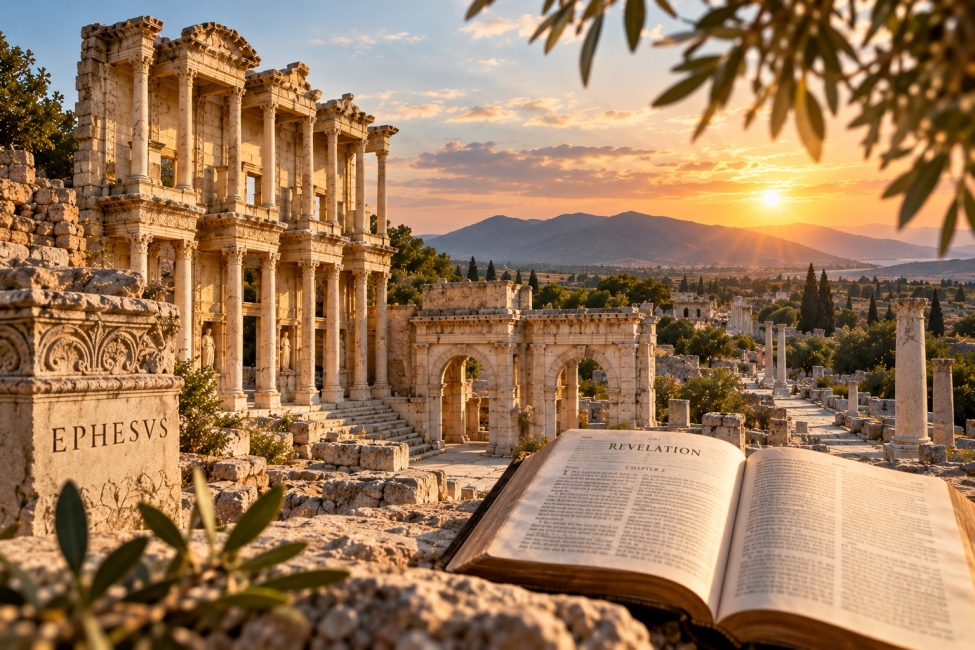
Ephesus is one of the most important ancient cities associated with early Christianity and one of the seven churches addressed in the Book of Revelation. Today, the ruins of ancient Ephesus near Selçuk in western Türkiye allow travelers to explore the historical setting behind one of the most famous messages in the New Testament.
But what exactly does the Bible say about the Church of Ephesus? Why was this church important? What did Jesus praise the Ephesians for, and why were they warned that they had abandoned their first love?
To understand the message of Revelation to Ephesus, it helps to look at both the biblical text and the ancient city where this Christian community lived.
Ancient Ephesus was located on the western coast of Asia Minor, in what is now Türkiye. The ruins of Ephesus are located near the modern town of Selçuk in İzmir Province.
During the Roman period, Ephesus was one of the most important cities in the eastern Mediterranean. It was a major commercial center, an important port and a crossroads connecting different parts of the ancient world.
Ephesus was also famous for the Temple of Artemis, one of the Seven Wonders of the Ancient World.
This combination of economic importance, cultural influence and religious diversity created the environment in which the Christian community of Ephesus developed.
Ephesus has a particularly strong connection with the early history of Christianity.
The city appears several times in the New Testament and is closely associated with the missionary activities of the Apostle Paul.
According to the Book of Acts, Paul spent an extended period in Ephesus teaching and preaching. His activities attracted considerable attention in the city, particularly because Christianity challenged aspects of the religious and commercial culture surrounding the worship of Artemis.
Acts 19 describes a major disturbance in Ephesus connected with the followers of Artemis and the economic interests of local craftsmen.
This episode provides an important historical background for understanding the Christian community that later received the message recorded in Revelation.
The message to Ephesus appears in Revelation 2:1–7.
The passage begins with a message addressed to the “angel” of the church in Ephesus. The church is then praised for several qualities, including its perseverance, discernment and resistance to false teaching.
The church is described as a community that has worked hard and endured difficulties for the sake of Christ.
However, the message also contains a serious warning.
The central criticism is that the church has forsaken its first love.
The phrase “first love” is one of the most widely discussed parts of the message to Ephesus.
At its simplest level, the passage suggests that the church remained active and committed in many ways, but something important had changed in its spiritual life.
The believers were praised for their endurance and their rejection of false teaching, yet they were warned that their relationship with Christ had lost something essential.
This creates one of the most memorable contrasts in the Seven Churches of Revelation:
A church can be active, hardworking and doctrinally careful while still losing the love that originally motivated its faith.
The message therefore calls the Ephesians to remember where they had fallen, repent and return to the works they had done at first.
The message to Ephesus is not entirely negative.
In fact, the church receives considerable praise.
These details show that the Church of Ephesus was not presented as a community that had simply abandoned Christianity.
Instead, Revelation presents a church that was active and discerning but had experienced a loss of its original love and devotion.
Revelation 2 also mentions the Nicolaitans, a group whose teachings the Ephesian church is praised for rejecting.
Very little is known with certainty about the Nicolaitans. The New Testament does not provide enough information to reconstruct their beliefs in detail.
What is clear from Revelation is that their practices or teachings were considered incompatible with the message being delivered to the churches.
The reference is significant because it shows that the early Christian communities in Asia Minor were dealing with questions about identity, teaching and religious practice.
To understand the message to the Church of Ephesus, it is useful to imagine the city itself.
Ephesus was a large and sophisticated urban center. Its streets, public buildings, temples, theaters and commercial spaces reflected its importance within the Roman world.
The city was also religiously diverse.
The famous Temple of Artemis represented one of the most influential religious traditions in the region, while other Greek, Roman, Anatolian and later Christian traditions also shaped the city's history.
Christians living in Ephesus were therefore part of a complex urban society rather than an isolated religious community.
The connection between Ephesus and Christianity begins well before the Book of Revelation.
The Book of Acts describes Paul's activities in Ephesus in considerable detail, particularly in Acts 19.
Paul's teaching attracted both supporters and opponents. The growth of Christianity became controversial because it challenged existing religious practices and, indirectly, businesses connected with the worship of Artemis.
The famous disturbance involving Demetrius the silversmith illustrates just how significant the religious economy of Ephesus was.
This background makes Ephesus particularly fascinating for travelers interested in biblical history: the city mentioned in Revelation was part of a much larger story of the spread of Christianity across Asia Minor.
Yes. Ephesus was one of the most significant locations associated with Paul's ministry in Asia Minor.
Acts describes an extended period of teaching in the city, and Ephesus later became an important center of Christianity.
The city is also traditionally associated with the Apostle John and with several important developments in early Christian history.
For this reason, visiting Ephesus is not simply about seeing Roman ruins. It offers an opportunity to explore a city that appears repeatedly in the story of early Christianity.
The Christian community of Ephesus continued to exist long after the period described in Revelation.
Ephesus remained an important Christian center for centuries and became associated with major developments in Christian history.
However, the ancient city gradually declined as its harbor became less useful and economic and political conditions changed.
Over time, the population shifted and the once-great city was eventually abandoned as a major urban center.
The archaeological site visitors see today therefore represents many different periods of Ephesus, not just the city described in the New Testament.
This requires an important distinction.
The original first-century congregation described in Revelation does not survive as a continuously functioning church in its original form.
However, visitors can walk through the ancient city where this Christian community lived and understand the physical environment surrounding the biblical story.
The archaeological remains include monumental streets, temples, public buildings, the Great Theatre and the famous Library of Celsus.
There are also important Christian heritage sites in and around Ephesus, including the Basilica of Saint John and the House of the Virgin Mary.
Ephesus brings together several different chapters of Christian history.
Here, travelers can explore a city connected with:
This makes Ephesus one of the most significant destinations for travelers interested in the biblical history of Türkiye.
Ephesus was not an isolated Christian community.
It was the first of the seven churches addressed in Revelation, followed by Smyrna, Pergamum, Thyatira, Sardis, Philadelphia and Laodicea.
These seven cities formed a network of important urban centers in western Asia Minor.
Today, travelers can follow the same broad geographical journey across western Türkiye and visit the archaeological remains associated with all seven churches.
If you want to understand where all seven churches are located today, read our guide:
Where Are the Seven Churches of Revelation Today?
A visit to Ephesus offers much more than a single biblical landmark.
Among the most important sights are:
The surrounding area also contains several important Christian heritage sites.
The Basilica of Saint John in Selçuk is traditionally associated with the Apostle John, while the House of the Virgin Mary is an important pilgrimage destination for many Christian visitors.
Ephesus is often the starting point for travelers interested in the Seven Churches of Revelation because it is one of the best-preserved and most accessible ancient cities on the route.
However, visiting all seven churches requires more planning because the sites are spread across western Türkiye.
For travelers who want to experience the complete biblical route, a dedicated itinerary can make the journey considerably easier.
Apasas Travel offers a Seven Churches of Revelation Tour that follows the route through the seven biblical cities.
For travelers who want more time to explore Türkiye alongside the Seven Churches, the 8-Day Seven Churches of Revelation Tour offers a longer journey combining biblical heritage with other important destinations.
Nearly two thousand years after the message was written, the central warning to Ephesus remains remarkably relevant.
The church was not criticized for being inactive. It was criticized precisely because something important had been lost beneath its activity.
The message encourages believers to remember their beginnings, recognize what has changed and return to the love and devotion that once characterized their faith.
This is perhaps why Ephesus remains such a powerful destination for Christian travelers.
You can read the words of Revelation and then stand in the landscape of the city to which they were originally addressed.
Ephesus appears in several parts of the New Testament, including Acts, and is one of the seven churches addressed in the Book of Revelation. The message to the Church of Ephesus is found in Revelation 2:1–7.
In Revelation 2, the church is praised for its perseverance, hard work and rejection of false teaching. However, it is criticized for having abandoned its first love and is called to remember, repent and return to its earlier works.
Ancient Ephesus is located near the modern town of Selçuk in İzmir Province, western Türkiye.
Yes. The archaeological site of ancient Ephesus is one of Türkiye's most important historical attractions and can be visited today.
Yes. Ephesus is the first of the seven churches addressed in Revelation chapters 2 and 3.
The Christian community continued for centuries, but the original first-century congregation described in Revelation does not survive as a continuously functioning church in its original form. The ancient city itself eventually declined and was abandoned as a major urban center.
Ephesus was an important center for the spread of Christianity in Asia Minor and is closely associated with the Apostle Paul's ministry. It later became one of the Seven Churches of Revelation and remained an important Christian center for centuries.
Yes. Ephesus is one of the seven biblical cities included in dedicated Seven Churches of Revelation itineraries. A guided multi-day journey allows travelers to connect Ephesus with Smyrna, Pergamum, Thyatira, Sardis, Philadelphia and Laodicea.
The story of Ephesus is much bigger than a single passage in Revelation.
It is the story of an ancient city where different cultures, religions and communities came together. It is the story of Paul's missionary work, the growth of early Christianity and a Christian community that received one of the most memorable messages in the Book of Revelation.
Today, the ruins of Ephesus allow visitors to step into that historical world.
Standing among the ancient streets and monumental buildings, it becomes easier to imagine the city in which the early Christian community lived and to understand why Ephesus became one of the most important Christian centers of ancient Asia Minor.
For Christian pilgrims and travelers interested in biblical history, Ephesus is more than an archaeological site. It is one of the places where the history of the early Church can be experienced in the landscape itself.
If you want to continue beyond Ephesus and visit all seven biblical cities, explore our Seven Churches of Revelation Tour or discover the longer 8-Day Seven Churches of Revelation Tour.

I graduated from Istanbul University with a degree in Radio, Television, and Cinema. During my academic journey, I focused on storytelling, visual communication, and cultural content creation, while my personal interests led me toward exploration and discovery.
Traveling, discovering new places, and experiencing different cultures are at the heart of my life. My strong interest in mythology allows me to see destinations not only as physical locations but as narratives shaped by history and meaning. My passion for reading continuously enriches and deepens this perspective.
I truly enjoy meeting new people and learning about diverse ways of life. With this mindset, I aim to share my experiences in a sincere, clear, and engaging way.
I love following the traces of stories wherever I go.
Disclosure Notice
By filling out this form, you agree that the personal data you provide to us will be processed in accordance with the Personal Data Protection Law No. 6698 and related legislation.
Your personal data will be processed solely for responding to your application, evaluating your requests, and fulfilling legal obligations; it will not be shared with third parties.
For detailed information, you can review our Privacy Policy.
By submitting the form, you acknowledge and consent to the processing of your personal data for the purposes specified above.

