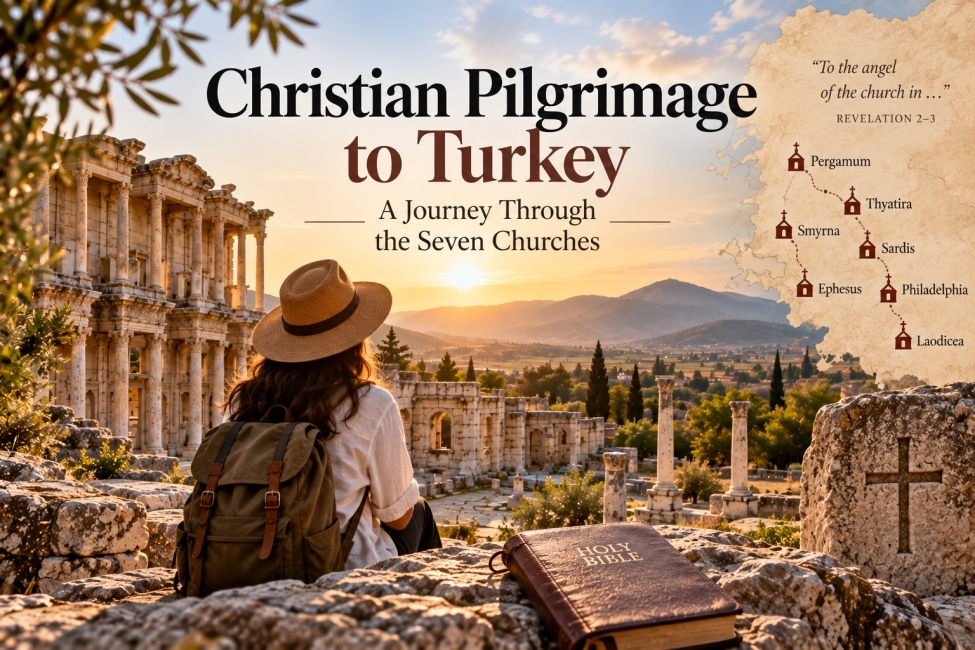
For Christians seeking to connect biblical history with the places where it unfolded, Turkey offers one of the world's most remarkable pilgrimage journeys.
Modern Turkey was once the heart of the ancient Roman province of Asia, a region where some of the earliest Christian communities developed. Among the most significant are the Seven Churches of Revelation: Ephesus, Smyrna, Pergamum, Thyatira, Sardis, Philadelphia, and Laodicea.
These seven communities are addressed individually in the opening chapters of the Book of Revelation. Their messages speak about faithfulness, perseverance, spiritual renewal, suffering, compromise, and hope.
Today, travelers can journey through western Turkey and visit the ancient cities associated with these churches, walking among archaeological remains that preserve the history of the world in which early Christians lived.
A Christian pilgrimage to Turkey therefore offers more than beautiful ruins. It provides an opportunity to read familiar biblical passages within their geographical, historical, and cultural setting.
Turkey occupies a unique position in Christian history.
In the first centuries of Christianity, Asia Minor was an important center of Christian communities, missionary activity, theological development, and trade.
The region is connected with figures and events described throughout the New Testament, including the missionary journeys of the Apostle Paul and the early Christian communities addressed in Revelation.
Many of the ancient cities mentioned in the New Testament are located in modern Turkey.
This makes the country particularly significant for travelers interested in Biblical archaeology, early Christianity, Christian history, and New Testament studies.
The Seven Churches are seven Christian communities addressed by name in Revelation chapters 2 and 3.
They were located in important cities of ancient Asia Minor:
These were not simply seven isolated religious buildings. They were Christian communities living within major cities of the ancient Roman world.
Each received a different message in Revelation, reflecting the circumstances and challenges associated with that community.
Visiting the sites today allows pilgrims to explore these messages alongside the archaeological evidence of the ancient cities.
The journey often begins with Ephesus, one of the most important ancient cities in western Turkey.
Today, the ruins of Ephesus are located near Selçuk in İzmir Province. The archaeological site contains monumental streets, temples, public buildings, theaters, and other remains that reveal the scale and importance of the ancient city.
In Revelation, the church of Ephesus is praised for its perseverance and discernment but receives a powerful warning: it has abandoned its first love.
This message gives pilgrims an opportunity to reflect on the relationship between religious commitment, endurance, and spiritual devotion.
Ephesus is also important beyond Revelation. The city is closely associated with the ministry of the Apostle Paul and the development of early Christianity in Asia Minor.
For this reason, Ephesus can be one of the most significant stops on a Christian pilgrimage through Turkey.
The ancient city of Smyrna corresponds to modern İzmir.
Unlike Ephesus, where visitors can walk through an extensive archaeological landscape, ancient Smyrna has largely been incorporated into the modern city.
The ancient Agora of Smyrna provides an important glimpse into the city's past.
In Revelation, Smyrna receives a message focused strongly on perseverance in the face of suffering.
The church is not criticized in the same way as several of the other Seven Churches. Instead, it is encouraged to remain faithful despite hardship.
For Christian pilgrims, Smyrna can therefore represent themes of perseverance, courage, and faithfulness.
From Smyrna, the pilgrimage route can continue north toward Pergamum, modern Bergama.
Pergamum was a major political, cultural, and religious center of the ancient world. Its spectacular acropolis rises above the modern town and contains numerous monumental remains.
Revelation describes Pergamum as the place “where Satan's throne is,” one of the most striking expressions in the messages to the Seven Churches.
The phrase has generated considerable discussion among biblical scholars. The ancient city's monumental religious architecture and political importance provide important historical context, but the precise meaning of the expression remains a subject of interpretation.
For pilgrims, Pergamum provides an opportunity to consider the challenges faced by Christians living within a powerful and religiously diverse Roman city.
The fourth church is Thyatira, located in the modern city of Akhisar in Manisa Province.
Thyatira was known as an important commercial and manufacturing center. The city had strong connections with various trades and associations.
The message to Thyatira is particularly detailed. Revelation praises the church for its love, faith, service, and perseverance but also warns about teachings and practices associated with a woman called Jezebel.
The passage raises important questions about faithfulness and compromise.
For modern pilgrims, Thyatira demonstrates how the early Christian communities existed within the economic and social structures of Roman cities.
The city is also connected with Lydia, the woman from Thyatira mentioned in Acts 16, who encountered Paul in Philippi.
The journey continues to Sardis, near modern Sart in Manisa Province.
Sardis was once the capital of the ancient Lydian kingdom and later became an important city under Persian, Hellenistic, and Roman rule.
Its archaeological remains include impressive structures that demonstrate the city's long and complex history.
The church of Sardis receives one of the strongest warnings in Revelation. Although it has a reputation for being alive, the message tells it to “wake up.”
The contrast between the city's former greatness and the spiritual warning addressed to its church creates a particularly thought-provoking experience for visitors.
The sixth church was located in ancient Philadelphia, corresponding to modern Alaşehir.
Compared with Ephesus or Pergamum, fewer ancient remains are visible today because the modern settlement developed over much of the ancient city.
Nevertheless, Philadelphia has an important place in the biblical story.
Revelation presents the church with an encouraging message and refers to an open door that no one can shut.
The church is praised for keeping Christ's word and not denying His name.
For Christian pilgrims, Philadelphia can therefore become a place for reflecting on faithfulness, perseverance, and hope, particularly when circumstances are difficult.
The final destination is Laodicea, located near modern Denizli.
Laodicea was a wealthy and influential ancient city situated in the Lycus Valley. Its archaeological remains include monumental structures that reflect the city's importance during the Roman period.
The message to Laodicea is perhaps the most widely recognized of the Seven Churches.
The church is described as neither hot nor cold but lukewarm.
This imagery has made Laodicea one of the most discussed locations in Revelation. The message challenges the church to recognize its spiritual condition and calls it toward renewal.
Visiting Laodicea also provides an opportunity to explore the wider history of the region, particularly when combined with nearby Hierapolis and Pamukkale.
A pilgrimage through the Seven Churches is different from an ordinary sightseeing tour because each destination has both a physical and biblical dimension.
At every stop, pilgrims can approach the experience through three questions:
Considering these three perspectives together creates a richer understanding of the journey.
The archaeological remains do not provide answers to every question raised by the biblical text, and later traditions should be distinguished from what can be established historically. Nevertheless, seeing the locations firsthand can provide valuable geographical and historical context.
The answer depends on how deeply you want to explore the sites and what else you want to see in Turkey.
A focused itinerary can visit all seven locations in approximately three days. This approach is particularly suitable for travelers whose main purpose is to follow the biblical route and who have limited time.
A longer itinerary allows the Seven Churches to become part of a broader Christian heritage and cultural journey through Turkey.
Travelers interested in a dedicated route can explore Apasas Travel's Seven Churches of Revelation Tour, which focuses on the seven biblical locations.
For travelers with more time, the 8-Day Seven Churches of Revelation Tour provides an extended journey combining the Seven Churches with additional historical and cultural destinations.
You do not need an academic background in theology or archaeology to appreciate the Seven Churches pilgrimage.
However, reading the relevant biblical passages before your journey can make the experience considerably more meaningful.
Start with Revelation chapters 1–3, which introduce John’s vision and contain the messages to the seven churches.
You may also want to read selected passages from Acts, particularly those connected with Paul's journeys through Asia Minor.
Reading these passages before arriving at each destination allows you to experience the ancient landscapes with their biblical context in mind.
A Christian pilgrimage through Turkey does not have to end with the Seven Churches.
The country contains numerous other places connected with early Christianity, including ancient cities, churches, basilicas, monasteries, and archaeological sites.
Depending on your interests and available time, a wider Christian heritage itinerary can include destinations associated with Paul, John, early Christian councils, Byzantine Christianity, and the development of Christian communities across Anatolia.
This broader context helps explain why Asia Minor became such an important part of early Christian history.
A pilgrimage through the Seven Churches is easier to enjoy when the route is planned around both geography and the amount of time you want to spend at each archaeological site.
The churches are spread across western Turkey, so trying to visit them without considering driving distances can make the journey unnecessarily tiring.
A well-planned itinerary allows you to focus on the biblical significance of each location while also leaving enough time to experience the archaeological remains.
For many international travelers, İzmir is a practical starting point.
Ancient Smyrna is located within modern İzmir, while Ephesus is approximately an hour away by road in the Selçuk area.
This makes the İzmir region a convenient gateway to the western part of the Seven Churches route.
Travelers arriving from Istanbul can also incorporate İzmir into a longer Turkey itinerary.
From the İzmir region, the route can continue toward Pergamum and then inland toward Thyatira, Sardis, Philadelphia, and Laodicea.
This progression takes you through different landscapes of western Turkey, from the Aegean region to the inland valleys of Anatolia.
The changing geography is an important part of the experience. These were not isolated religious communities; they existed within major cities connected by trade routes, political networks, and the wider Roman world.
Because much of a Seven Churches pilgrimage takes place outdoors, weather should be an important part of your planning.
Spring and autumn are generally comfortable periods for exploring the archaeological sites of western Turkey.
Summer is also possible, but temperatures can be high, particularly during long walks through large archaeological sites such as Ephesus and Pergamum.
Winter can offer cooler conditions and fewer visitors, although weather conditions and shorter daylight hours should be considered when planning a multi-site itinerary.
Whichever season you choose, comfortable walking shoes, sun protection, and water are useful throughout the journey.
The pilgrimage does not require specialized hiking equipment, but travelers should be prepared for walking.
Some archaeological sites have uneven ancient roads, stone surfaces, stairs, slopes, and exposed areas.
Ephesus and Pergamum in particular can involve several hours of walking.
The physical demands also depend on the itinerary. A three-day journey concentrates the sightseeing and road travel, while a longer itinerary can distribute the experience over more days.
If you are traveling with older family members or people with limited mobility, it is worth discussing the itinerary and walking requirements with your tour provider before departure.
Both approaches are possible.
Independent travelers can rent a car and organize their own accommodation and route. This provides flexibility but also means taking responsibility for driving, navigation, parking, hotel planning, and archaeological site schedules.
A private guided journey offers a different experience.
Instead of concentrating on logistics, travelers can focus on the historical and biblical context of the places they are visiting.
A knowledgeable guide can explain the relationship between the ancient city, its archaeological remains, and the passages associated with the Seven Churches.
For Christian pilgrims, this context can be particularly valuable because the significance of the journey comes from the combination of Scripture, geography, archaeology, and history.
In addition to normal travel essentials, pilgrims may want to bring a few items specifically for the journey.
One of the most meaningful ways to experience the pilgrimage is to read the relevant passage when you arrive at each location.
For Ephesus, read Revelation 2:1–7.
For Smyrna, read Revelation 2:8–11.
For Pergamum, read Revelation 2:12–17.
For Thyatira, read Revelation 2:18–29.
For Sardis, read Revelation 3:1–6.
For Philadelphia, read Revelation 3:7–13.
For Laodicea, read Revelation 3:14–22.
Reading these passages on location does not replace historical or archaeological study, but it provides a direct way to connect the biblical text with the geography of the ancient cities.
Yes. The Seven Churches route can be adapted for church groups, Bible study groups, pastors, Christian organizations, families, and private pilgrimage groups.
Group travel also makes it possible to structure the journey around shared Bible readings, discussions, prayer, and historical presentations, depending on the group's preferences.
A private itinerary can be particularly useful when a group wants to control its pace or dedicate additional time to particular locations.
The Seven Churches can be part of a much wider Christian heritage journey through Turkey.
Depending on the duration of the trip, travelers may consider adding destinations associated with the Apostle Paul, early Christian communities, ancient churches, and important Christian historical centers.
Ephesus itself offers several important connections beyond the Seven Churches, while the area around Laodicea provides access to Hierapolis and Pamukkale.
A longer itinerary can therefore connect the Seven Churches with the wider story of Christianity in Anatolia.
The appropriate duration depends largely on your travel goals.
A 3-Day Seven Churches Tour is designed around the seven biblical locations and can suit travelers who have limited time or want the pilgrimage to be the focused part of a larger Turkey vacation.
An 8-Day itinerary provides more time to combine the Seven Churches with additional destinations and cultural experiences.
If the Seven Churches are the central purpose of your journey, explore the Seven Churches of Revelation Tour by Apasas Travel.
If you want to make the pilgrimage part of a longer Turkey journey, the 8-Day Seven Churches of Revelation Tour offers an extended itinerary.
Turkey contains many important Christian heritage sites. The Seven Churches of Revelation form one of the most distinctive pilgrimage routes because all seven communities are named directly in the Book of Revelation and their ancient locations can be visited today.
They are located in western Turkey. Ephesus is near Selçuk, Smyrna is modern İzmir, Pergamum is modern Bergama, Thyatira is modern Akhisar, Sardis is near Sart, Philadelphia is modern Alaşehir, and Laodicea is near Denizli.
Yes. Travelers can visit the archaeological locations associated with all seven churches. The visible remains vary considerably from one site to another because the ancient cities experienced different histories and later development.
A focused itinerary can be completed in around three days, while a longer pilgrimage can take a week or more and incorporate additional Christian, historical, and cultural destinations.
A guide is not required, but it can provide useful historical, archaeological, and biblical context. Independent travel is also possible for visitors who prefer to organize their own route.
Yes. Istanbul can be added before or after the Seven Churches route. This is particularly practical for international visitors who want to experience both modern Turkey and the ancient Christian heritage of western Anatolia.
Yes. Pamukkale and the ancient city of Hierapolis are close to Laodicea and can be incorporated naturally into a longer itinerary.
A Christian pilgrimage through the Seven Churches offers a rare opportunity to bring together faith, Scripture, archaeology, and history.
At Ephesus, you encounter the church called to remember its first love.
At Smyrna, you encounter a message about faithfulness through suffering.
At Pergamum, you explore one of the ancient world's most important religious and political centers.
At Thyatira, you consider the relationship between faith and compromise.
At Sardis, the message is a call to wake up.
At Philadelphia, the image is one of an open door.
And at Laodicea, the warning about being lukewarm has remained one of the best-known passages in Revelation.
These ancient cities allow modern travelers to place those messages within the physical landscape of western Anatolia.
The journey is therefore not simply about seeing ruins. It is about understanding the world in which the earliest Christian communities lived and considering the historical context behind some of the New Testament's most enduring passages.
If you are planning a dedicated Christian pilgrimage through Turkey, Apasas Travel can help organize the journey around the Seven Churches and their historical context.
For a focused experience, discover the Seven Churches of Revelation Tour.
For travelers looking for a longer experience combining the biblical route with additional destinations, explore the 8-Day Seven Churches of Revelation Tour.
Whether you come as an individual traveler, a couple, a family, or a Christian group, walking through these ancient cities offers an opportunity to experience one of the most fascinating chapters in the history of Christianity in Asia Minor.
Read the passages. Walk the ancient roads. Explore the cities. And discover the landscape behind the Seven Churches of Revelation.

I graduated from Istanbul University with a degree in Radio, Television, and Cinema. During my academic journey, I focused on storytelling, visual communication, and cultural content creation, while my personal interests led me toward exploration and discovery.
Traveling, discovering new places, and experiencing different cultures are at the heart of my life. My strong interest in mythology allows me to see destinations not only as physical locations but as narratives shaped by history and meaning. My passion for reading continuously enriches and deepens this perspective.
I truly enjoy meeting new people and learning about diverse ways of life. With this mindset, I aim to share my experiences in a sincere, clear, and engaging way.
I love following the traces of stories wherever I go.
Disclosure Notice
By filling out this form, you agree that the personal data you provide to us will be processed in accordance with the Personal Data Protection Law No. 6698 and related legislation.
Your personal data will be processed solely for responding to your application, evaluating your requests, and fulfilling legal obligations; it will not be shared with third parties.
For detailed information, you can review our Privacy Policy.
By submitting the form, you acknowledge and consent to the processing of your personal data for the purposes specified above.

