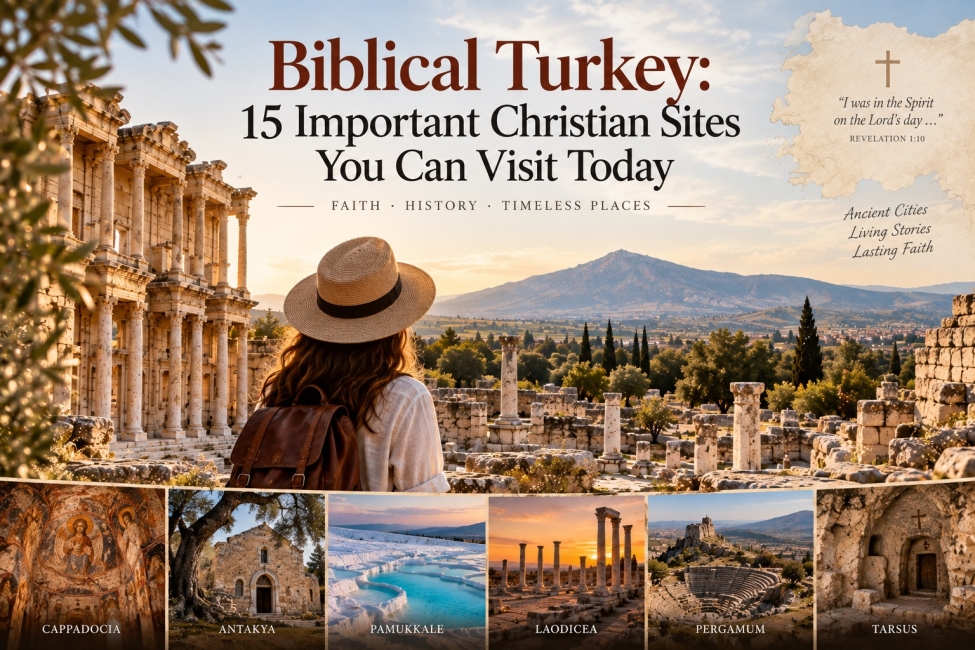
Turkey is home to some of the most important Christian heritage sites in the world.
Long before the modern Republic of Turkey existed, Anatolia was a major center of the ancient Mediterranean world. It was also one of the most important regions in the development and spread of early Christianity.
The New Testament mentions numerous cities and communities located in what is now modern Turkey. The Apostle Paul traveled through Anatolia, early Christian communities developed in major cities, and the Seven Churches of Revelation were established in western Asia Minor.
Today, travelers can visit ancient cities, churches, basilicas, pilgrimage sites, monasteries, caves, and archaeological remains connected with this long Christian history.
Some of these places are directly mentioned in the Bible. Others became important Christian pilgrimage destinations in later centuries. Together, they reveal the extraordinary depth of Christian history in Turkey.
Here are 15 important Christian sites in Turkey that you can visit today.
Location: Selçuk, İzmir
Ephesus is one of the most important archaeological and Christian heritage sites in Turkey.
Ancient Ephesus was one of the Seven Churches of Revelation and became an important center of early Christianity. The city is also closely associated with the Apostle Paul and the Christian community described in the New Testament.
Today, visitors can walk along ancient marble streets and explore the Library of Celsus, the Great Theatre, the Terrace Houses, and numerous other monuments.
The Christian history of Ephesus extends far beyond the period of Revelation. The city later became an important center of Christianity, and the Council of Ephesus was held here in 431 AD.
UNESCO recognizes Ephesus for its exceptional testimony to the Hellenistic, Roman, and early Christian periods. The site also includes Ayasuluk Hill and the House of the Virgin Mary. :contentReference[oaicite:1]{index=1}
For anyone interested in biblical Turkey, Ephesus is an essential destination.
Location: Near Selçuk, İzmir
On Mount Bülbüldağ, close to Ephesus, visitors can find one of Turkey's best-known Christian pilgrimage sites: the House of the Virgin Mary.
The small stone structure is traditionally identified as the place where Mary, the mother of Jesus, spent her final years.
This identification is based on Christian tradition rather than archaeological evidence proving that Mary lived at the site. Nevertheless, the location has become an important place of pilgrimage for Christians from around the world.
The site includes the small chapel, a spring, and the famous Wall of Wishes where visitors leave prayers and personal wishes.
UNESCO describes the House of the Virgin Mary as a major Christian pilgrimage destination that continues to attract visitors today.
Location: Selçuk, İzmir
Just below Selçuk Castle on Ayasuluk Hill stand the remains of the Basilica of St. John.
The basilica was built during the Byzantine period over the traditional burial site of John the Apostle.
According to Christian tradition, John spent his later years in the Ephesus region and was buried at this location.
The monumental basilica was constructed during the reign of Byzantine Emperor Justinian in the sixth century.
Today, visitors can walk through the remains of the basilica and see its columns, walls, baptistery, and other architectural features.
The Basilica of St. John is part of the Christian heritage of Ephesus recognized by UNESCO and remains an important destination for Christian travelers.
Location: Ephesus, İzmir
Another important Christian site in Ephesus is the ancient Church of Mary, also known as the Council Church.
The church is traditionally associated with the Council of Ephesus in 431 AD, one of the major councils in the history of Christianity.
The council addressed important theological questions concerning Mary and the nature of Christ. The historical event helped establish Ephesus as one of the important Christian centers of Late Antiquity.
The remains of the church include architectural elements and one of the well-preserved baptisteries associated with the ancient Christian community.
For travelers interested in the development of Christian doctrine and the history of the early Church, the Church of Mary provides an important connection between archaeology and Christian history.
Location: Near Ephesus, Selçuk
Close to Ephesus is another site associated with an ancient Christian tradition: the Cave of the Seven Sleepers.
According to the legend, seven young Christians took refuge in a cave while fleeing persecution during the Roman period. They were said to have fallen asleep and miraculously remained there for centuries.
The story became an important tradition in both Christianity and Islam.
The site near Ephesus contains archaeological remains associated with the later development of the tradition, including tombs and religious structures.
While the historical details of the legend cannot be independently established, the Cave of the Seven Sleepers remains an interesting part of the religious heritage surrounding Ephesus. GoTürkiye identifies the site as a place of significance in both Christian and Islamic traditions.
Location: İzmir
Ancient Smyrna is the biblical city associated with modern İzmir and one of the Seven Churches of Revelation.
The church of Smyrna received a message emphasizing faithfulness despite suffering and hardship.
Unlike Ephesus, where a vast ancient city remains visible, much of Smyrna has been incorporated into the modern city of İzmir.
The Agora of Smyrna is one of the most important archaeological remains that visitors can explore today.
For Christian travelers, Smyrna is also associated with the later history of Polycarp, an important early Christian bishop traditionally connected with the city.
Visiting Smyrna provides a fascinating contrast between an ancient Christian community and one of Turkey's largest modern cities.
Location: Bergama, İzmir
Ancient Pergamum was one of the most important political, cultural, and religious centers of Asia Minor.
The city is another member of the Seven Churches of Revelation and is addressed in Revelation 2:12–17.
The Acropolis of Pergamum rises dramatically above modern Bergama and contains extensive remains from the Hellenistic and Roman periods.
Visitors can explore the ancient theater, temples, monumental terraces, and other structures that reveal the city's importance.
Pergamum is especially significant for Christian travelers because Revelation describes the city as the place “where Satan's throne is.” The exact meaning of this expression has been interpreted in different ways, making the site an interesting place to explore the relationship between Christianity and the religious environment of ancient Asia Minor.
Location: Akhisar, Manisa
Ancient Thyatira is located beneath and around the modern city of Akhisar.
It was one of the Seven Churches of Revelation and received a detailed message in Revelation 2:18–29.
The church was praised for its love, faith, service, and perseverance but was also warned about teachings associated with a woman called Jezebel.
Thyatira was known for trade and craftsmanship, making its commercial character an important part of the historical background to the biblical message.
The city also has a New Testament connection through Lydia of Thyatira, mentioned in Acts 16. Lydia was a seller of purple cloth who encountered Paul in Philippi.
Although the visible archaeological remains of Thyatira are more limited than those of Ephesus or Pergamum, its biblical significance makes Akhisar an important stop on a Christian pilgrimage through Turkey.
Location: Sart, near Salihli, Manisa
Sardis was the ancient capital of Lydia and later became an important Roman city.
It is also one of the Seven Churches of Revelation.
The church of Sardis received the famous warning:
“Wake up!”
Today, the archaeological site contains impressive remains from different periods of the city's history, including Roman structures and the ancient synagogue.
Sardis offers an especially interesting combination of biblical history and archaeology because the city's impressive political and economic past provides the backdrop for a message focused on spiritual awareness and renewal.
The archaeological site of Sardis and the Lydian Tumuli of Bin Tepe were added to the UNESCO World Heritage List in 2025, further highlighting the importance of the ancient city.
Location: Alaşehir, Manisa
Ancient Philadelphia corresponds to modern Alaşehir.
The city was one of the Seven Churches of Revelation and received one of the most encouraging messages in the Book of Revelation.
Revelation describes an “open door that no one can shut” and praises the church for remaining faithful despite having little strength.
Much of ancient Philadelphia is beneath the modern city, so the visible remains are more limited than at Ephesus, Pergamum, or Sardis.
Nevertheless, Philadelphia remains an important destination for travelers following the biblical route through western Turkey.
Location: Near Denizli
Laodicea is the final church in the traditional sequence of the Seven Churches of Revelation.
The ancient city was a prosperous center in the Lycus Valley and became an important Roman settlement.
Its message in Revelation is famous for the image of being “lukewarm”.
Today, visitors can explore extensive archaeological remains, including monumental streets, theaters, churches, and other structures.
Laodicea is also close to Hierapolis and Pamukkale, making it possible to combine biblical history with one of Turkey's most famous natural and archaeological landscapes.
Hierapolis-Pamukkale is included on the UNESCO World Heritage List, while Laodicea itself forms an important part of the wider archaeological landscape of the region.
Location: Antakya, Hatay
Moving beyond the Seven Churches, one of the most important early Christian sites in southern Turkey is St. Peter's Cave Church in Antakya.
Antioch was one of the major centers of early Christianity and is closely associated with the missionary activity of the Apostle Paul and the early Christian community.
The cave is traditionally associated with Peter and is regarded as one of the earliest Christian places of worship in the city.
The site demonstrates that the Christian story of Anatolia extends far beyond the Seven Churches of Revelation.
For travelers interested in the earliest decades of Christianity, Antioch provides an important additional chapter in the story.
Location: Tarsus, Mersin
Tarsus is traditionally recognized as the birthplace of the Apostle Paul.
The ancient city was an important center of the eastern Mediterranean and played a significant role in the cultural world of the Roman period.
Today, visitors can explore sites associated with Paul's memory, including St. Paul's Well and the historic area traditionally connected with his birthplace.
For Christian pilgrims, Tarsus provides a direct connection with one of the most influential figures in the spread of Christianity throughout the Roman world.
Location: Yalvaç, Isparta
Pisidian Antioch is another important biblical site associated with the missionary journeys of the Apostle Paul.
The city appears in the Book of Acts in accounts describing Paul's preaching in the region.
The archaeological site contains remains of the ancient settlement and provides an opportunity to explore the environment in which Paul and other early Christian missionaries traveled and preached.
For travelers interested in the journeys of Paul, Pisidian Antioch can be an important addition to a Christian pilgrimage through Turkey.
Location: Cappadocia
The final destination on this list takes us much further east into central Anatolia.
The Göreme Open Air Museum is one of Turkey's most extraordinary Christian heritage sites.
Rather than an ancient city connected directly with the New Testament, Göreme represents the later development of Christian monastic and artistic traditions in Cappadocia.
The soft volcanic rock of Cappadocia was carved into churches, chapels, monasteries, and living spaces. Many of the churches preserve remarkable frescoes depicting scenes from the Bible and the life of Christ.
The complex is part of the UNESCO-listed Göreme National Park and the Rock Sites of Cappadocia.
Among the best-known churches are the Dark Church, Tokalı Church, Apple Church, Snake Church, and Sandals Church.
GoTürkiye describes Göreme as an important center of early Christian heritage, with numerous rock-cut churches and frescoes surviving today.
Turkey offers one of the most remarkable Christian heritage journeys in the Mediterranean. From the churches addressed in the Book of Revelation to ancient pilgrimage sites, early Christian communities, and places associated with the lives of biblical figures, the country brings together different chapters of Christian history across a surprisingly compact geography.
For travelers planning a Christian pilgrimage to Turkey, the most important question is not simply where to go, but how to connect these sites into a meaningful journey.
Your ideal itinerary depends on how much time you have and whether your main interest is the Seven Churches of Revelation or a broader exploration of Christianity in ancient Turkey.
If your main goal is to visit the seven churches mentioned in Revelation, a focused itinerary through western Turkey is the most practical choice.
The route connects:
These ancient communities are spread across modern-day İzmir, Manisa and Denizli provinces. A private 3-day Seven Churches of Revelation tour can be a practical option for travelers who want to focus specifically on the biblical churches while also seeing their archaeological surroundings.
With more time, you can expand beyond the Seven Churches and include places connected with early Christianity and later Christian traditions.
An extended journey can combine:
This type of itinerary allows travelers to move beyond the specific churches of Revelation and explore Christianity across different periods of Anatolian history.
For travelers who want a more comprehensive experience, our 8-day Seven Churches of Revelation tour combines the biblical sites with Istanbul, Ephesus, Pamukkale and other important destinations.
The answer depends on how deeply you want to explore each location.
| Trip Length | Best For |
|---|---|
| 2–3 days | A focused Seven Churches of Revelation journey |
| 4–6 days | Seven Churches plus Ephesus, Pamukkale and additional Christian sites |
| 7–10 days | A broader Christian heritage journey through western and central Turkey |
| 10+ days | A more extensive biblical and early Christian itinerary including southern and central Anatolia |
A shorter journey allows you to concentrate on the most important locations, while a longer itinerary gives you more time to understand the historical context of each site.
Spring and autumn are generally comfortable seasons for exploring archaeological sites in Turkey. Temperatures are usually more pleasant for walking, particularly at large open-air sites such as Ephesus, Sardis, Pergamum and Laodicea.
Summer can also be an excellent time to travel, but many archaeological sites become very hot during the middle of the day. Early morning visits can make a significant difference.
Winter offers quieter conditions at many destinations, although weather and shorter daylight hours should be considered when planning a multi-site itinerary.
Both approaches can work well, depending on your travel style.
Independent travel gives you greater flexibility with accommodation, transportation and the amount of time you spend at each site. However, some of the biblical and archaeological connections can be difficult to understand without historical context.
A private guided journey can make it easier to connect the archaeological remains with the biblical texts and historical events. A licensed guide can also help explain the different interpretations surrounding sites whose Christian associations are based on tradition rather than definitive archaeological evidence.
For a pilgrimage-style journey, this context can be particularly valuable. Standing among ancient ruins is one experience. Understanding who lived there, what happened there and why the location became important is another.
If your journey is focused on the Seven Churches, reading the relevant biblical passages before traveling can add another layer to the experience.
Start with Revelation chapters 1–3, which contain the messages addressed to the seven churches.
You can also read relevant passages from Acts to understand the spread of Christianity through Anatolia and the wider eastern Mediterranean world.
Reading these passages before arriving at Ephesus, Pergamum, Smyrna or the other ancient cities can help transform the journey from a simple archaeological tour into a historical and biblical exploration.
Many of Turkey's ancient Christian heritage sites involve substantial walking over uneven stone surfaces. Comfortable shoes are essential, especially when visiting several archaeological sites in the same day.
Several important sites are large open-air archaeological areas with limited shade. Carrying water is especially important during warmer months.
Ephesus deserves more than a quick visit. The ancient city contains monumental architecture, religious structures, streets, public buildings and remains connected with its importance as an early Christian center.
If your itinerary includes Ephesus, consider allowing additional time for the House of the Virgin Mary and the Basilica of St. John as well.
Some places on a Christian heritage itinerary are archaeological sites, while others continue to have religious significance today. Visitors should approach active pilgrimage sites respectfully and follow local visitor rules.
One of the most interesting aspects of Christian travel in Turkey is the relationship between historical evidence, archaeology and religious tradition.
For example, the House of the Virgin Mary near Ephesus is traditionally identified as a place where Mary spent her final years. The site has become an important pilgrimage destination, but the identification is based on Christian tradition rather than archaeological proof that definitively establishes Mary's residence there.
The same distinction is useful when visiting other traditionally associated locations. Understanding what is documented, what is archaeologically established and what belongs to longstanding religious tradition allows travelers to appreciate these places without confusing different types of historical evidence.
Perhaps the most fascinating aspect of traveling through Biblical Turkey is that the journey does not belong to a single historical period.
At Ephesus, you encounter the world of the early Christian communities alongside the remains of one of the ancient Mediterranean's major cities.
At Cappadocia, the experience changes completely. Rock-cut churches and monastic landscapes reveal later chapters of Christian history.
In places such as Tarsus, Pisidian Antioch and Antakya, travelers encounter locations associated with the expansion of Christianity throughout Anatolia and the eastern Mediterranean.
Together, these destinations show that Christianity in ancient Anatolia was not limited to one city or one generation. It developed across centuries, regions and communities.
The seven locations mentioned in Revelation correspond to ancient cities in modern Turkey. Their original Christian communities no longer exist in the same form, although the archaeological remains and historical locations can still be visited.
Yes. A carefully planned private itinerary can connect all seven locations in approximately three days. Because the sites are spread across western Turkey, the journey involves significant driving between locations.
Yes. Ephesus is one of the seven churches addressed in the Book of Revelation and is also one of the most important archaeological and early Christian sites in Turkey.
The site is traditionally identified as Mary's final residence, but this identification is based on Christian tradition rather than definitive archaeological evidence.
Yes. Many travelers visit the sites for religious, historical, archaeological and spiritual reasons. Turkey offers a wide range of destinations connected with the history of early Christianity.
A journey through Biblical Turkey is more than a collection of archaeological stops. It is an opportunity to walk through landscapes where ancient communities lived, worshipped, traded and communicated across the Roman world.
From the messages to the Seven Churches of Revelation to the traditions surrounding Mary, Paul and other early Christian figures, these places connect the biblical world with the physical landscapes of modern Turkey.
Whether you have three days for the Seven Churches or more than a week for a broader Christian heritage journey, Turkey offers an extraordinary opportunity to explore these stories where history and tradition meet.
Ready to explore Biblical Turkey? Discover our 3-day Seven Churches of Revelation itinerary or explore the 8-day Seven Churches of Revelation journey for a more extensive experience.

I graduated from Istanbul University with a degree in Radio, Television, and Cinema. During my academic journey, I focused on storytelling, visual communication, and cultural content creation, while my personal interests led me toward exploration and discovery.
Traveling, discovering new places, and experiencing different cultures are at the heart of my life. My strong interest in mythology allows me to see destinations not only as physical locations but as narratives shaped by history and meaning. My passion for reading continuously enriches and deepens this perspective.
I truly enjoy meeting new people and learning about diverse ways of life. With this mindset, I aim to share my experiences in a sincere, clear, and engaging way.
I love following the traces of stories wherever I go.
Disclosure Notice
By filling out this form, you agree that the personal data you provide to us will be processed in accordance with the Personal Data Protection Law No. 6698 and related legislation.
Your personal data will be processed solely for responding to your application, evaluating your requests, and fulfilling legal obligations; it will not be shared with third parties.
For detailed information, you can review our Privacy Policy.
By submitting the form, you acknowledge and consent to the processing of your personal data for the purposes specified above.

