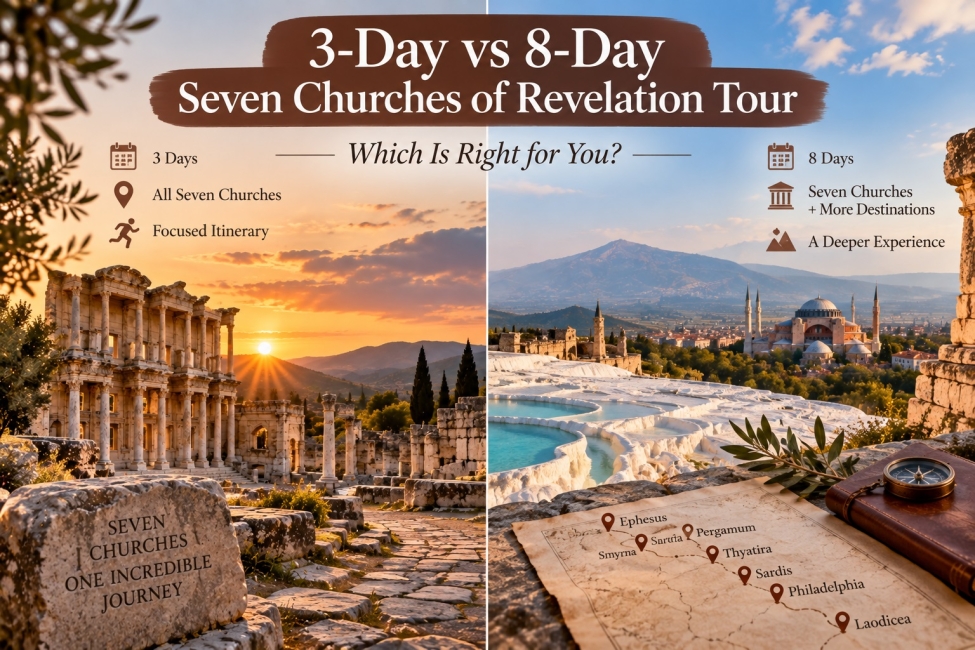
Following the Seven Churches of Revelation in Turkey is a unique journey through the biblical and historical landscape of western Anatolia. But once you decide to make the trip, another important question comes up: How many days should you spend?
A focused 3-Day Seven Churches of Revelation Tour and a longer 8-Day Seven Churches of Revelation Tour can both take you to the seven biblical locations, but the experience can be quite different.
The shorter itinerary focuses primarily on the Seven Churches themselves. The longer journey gives you more time for the biblical sites while also allowing you to experience additional historical and cultural destinations in Turkey.
So which option should you choose?
There is no single answer. The right itinerary depends on your available vacation time, travel style, interest in archaeology, desired pace, and whether the Seven Churches are the main purpose of your trip or part of a wider Turkey experience.
In this guide, we compare the two approaches so you can understand what each type of journey offers.
The Seven Churches of Revelation were Christian communities located in the ancient Roman province of Asia. They are named in the opening chapters of the Book of Revelation:
All seven ancient locations are in modern-day Turkey.
For Christians interested in biblical history, visiting these places provides an opportunity to connect the text of Revelation with the physical landscape of western Anatolia.
However, the seven locations are spread across a considerable area. This means that the amount of time available can significantly affect how the journey feels.
| Feature | 3-Day Tour | 8-Day Tour |
|---|---|---|
| Main focus | Seven Churches | Seven Churches + wider Turkey experience |
| Duration | 3 days | 8 days |
| Travel pace | More concentrated | More extended |
| Archaeological exploration | Focused | More time available |
| Additional destinations | Limited | More extensive |
| Best suited to | Travelers with limited time | Travelers wanting a broader itinerary |
A three-day itinerary is designed for travelers who want to concentrate on the biblical route without dedicating an entire week to the journey.
The primary objective is to visit all seven locations efficiently while making the most of the available time.
Because the churches are spread across western Turkey, the itinerary involves driving between several destinations. Some days can therefore include significant travel time.
The advantage is that you can experience the complete Seven Churches route within a relatively short period.
This can be particularly useful for travelers who are already visiting Turkey and want to add a dedicated biblical journey to their existing itinerary.
A focused itinerary can take you through the principal locations associated with:
You can explore the major archaeological remains, learn about the biblical messages addressed to each church, and travel through the landscapes of western Anatolia where these early Christian communities existed.
The main difference is that the schedule is concentrated. There is less opportunity to add numerous side trips or spend an entire day at individual destinations.
A shorter Seven Churches journey can work well for travelers who:
For these travelers, a focused route can provide an efficient introduction to the Seven Churches and their historical context.
Apasas Travel offers a dedicated Seven Churches of Revelation Tour for travelers looking for this type of focused experience.
An eight-day itinerary approaches the journey differently.
Instead of treating the Seven Churches as the entire trip, the longer itinerary allows them to become part of a broader exploration of Turkey.
This means there is more time to experience archaeological sites, historical destinations, local culture, and some of the country's other major attractions.
The longer duration can also make the journey feel less concentrated because there is more flexibility in how the itinerary is structured.
For international travelers flying a long distance to Turkey specifically for a biblical heritage journey, an extended itinerary can also make sense because it combines the pilgrimage with a wider introduction to the country.
The longer journey can incorporate the Seven Churches together with destinations such as Istanbul, Ephesus, Pamukkale, and Hierapolis, depending on the specific itinerary.
This creates a broader historical experience.
You are not only visiting the seven locations mentioned in Revelation but also seeing some of the major cultural and archaeological highlights of Turkey.
For travelers interested in Christianity, ancient history, and Turkish culture at the same time, this can provide a more comprehensive travel experience.
You can explore the details of the 8-Day Seven Churches of Revelation Tour offered by Apasas Travel.
One of the most important differences is not simply the number of days but the pace of the journey.
With three days, the Seven Churches are the central objective. The itinerary needs to make efficient use of each day because the destinations are geographically spread out.
With eight days, there is more room to separate the archaeological visits from other sightseeing experiences.
This can be particularly valuable at major sites such as Ephesus and Pergamum, where travelers may want additional time to explore the ruins and understand their historical significance.
A longer itinerary can also provide more opportunities for breaks, local experiences, and sightseeing beyond the biblical route.
A dedicated three-day Seven Churches itinerary can be structured around all seven biblical locations.
The important point is that “visiting” each church does not mean spending exactly the same amount of time at every location.
The archaeological remains differ considerably from site to site.
Ephesus and Pergamum, for example, contain extensive archaeological remains, while much of ancient Thyatira and Philadelphia is incorporated into or located beneath modern settlements.
Consequently, the amount of time spent at each location can vary according to what remains visible and what travelers want to explore.
The Seven Churches were located in cities with very different histories and physical environments.
Ephesus was a major ancient city with extensive monumental remains.
Pergamum features a dramatic acropolis and a large archaeological landscape.
Sardis preserves important remains from different periods of the city's history.
By contrast, Thyatira and Philadelphia have fewer visible remains because modern settlements developed over the ancient cities.
This is why a Seven Churches itinerary should not be measured simply by the number of sites visited.
The historical and archaeological context of each location is different.
The main addition is time.
More time means more opportunity to explore beyond the essential biblical stops.
Depending on the itinerary, travelers can combine the Seven Churches with major destinations and archaeological sites that would be difficult to include comfortably in a tightly scheduled three-day journey.
The eight-day format can therefore be useful for visitors who see their trip not only as a pilgrimage but also as a broader cultural journey through Turkey.
Both itineraries can be centered on the biblical significance of the Seven Churches.
The distinction is primarily one of scope and duration, rather than whether one itinerary is biblical and the other is not.
A three-day journey places the Seven Churches at the center of the entire experience.
An eight-day journey gives the Seven Churches more space within a wider Turkey itinerary.
If your primary objective is to visit the seven biblical locations in a limited amount of time, the focused option provides a direct route.
If you want to combine the biblical journey with additional historical and cultural experiences, the extended itinerary provides more room to do so.
Travel time is an important consideration when planning a Seven Churches journey.
The seven ancient cities are spread across western Turkey, so the route involves several road journeys between archaeological sites. In a three-day itinerary, these transfers naturally take up a larger proportion of the available time.
An eight-day itinerary gives the journey more breathing room. There is greater flexibility to divide the route into manageable sections and include additional destinations along the way.
This difference can be especially important for travelers who prefer not to spend long portions of their vacation on the road.
Both itineraries can include the principal archaeological sites, but the available time is different.
A three-day journey prioritizes the essential locations. At larger sites, travelers should expect to spend several hours walking and exploring before continuing to the next destination.
An eight-day itinerary allows more flexibility around the archaeological schedule. You can spend additional time at major sites and combine the Seven Churches with other historical attractions without making every day exclusively about driving and site visits.
For travelers with a strong interest in archaeology, this additional flexibility can be an important consideration.
One of the main distinctions between the two itineraries is the opportunity to see destinations beyond the Seven Churches.
Depending on the itinerary, an extended journey can include places such as:
This means the eight-day option can function as both a Seven Churches pilgrimage and a wider Turkey itinerary.
The focused three-day format offers several practical characteristics:
The trade-off is that the schedule is naturally more concentrated, with less room for extensive side trips.
The longer format offers a different set of possibilities:
The obvious consideration is that the trip requires a significantly larger time commitment.
The choice of itinerary can also depend on the physical pace that works best for your group.
Both options involve walking through archaeological sites, and some locations have uneven surfaces, stairs, or exposed areas.
A three-day itinerary can mean more concentrated travel between locations.
An eight-day itinerary provides more opportunities to distribute sightseeing and travel across additional days.
Families and groups with travelers who prefer a slower pace may therefore want to consider how much time they would like to spend on the road and how much time they want available for rest.
The Seven Churches route is suitable for different types of Christian travelers, including individual pilgrims, couples, families, church groups, Bible study groups, and travelers interested in early Christian history.
For a group whose primary objective is specifically to study the Seven Churches, a focused itinerary can keep attention on the biblical locations and their messages in Revelation.
For groups traveling to Turkey for the first time, a longer itinerary can provide an opportunity to combine the biblical journey with a broader introduction to the country's history and culture.
A private tour also allows the itinerary to be discussed and adjusted around the interests of the group.
Yes. This is one of the main reasons some travelers choose a longer itinerary.
The Seven Churches are located in a region containing many other important historical and cultural destinations.
For example, Ephesus can be combined with the wider archaeological and Christian heritage of the Selçuk area, while Laodicea is located close to Pamukkale and Hierapolis.
An extended itinerary can therefore connect biblical history with the wider history of ancient Anatolia.
Rather than asking which duration is universally better, consider what you want from the journey.
| If Your Priority Is... | Consider |
|---|---|
| Visiting all seven biblical locations in a short period | 3-Day Tour |
| Keeping the Seven Churches as the main focus | 3-Day Tour |
| Combining the Seven Churches with other Turkey highlights | 8-Day Tour |
| Having more time for additional sightseeing | 8-Day Tour |
| Fitting the pilgrimage into a short vacation | 3-Day Tour |
| Making the journey part of a longer Turkey holiday | 8-Day Tour |
This comparison is about itinerary structure rather than one option being universally suitable for every traveler.
Before choosing an itinerary, consider these practical questions:
Answering these questions will make it easier to select the itinerary structure that fits your trip.
If you want a focused journey through the seven biblical locations, you can explore Apasas Travel's Seven Churches of Revelation Tour.
This option is centered on the Seven Churches and is designed for travelers who want to explore the biblical route through western Turkey within a shorter itinerary.
If you have more time and want to combine the Seven Churches with other important destinations, take a look at the 8-Day Seven Churches of Revelation Tour.
The longer itinerary provides additional time for destinations beyond the seven biblical cities and can turn the pilgrimage into a broader Turkey travel experience.
Yes. A dedicated itinerary can be organized around all seven biblical locations within three days. Because the sites are geographically spread out, the schedule is concentrated and includes travel between several destinations.
Eight days provides enough time to visit the Seven Churches while also allowing an itinerary to incorporate additional historical and cultural destinations in Turkey.
Private itineraries are available, allowing the route and experience to be organized around the interests and schedule of your group.
Ephesus and Pergamum are among the most extensive and visually impressive archaeological sites on the route. Sardis also contains substantial remains. Thyatira and Philadelphia have more limited visible remains because modern settlements occupy much of the ancient cities.
Yes. Pamukkale and the ancient city of Hierapolis are located near Laodicea, making them natural additions to a longer Seven Churches itinerary.
Yes. An extended itinerary can combine Istanbul with the Seven Churches and other destinations in Turkey. The eight-day itinerary offered by Apasas Travel is designed as a broader journey rather than a Seven Churches-only trip.
The choice between a three-day and an eight-day Seven Churches journey ultimately depends on the kind of experience you want to create.
A 3-Day Seven Churches Tour keeps the biblical route at the center and allows travelers with limited time to visit all seven locations.
An 8-Day Seven Churches Tour provides a wider framework, giving travelers the opportunity to combine the biblical sites with other important destinations in Turkey and spend more time exploring the country's archaeological and cultural heritage.
Both approaches can take you through the remarkable landscape of the Seven Churches of Revelation.
The key difference is how much time you want to devote to the journey and whether you want your trip to focus almost entirely on the seven biblical cities or incorporate them into a broader exploration of Turkey.
If you are ready to start planning, explore the 3-Day Seven Churches of Revelation Tour or the 8-Day Seven Churches of Revelation Tour and choose the itinerary that matches your available time and travel plans.

I graduated from Istanbul University with a degree in Radio, Television, and Cinema. During my academic journey, I focused on storytelling, visual communication, and cultural content creation, while my personal interests led me toward exploration and discovery.
Traveling, discovering new places, and experiencing different cultures are at the heart of my life. My strong interest in mythology allows me to see destinations not only as physical locations but as narratives shaped by history and meaning. My passion for reading continuously enriches and deepens this perspective.
I truly enjoy meeting new people and learning about diverse ways of life. With this mindset, I aim to share my experiences in a sincere, clear, and engaging way.
I love following the traces of stories wherever I go.
Disclosure Notice
By filling out this form, you agree that the personal data you provide to us will be processed in accordance with the Personal Data Protection Law No. 6698 and related legislation.
Your personal data will be processed solely for responding to your application, evaluating your requests, and fulfilling legal obligations; it will not be shared with third parties.
For detailed information, you can review our Privacy Policy.
By submitting the form, you acknowledge and consent to the processing of your personal data for the purposes specified above.

