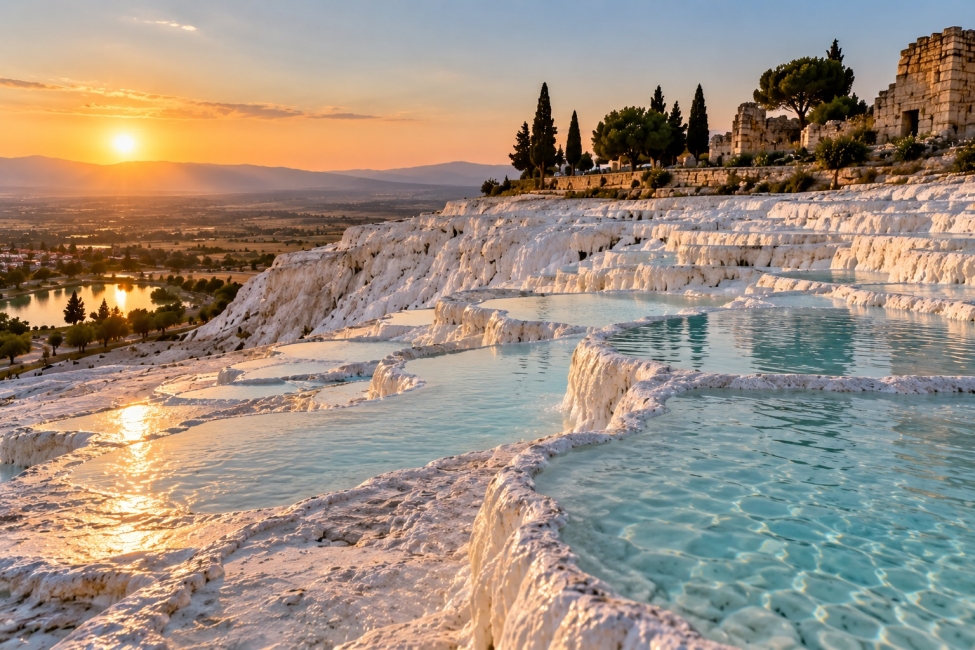
Pamukkale is one of the most recognizable natural landscapes in Türkiye. Its brilliant white travertine terraces, warm thermal water and ancient ruins of Hierapolis create a destination that looks almost unreal.
But there is one question almost every traveler asks before visiting: Can you still swim in the Pamukkale thermal pools?
The answer is more complicated than a simple yes or no.
You can experience the thermal water at Pamukkale, but visitors cannot freely swim across all of the famous white travertine terraces. Access is carefully controlled to protect the fragile calcium deposits that created the landscape. Certain areas are designated for entering the water, while other sections are protected and must not be entered.
There is also another option for travelers who want a proper thermal swimming experience: the historic Antique Pool, also known as Cleopatra's Pool, located within the Hierapolis archaeological site.
In this complete guide, we will explain how swimming at Pamukkale works today, what you can expect when visiting the white terraces, where you can enter the thermal water, what the rules mean, and how to make the most of your visit.
Pamukkale means "Cotton Castle" in Turkish, a name inspired by the extraordinary white appearance of its terraces.
The landscape was created by hot, mineral-rich thermal water flowing over the hillside. The water contains calcium carbonate, which is deposited as the water moves and cools. Over thousands of years, these deposits created terraces, pools, cascades and white mineral formations.
The result is a landscape that looks almost like a frozen waterfall covering the side of a mountain.
Pamukkale is not simply a natural attraction. The site forms part of the larger Hierapolis-Pamukkale UNESCO World Heritage Site, where the natural thermal landscape and the remains of an ancient Greco-Roman city exist together. UNESCO describes the site as an exceptional combination of natural formations and a historic thermal center.
The relationship between Pamukkale and thermal water is thousands of years old.
Ancient Hierapolis developed as a thermal center, taking advantage of the naturally heated mineral waters emerging from the landscape.
The city was established in the late 2nd century BC by the Attalid rulers of Pergamon. Over the following centuries, Hierapolis became an important Roman city and thermal destination.
Baths and pools were central to life in the ancient city. Thermal water was used not only for bathing but also as part of the wider social, cultural and religious life of Hierapolis.
UNESCO describes Hierapolis as an exceptional example of a Greco-Roman thermal installation established within an extraordinary natural landscape. The ancient city included large thermal basins and swimming pools as part of its thermal facilities.
Yes, but not everywhere.
This is the most important thing to understand before visiting.
The famous white terraces are protected because they are made from delicate calcium carbonate deposits. Uncontrolled access can affect their surface, color and water flow.
For this reason, visitors cannot simply choose any white pool they see and jump into the water.
Access to the travertines is controlled, and there are designated areas where visitors can experience the thermal water. Other sections are closed for conservation.
This means that photographs showing people sitting in or swimming across large numbers of white pools do not necessarily represent what you will experience during your visit.
The white travertines are not ordinary rock formations. Their appearance is the result of an ongoing geological process involving thermal water and mineral deposits.
Every visitor who walks across the surface potentially affects this delicate environment.
Overcrowding, uncontrolled movement, footwear and inappropriate use of the pools can contribute to physical damage or changes in the appearance of the formations.
UNESCO has specifically identified visitor pressure as an important management issue for Hierapolis-Pamukkale. Its current World Heritage description notes that visitor access to the travertine terraces is restricted to help sustain water flow and maintain the color and structure of the formations.
In other words, the restrictions are part of the effort to ensure that the white landscape remains available for future generations.
Visitors can experience the travertines through designated visitor routes, but access is controlled rather than unrestricted.
Where visitors are permitted to enter the water, the experience is generally more like wading through shallow thermal pools than swimming laps in a conventional pool.
The shallow water, white mineral surface and surrounding landscape create the distinctive Pamukkale experience.
You should always follow the current route, barriers and instructions provided at the site rather than assuming that every visible pool is accessible.
If you have seen photographs of people walking through Pamukkale, you may have noticed that they are barefoot.
There is a very good reason for this.
Footwear can damage the delicate surface of the travertines and can also introduce dirt and other materials onto the white mineral formations.
Visitors therefore need to remove their shoes when entering the designated travertine area.
It is a good idea to bring a small bag where you can safely carry your shoes while walking through the water.
Walking across the travertines is not necessarily difficult, but it requires care.
The surface can be uneven, and wet areas can be slippery. The mineral formations are also naturally irregular, so this is not the same experience as walking across a smooth swimming pool floor.
Take your time and avoid rushing through the water.
Comfortable shoes are useful for the archaeological areas of Hierapolis, but they need to be removed when you enter the designated travertine sections.
No.
This is another common misconception created by photographs of Pamukkale.
The amount of water visible across the terraces can change, and different sections may have different levels of water at different times.
The thermal water is managed as part of the conservation of the site. Some areas may be supplied with water while others remain dry.
This means that the Pamukkale you see in one photograph may look different from the Pamukkale you see during your own visit.
The constantly changing relationship between water, minerals and sunlight is also part of what makes the landscape so fascinating.
The brilliant white color of Pamukkale comes from calcium carbonate deposits.
When fresh mineral deposits accumulate on the surface, they can create an intensely white appearance. Water flow, sunlight, weather and the condition of individual terraces can all affect how the landscape looks.
Some areas may appear brilliantly white, while other sections can have a slightly different tone depending on their condition and water coverage.
This is why photographs taken at different times of year can look surprisingly different even when they show the same location.
The thermal waters of the area are naturally warm, but the temperature can vary depending on the specific spring, pool and conditions.
UNESCO's documentation of the site describes the thermal spring system and notes an average water temperature of around 35°C in the springs associated with the property.
However, visitors should not assume that every pool or water section will have exactly the same temperature.
If your main goal is to swim in thermal water at Pamukkale, you should know about the Antique Pool.
Often called Cleopatra's Pool, the Antique Pool is a separate thermal pool within the Hierapolis archaeological area.
Unlike the shallow travertine terraces, the Antique Pool is designed as a bathing area and provides a more conventional swimming experience.
The pool is surrounded by ancient remains, and marble architectural fragments can be seen beneath the thermal water.
This creates an unusual experience: you are swimming in warm mineral water while surrounded by archaeological remains from the ancient thermal center.
No.
This distinction is important.
The Pamukkale travertines are natural mineral terraces formed by thermal water.
The Antique Pool is a separate historic bathing pool within Hierapolis.
Both are connected to the thermal water system, but they provide very different visitor experiences.
| Feature | Pamukkale Travertines | Antique Pool |
|---|---|---|
| Type | Natural travertine formations | Historic thermal bathing pool |
| Water experience | Shallow water in designated areas | Swimming and bathing |
| Surface | Mineral travertine | Pool with ancient architectural fragments |
| Purpose today | Natural and archaeological experience | Thermal bathing experience |
If swimming is an important part of your Pamukkale experience, the Antique Pool can add another dimension to your visit.
The experience is different from standing in the shallow travertine water. You are surrounded by ancient architecture while enjoying naturally warm thermal water.
It also helps visitors understand why Hierapolis developed as a major thermal destination in antiquity.
Instead of thinking of the travertines and the Antique Pool as competing attractions, consider them two different parts of the same thermal landscape.
The Antique Pool is particularly unusual because archaeological fragments can be seen beneath the water.
These remains are connected to the ancient structures that once surrounded the thermal area.
This is one of the features that makes the pool different from a modern spa. The setting combines thermal bathing with the archaeological atmosphere of Hierapolis.
One of the biggest mistakes visitors can make is treating Pamukkale as only a natural attraction.
The white travertines are the most recognizable part of the destination, but the archaeological city of Hierapolis is equally important.
Once you have explored the terraces, allow time to walk through the ancient city.
The theater is one of the most impressive surviving structures at Hierapolis.
Its monumental architecture provides a sense of the scale and importance of the ancient city.
Hierapolis has one of the most extensive ancient necropolises in the region.
Tombs, sarcophagi and monumental funerary structures stretch across a large area outside the main city.
The monumental gate provides an impressive entrance to the ancient urban landscape and forms part of the Roman remains of Hierapolis.
The religious area of Hierapolis is associated with ancient cult practices and the famous Ploutonion, an important sacred location within the ancient city.
Hierapolis also became an important Christian center during late antiquity. UNESCO identifies the city as the place traditionally associated with the martyrdom of St. Philip and notes the Martyrium constructed in the 5th century.
The real strength of Pamukkale is the combination of natural and cultural heritage.
You can begin your day surrounded by brilliant white mineral terraces, then walk through the remains of a Greco-Roman city, visit ancient baths and theaters, and finish with a thermal bathing experience.
Very few destinations combine such a dramatic natural landscape with such a substantial archaeological site.
If you want to see only the travertines, you can spend a relatively short amount of time exploring the area.
However, if you want to understand the destination properly, plan several hours.
A more complete visit can include:
This approach turns a quick photo stop into a much more meaningful historical and natural experience.
If you plan to experience the water, packing correctly will make your visit much easier.
Remember that Pamukkale involves much more walking than simply visiting a swimming pool, so comfortable footwear is important for the archaeological areas.
Absolutely.
The attraction of Pamukkale is not simply the opportunity to swim.
The white travertines themselves are the result of a remarkable geological process, while Hierapolis provides thousands of years of cultural and archaeological history.
Even if some pools are closed or dry during your visit, the landscape remains extraordinary.
The experience is about seeing the relationship between thermal water, geology, ancient architecture and the history of a city that developed around its hot springs.
If you are wondering whether you can still swim in the white pools of Pamukkale, the most accurate answer is: you can experience the thermal water in designated areas, but you cannot freely swim throughout the entire travertine landscape.
The restrictions exist because Pamukkale is a fragile natural and archaeological heritage site.
For travelers who want to experience the water, the designated travertine areas provide the iconic Pamukkale experience, while the Antique Pool offers a more traditional thermal bathing experience within the ancient city.
And the best way to experience Pamukkale is to combine the water with the history of Hierapolis. Once you understand that the terraces are only one part of a much larger archaeological landscape, the destination becomes even more impressive.
Planning a visit to Pamukkale is relatively easy, but knowing what to expect before you arrive can make a big difference.
The most important thing is to remember that Pamukkale is both a natural heritage site and an archaeological site. You are not simply visiting a thermal spa.
You will be walking outdoors, exploring ancient ruins and experiencing a protected landscape where access to some areas is controlled.
Pamukkale can be visited throughout much of the year, but the experience changes with the seasons.
Spring offers comfortable conditions for walking around Hierapolis and the travertines. The surrounding landscape is greener, and temperatures are generally more pleasant for spending several hours outdoors.
Spring is a particularly good option if you want to combine Pamukkale with other archaeological destinations in western Türkiye.
Summer is the busiest season and brings long, sunny days.
However, the white travertines can become very bright under the strong sun, and walking across the open archaeological landscape can feel hot during the middle of the day.
If you visit during July or August, consider arriving earlier in the day or planning your visit around the cooler parts of the morning and late afternoon.
Autumn can provide a comfortable balance between warm weather and more manageable conditions for walking.
The softer light can also be excellent for photography, particularly later in the afternoon.
Winter offers a quieter atmosphere and a completely different visual character.
Cold or rainy weather can make outdoor exploration less comfortable, but the site can be particularly peaceful outside the main tourist season.
Early morning and late afternoon are often the most comfortable periods for exploring the site, especially during the warmer months.
Morning light can make the travertines appear especially bright and clean, while late afternoon creates softer shadows across the terraces and ancient ruins.
Visiting earlier also gives you more time to explore Hierapolis before the hottest part of the day.
Yes. Pamukkale is commonly visited as a day trip from several destinations in western Türkiye.
It can be incorporated into itineraries from places such as Selçuk, İzmir, Kuşadası and other Aegean destinations.
A day trip gives you enough time to experience the travertines and explore the main areas of Hierapolis, although travelers interested in archaeology may prefer to spend more time in the region.
This distinction is important when planning your expectations.
A modern thermal spa is designed primarily for bathing, relaxation and wellness.
Pamukkale is a protected natural and archaeological site.
Its thermal water is part of the geological process that created the travertines, while the ancient city of Hierapolis developed around the thermal springs.
You should therefore approach the destination as a combination of nature, archaeology and thermal heritage, rather than as a conventional spa resort.
Families can visit Pamukkale, but children should always be supervised closely around the water.
The travertine surfaces can be slippery and uneven, and access is restricted in certain areas.
Parents should follow all signs and visitor instructions and should not allow children to enter closed sections or climb on protected formations.
The Antique Pool may provide a different bathing environment, but families should check the current access conditions and requirements before planning to swim there.
The traditional visitor experience on the accessible travertines is barefoot.
Visitors should follow the current site rules rather than wearing footwear across protected mineral surfaces.
This is another reason why bringing a small bag for your shoes is useful.
Yes. If you plan to enter the water, bringing a small towel is practical.
A lightweight towel is particularly convenient because you may also be carrying your shoes and other personal belongings.
If you are traveling as part of a tour, check what is provided before packing unnecessary items.
Photography is one of the most popular activities at Pamukkale.
The contrast between white travertine, turquoise water and the surrounding landscape creates excellent opportunities for photographs.
However, visitors should prioritize the protection of the site over getting a particular photograph.
Do not cross barriers, enter closed areas or climb onto formations simply to reach a better viewpoint.
If you search for Pamukkale online, you may find photographs showing dramatically different amounts of water.
This can be confusing for first-time visitors.
The reason is that water distribution and access are managed across the site. Different terraces may receive water at different times, while other sections may be temporarily dry.
Weather, season, sunlight and conservation practices can also change the appearance of the landscape.
Therefore, it is better to think of Pamukkale as a living geological landscape rather than a fixed collection of identical pools.
The white surface is created by calcium carbonate deposits from the thermal water.
As the mineral-rich water flows over the terraces, deposits accumulate and gradually create the bright formations visible today.
The process is ongoing, but it is extremely slow from a human perspective.
This is why protecting the existing formations is so important.
Every generation of visitors sees only one moment in the much longer geological history of Pamukkale.
A visit to Pamukkale should ideally include both the natural terraces and the ancient city.
The relationship between the two is what makes the destination unique.
Hierapolis was built around the thermal springs, and the city's history is inseparable from the water.
Ancient residents and visitors came to the area because of the thermal springs, while the dramatic landscape became the setting for a large Greco-Roman city.
Today, visitors can follow the same basic relationship in reverse: explore the ancient city and then experience the thermal landscape that helped make Hierapolis important.
The ancient theater is one of the highlights of the archaeological site. Its monumental scale and surviving architectural decoration give visitors a strong impression of the city's importance during the Roman period.
The necropolis extends across a large area and contains numerous tombs and funerary monuments.
It demonstrates how important Hierapolis became as a regional settlement and thermal destination.
The monumental gate formed part of the entrance to the Roman city and provides an impressive introduction to the archaeological remains.
The thermal character of Hierapolis can be understood particularly well through its bathing architecture.
The city's ancient baths demonstrate how thermal water was integrated into Roman urban life.
Hierapolis later became an important Christian center. The Martyrium associated with St. Philip reflects the city's religious importance during late antiquity.
Although Pamukkale is often promoted primarily as a natural attraction, Hierapolis also has an important place in early Christian history.
UNESCO identifies Hierapolis as the place associated with the martyrdom of St. Philip and notes the construction of the Martyrium in the 5th century. The city also contained several churches and became an important religious center during the Eastern Roman period. :chatgpt-content-reference{index="6"}
This means that a visit to Pamukkale can be relevant not only to travelers interested in geology and ancient Roman history, but also to those exploring early Christian heritage in Türkiye.
Pamukkale is located in a region with many important archaeological and cultural attractions.
A wider itinerary can connect Pamukkale with Ephesus, Aphrodisias, Laodicea and other historical sites in western Türkiye.
For travelers based around Selçuk or Kuşadası, Pamukkale can be incorporated into a longer Aegean itinerary.
Our Pamukkale travertines guide provides another way to explore the destination and plan a visit focused on both the natural formations and ancient Hierapolis.
If this is your first visit, keep the following points in mind:
You can experience the thermal water in designated areas, but the white travertine terraces are not an unrestricted swimming area. Access is controlled to protect the mineral formations.
Visitors can enter designated shallow water areas, but not every white pool is accessible. The exact water coverage and accessible areas can vary, so visitors should follow the current site rules.
The Antique Pool, commonly known as Cleopatra's Pool, is the dedicated thermal bathing pool within the Hierapolis archaeological site. It provides a different experience from entering the shallow travertine terraces.
Yes, visitors entering the designated travertine areas need to remove their shoes. This helps protect the delicate mineral formations.
The water comes from natural thermal springs and is warm, although temperatures can vary depending on the specific spring and pool.
Absolutely. Swimming is only one part of the experience. The travertines, Hierapolis ruins, ancient theater, necropolis and religious monuments make the destination worthwhile even if you do not enter the water.
Several hours are recommended if you want to explore both the travertines and Hierapolis. Travelers interested in archaeology may want to allow even more time.
Yes, but children should be supervised carefully around the water and uneven surfaces. Families should follow all access restrictions and current visitor instructions.
Swimming at Pamukkale has changed considerably compared with the images many travelers have seen from previous decades.
Today, the focus is on balancing visitor access with the protection of an exceptionally fragile natural and archaeological landscape.
You can still experience the warm thermal water, but you should not expect to swim freely across every white terrace. Designated areas provide access to the water, while protected sections remain off-limits.
For travelers who want a more traditional swimming experience, the Antique Pool provides a separate thermal bathing environment within the ancient city of Hierapolis.
Most importantly, do not visit Pamukkale only to ask where you can swim.
Walk through the white terraces, explore Hierapolis, see the ancient theater, discover the necropolis and understand why people have been drawn to these thermal waters for thousands of years.
That combination of geology, thermal water, archaeology and history is what makes Pamukkale one of Türkiye's most remarkable destinations.
Ready to experience it for yourself? Explore our Pamukkale travertines guide and start planning your visit to the Cotton Castle and ancient Hierapolis.

I graduated from Istanbul University with a degree in Radio, Television, and Cinema. During my academic journey, I focused on storytelling, visual communication, and cultural content creation, while my personal interests led me toward exploration and discovery.
Traveling, discovering new places, and experiencing different cultures are at the heart of my life. My strong interest in mythology allows me to see destinations not only as physical locations but as narratives shaped by history and meaning. My passion for reading continuously enriches and deepens this perspective.
I truly enjoy meeting new people and learning about diverse ways of life. With this mindset, I aim to share my experiences in a sincere, clear, and engaging way.
I love following the traces of stories wherever I go.
Disclosure Notice
By filling out this form, you agree that the personal data you provide to us will be processed in accordance with the Personal Data Protection Law No. 6698 and related legislation.
Your personal data will be processed solely for responding to your application, evaluating your requests, and fulfilling legal obligations; it will not be shared with third parties.
For detailed information, you can review our Privacy Policy.
By submitting the form, you acknowledge and consent to the processing of your personal data for the purposes specified above.

