Almost everyone recognizes Artemis.
In Greek mythology, she is the young goddess of the hunt, usually shown carrying a bow, arrows, and accompanied by a deer.
Then visitors arrive in Ephesus…
And everything they thought they knew changes.
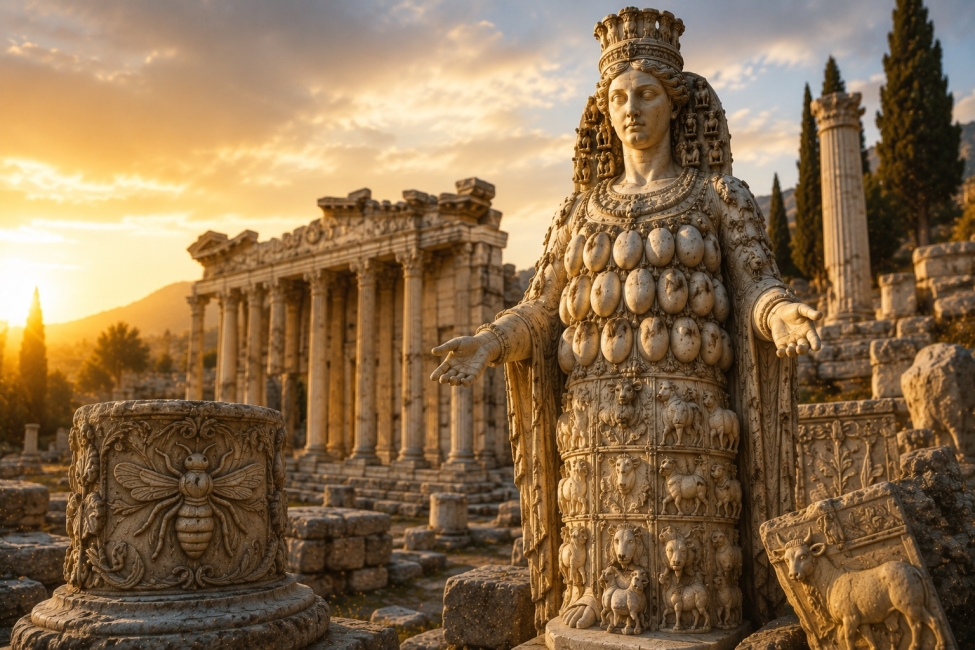
The famous Statue of Artemis of Ephesus looks nothing like the graceful huntress found in museums or mythology books.
Instead, she stands upright, covered with mysterious symbols, sacred animals, and rows of strange rounded objects across her chest.
For centuries, historians, archaeologists, and travelers have asked the same question:
Why does the Ephesian Artemis look so different?
The answer takes us far beyond Greek mythology and into one of the world's most fascinating religious traditions.
In classical Greek mythology, Artemis was the daughter of Zeus and Leto and the twin sister of Apollo.
She was the goddess of hunting, wilderness, wildlife, young women, and childbirth.
Artists almost always portrayed her as a beautiful young woman carrying a bow and quiver, often accompanied by deer or hunting dogs.
This image became famous throughout ancient Greece.
But Ephesus was different.
Long before Greek settlers arrived on the western coast of Anatolia, local people already worshipped an ancient mother goddess connected with fertility, nature, and prosperity.
Rather than replacing this older deity, the Greeks blended her traditions with those of Artemis.
The result was an entirely unique goddess found nowhere else in the ancient world.
The Ephesian Artemis wasn't simply one deity among many.
She was the identity of the city itself.
Her image appeared on coins, official seals, sculptures, jewelry, and public monuments.
Merchants prayed to her before long journeys.
Families sought her protection.
Women asked for safe childbirth.
Travelers crossed hundreds of kilometers to visit her magnificent temple.
The Temple of Artemis became one of the Seven Wonders of the Ancient World—not only because of its enormous size but because millions believed the goddess herself lived there.
If you'd like to learn how this extraordinary sanctuary disappeared, read our guide Why Was the Temple of Artemis Destroyed? The Rise and Fall of a Wonder.
This is often the first thing visitors notice.
The Ephesian Artemis carries no bow.
No arrows.
No hunting dogs.
She isn't shown running through forests or climbing mountains.
Instead, she stands completely still.
Her rigid posture represents permanence, stability, and divine protection.
Rather than emphasizing hunting, the Ephesian Artemis symbolizes abundance, fertility, prosperity, and the continuous cycle of life.
She became less of a huntress and more of a universal mother protecting both people and nature.
No feature of the statue has generated more debate.
Across the front of the goddess are dozens of smooth, rounded objects arranged in neat rows.
At first glance, many visitors assume they represent multiple breasts.
For centuries, this was the most widely accepted interpretation.
The image seemed to reinforce Artemis as a fertility goddess capable of nourishing all living things.
However, modern archaeologists are no longer certain.
Several fascinating theories compete to explain their true meaning.
The traditional interpretation suggests the rounded objects symbolize many breasts.
This would make Artemis the ultimate mother figure—capable of feeding and protecting all life.
For generations, guidebooks, museums, and history books accepted this explanation.
It remains one of the most recognizable interpretations today.
Many modern scholars now favor a different explanation.
They believe the objects may actually represent the preserved testicles of sacrificial bulls offered during religious ceremonies.
According to this theory, these sacred offerings symbolized fertility, strength, renewal, and the bond between humans and the divine.
If correct, the statue reflects ritual practices rather than anatomy.
This interpretation has gained considerable support among archaeologists in recent decades.
No one knows with complete certainty what the famous rounded ornaments on the Ephesian Artemis statue actually represent. More than two thousand years later, the mystery remains one of archaeology's most fascinating unsolved questions.
The mysteries of the Ephesian Artemis don't end here.
In the next section, we'll uncover the meaning of the bees, lions, deer, zodiac symbols, and other sacred animals carved onto her statue—and discover why she became one of the most powerful goddesses in the entire Roman Empire.
Not every expert agrees with the previous theories.
Some archaeologists believe the mysterious rounded objects may not represent parts of the body at all.
Instead, they could be decorative amber beads, precious ornaments, or ritual jewelry attached to the statue during religious ceremonies.
Ancient descriptions mention that cult statues were often richly decorated with gold, gemstones, fabrics, and ceremonial offerings.
If this theory is correct, the famous ornaments reflected wealth, devotion, and the generosity of Artemis' followers rather than fertility itself.
The famous chest ornaments are only part of the story.
Look closely and you'll discover an entire world of symbolism carved into the statue.
Every animal represented one of Artemis' divine powers.
The lions symbolize strength, royal authority, and the goddess' power over nature.
Although the Ephesian Artemis differs from the Greek huntress, deer still represent her ancient connection with wildlife and the natural world.
Bulls symbolize fertility, prosperity, agricultural abundance, and sacred sacrifice.
Perhaps the most famous symbol of Ephesus.
The bee represented Artemis herself, and even the priestesses serving her temple were known as Melissae, meaning "Bees."
Today, the bee remains one of the enduring symbols of the city.
When the Roman Empire took control of Ephesus, many local traditions disappeared.
Artemis was one of the remarkable exceptions.
The Romans admired her so much that they preserved her temple, sponsored festivals in her honor, and continued making offerings for centuries.
Pilgrims arrived from every corner of the empire, making Ephesus one of the most important religious destinations in the ancient Mediterranean.
At the height of its influence, the Temple of Artemis attracted visitors much like famous pilgrimage sites do today.
The original cult statue no longer survives.
However, visitors can still admire magnificent Roman copies that reveal how extraordinary the goddess once appeared.
The best place to see them is the Ephesus Museum in Selçuk, where two beautifully preserved statues of the Ephesian Artemis are displayed.
Although the Temple of Artemis is now represented by only a few remaining columns, standing there while viewing the museum statues helps visitors imagine the immense spiritual importance this sanctuary once held.
The Temple of Artemis was considered one of the Seven Wonders of the Ancient World for more than 500 years. Pilgrims traveled from across the Mediterranean not only to admire its architecture but to seek the protection and blessing of the goddess herself.
The Ephesian Artemis combined the Greek goddess with an older Anatolian mother goddess, creating a unique figure associated with fertility, prosperity, and protection.
Scholars still debate their meaning. They may represent multiple breasts, sacrificial bull testicles, or ceremonial ornaments. No single theory has been universally accepted.
The bee symbolized purity, fertility, and devotion. The priestesses serving Artemis were called Melissae, meaning "Bees."
Yes. The archaeological site is open to visitors in Selçuk, Türkiye. Although only a few columns remain, it is one of the most historically significant places in the ancient world.
Excellent Roman copies of the Ephesian Artemis are displayed in the Ephesus Museum in Selçuk.
Most visitors walk through Ephesus without realizing that one of history's greatest religious mysteries once stood just outside the ancient city.
Understanding the symbolism of Artemis transforms your visit from simply seeing ruins into uncovering the beliefs that shaped one of the Roman Empire's most important cities.
If you're planning to explore Ephesus, join one of our guided Ephesus Tours. Our expert local guides explain the fascinating myths, symbols, and stories hidden throughout the archaeological site, helping you see Ephesus through the eyes of the people who once worshipped its greatest goddess.
The Ephesian Artemis isn't mysterious because historians haven't found all the answers.
She's mysterious because she represents thousands of years of beliefs woven together into a single image.
Greek mythology.
Anatolian traditions.
Roman religion.
Ancient symbolism.
Every carved animal, every ornament, and every detail tells a story that has survived for more than two millennia.
The next time you see the Statue of Artemis of Ephesus, don't ask why she looks different.
Ask what story each symbol is trying to tell.

I graduated from Istanbul University with a degree in Radio, Television, and Cinema. During my academic journey, I focused on storytelling, visual communication, and cultural content creation, while my personal interests led me toward exploration and discovery.
Traveling, discovering new places, and experiencing different cultures are at the heart of my life. My strong interest in mythology allows me to see destinations not only as physical locations but as narratives shaped by history and meaning. My passion for reading continuously enriches and deepens this perspective.
I truly enjoy meeting new people and learning about diverse ways of life. With this mindset, I aim to share my experiences in a sincere, clear, and engaging way.
I love following the traces of stories wherever I go.
Disclosure Notice
By filling out this form, you agree that the personal data you provide to us will be processed in accordance with the Personal Data Protection Law No. 6698 and related legislation.
Your personal data will be processed solely for responding to your application, evaluating your requests, and fulfilling legal obligations; it will not be shared with third parties.
For detailed information, you can review our Privacy Policy.
By submitting the form, you acknowledge and consent to the processing of your personal data for the purposes specified above.

