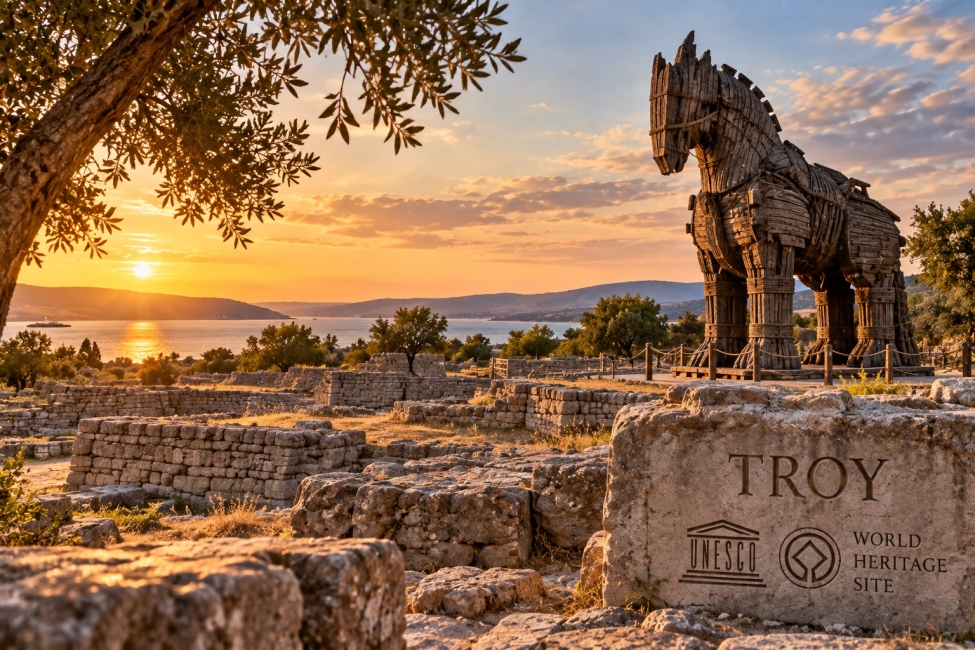
Few ancient cities have captured the imagination of the world quite like Troy. Immortalized by Homer's Iliad, associated with the legendary Trojan War and located on the historic landscape of northwestern Turkey, Troy has become much more than an archaeological site.
Today, the Archaeological Site of Troy is recognized as a UNESCO World Heritage Site, reflecting its extraordinary historical, archaeological and cultural importance.
Located near the Dardanelles in Çanakkale Province, Troy represents thousands of years of settlement and the meeting of different civilizations. Its importance comes not only from the legends surrounding the city, but also from the archaeological evidence revealing how communities lived, traded and interacted across Anatolia, the Aegean and the Balkans.
So why was Troy included on the UNESCO World Heritage List? What makes the site so important, and what can visitors actually see today?
This guide explores the history, archaeology and cultural significance of the Troy UNESCO World Heritage Site in Turkey.
Yes. The Archaeological Site of Troy was added to the UNESCO World Heritage List in 1998.
UNESCO recognizes Troy under three cultural criteria: Criterion (ii), Criterion (iii) and Criterion (vi). Together, these criteria reflect Troy's importance in documenting cultural connections between Anatolia, the Aegean and the Balkans, its long sequence of civilizations and its exceptional connection to major works of literature and the arts.
This makes Troy one of Turkey's most important archaeological destinations for understanding both ancient history and the cultural traditions that grew from it.
The ancient site of Troy is located at Hisarlık in Çanakkale Province, in northwestern Turkey.
The archaeological mound overlooks the surrounding plain near the Dardanelles, an important geographical passage connecting the Aegean and Black Sea regions.
This location is one of the reasons Troy became such an important settlement over the centuries. It stood at a crossroads where different regions, cultures and trade routes came into contact.
For modern travelers, Troy can also be combined with other major attractions in Çanakkale, including the Dardanelles and the Gallipoli historical landscape.
Troy is important for two closely connected reasons: its archaeological history and its literary legacy.
Archaeological research has revealed multiple layers of settlement at the site. Rather than representing one single city from one specific period, Troy contains evidence of communities that occupied the location over thousands of years.
At the same time, the legendary Troy described in Homer's Iliad has had an enormous influence on literature, art and popular culture.
This combination makes Troy unusual. Visitors are not simply exploring the remains of an ancient settlement; they are walking through a place that has continued to influence how people imagine the ancient world for more than two millennia.
Troy has a history stretching back approximately 4,000 years.
Archaeological evidence shows a long sequence of occupation at the site, with different settlements being constructed, modified and rebuilt over time.
UNESCO describes Troy as an archaeological site representing various civilizations over more than 4,000 years. The settlement sequence provides important evidence for understanding cultural development and interaction in the region.
This long history is one of the main reasons the site has such exceptional archaeological value.
One of the most fascinating aspects of visiting Troy is understanding that the ruins do not represent just one city.
Archaeologists have identified different layers of Troy, traditionally numbered from Troy I onward. Each layer represents a different phase in the history of the settlement.
Some periods are associated with the Bronze Age, while later layers reflect Greek and Roman occupation.
This layered history means that the site should be viewed as a continuously evolving settlement rather than a single frozen moment in time.
Several of Troy's archaeological layers are particularly important for understanding the development of the settlement.
Troy I represents one of the earliest known settlement phases at the site. The remains provide evidence of the prehistoric communities that established themselves at Hisarlık.
Troy II is associated with a substantial fortified settlement and is particularly important in archaeological discussions of the site's early Bronze Age development.
Defensive structures and architectural remains demonstrate that the settlement had developed considerably in complexity.
Troy VI is one of the layers most frequently discussed in connection with the legendary Troy of the Trojan War.
Its substantial fortifications and monumental remains have contributed significantly to debates about the relationship between the archaeological city and the traditions preserved in ancient literature.
However, it is important to distinguish archaeological evidence from literary tradition. The existence of the archaeological settlement is well established, while the precise historical relationship between Troy's archaeological layers and the events described by Homer remains a subject of scholarly discussion.
The name Troy is inseparable from Homer's Iliad.
The epic tells the story of the conflict between the Trojans and the Greek forces, including legendary figures such as Achilles and Hector.
Whether every event described in the poem should be interpreted as historical fact is a separate question. What is certain is that the story has had an extraordinary cultural impact.
UNESCO specifically recognizes Troy's influence on major literary works and the arts as part of the reason for its World Heritage status.
This is why a visit to Troy can feel different from visiting many other archaeological sites. The ruins are connected not only to physical remains, but also to stories that have been retold for generations.
The Trojan War occupies a unique space between mythology, literature and archaeology.
Ancient Greek literature describes a conflict in which Greek forces besieged Troy. The story includes famous episodes involving Achilles, Hector, Helen and the Trojan Horse.
Archaeology, meanwhile, provides evidence of multiple settlements, defensive walls, destruction layers and changing communities at Hisarlık.
These two perspectives should not automatically be treated as identical. Archaeology can tell us about buildings, settlements and material culture, while literary works preserve stories shaped by oral tradition, poetry and centuries of cultural memory.
The fascinating question is how these different strands of history became connected to create the Troy we know today.
The modern archaeological story of Troy is strongly associated with Heinrich Schliemann.
Schliemann began excavations at Hisarlık in the 19th century, believing that the location could reveal the historical Troy described in ancient literature.
His work attracted enormous international attention and helped transform Troy from a legendary name into a major archaeological destination.
However, archaeological research at the site did not end with Schliemann. Later generations of archaeologists significantly expanded and refined the understanding of Troy's complex settlement history.
Today, the site is understood through more than a century of continuing archaeological research rather than through Schliemann's excavations alone.
The UNESCO designation is based on more than the fame of the Trojan War.
Troy's World Heritage significance comes from several interconnected factors.
UNESCO inscribed Troy under criteria (ii), (iii) and (vi), specifically recognizing these cultural and historical dimensions.
One of the most important ideas behind the Troy UNESCO World Heritage designation is the site's role as a cultural bridge.
Troy's geographical position placed it between Anatolia, the Aegean, the Balkans and routes leading toward the Black Sea.
Over thousands of years, people moved through this wider region for trade, migration, warfare and cultural exchange.
The archaeological remains therefore tell a much larger story than the history of one ancient city. They help researchers understand how different parts of the ancient world interacted.
Visitors today can walk through the archaeological remains and explore different parts of the ancient settlement.
Among the features visible at the site are sections of defensive walls, gates, pathways and architectural remains from different periods.
UNESCO notes that archaeological investigations have revealed numerous defensive structures, including sections of fortification walls, gates and other remains within the citadel and lower city.
Walking through these remains provides a physical sense of how Troy developed from an early settlement into a complex fortified city.
The defensive walls are among the most impressive features of the archaeological site.
Fortifications were essential to the city's development, particularly given Troy's strategic geographical position.
Different sections of the walls belong to different periods, which makes them particularly valuable for understanding the evolution of the settlement.
Standing beside these ancient defenses also makes the legendary stories of a besieged city easier to imagine, even though archaeology and Homer's literary narrative must be considered separately.
No discussion of Troy would be complete without the Trojan Horse.
According to the literary tradition, the Greeks used a giant wooden horse as a deception to enter the city after a long siege.
The famous horse became one of the most recognizable symbols of the Trojan War.
However, visitors should understand that the wooden horse displayed near the archaeological site is a modern reconstruction created for visitors and is not an ancient surviving artifact.
Its presence is nevertheless useful for bringing the legendary story of Troy to life and has become one of the most recognizable visual symbols associated with visiting the site.
For most visitors, several hours are enough to explore the principal archaeological remains at a comfortable pace.
However, the amount of time you need depends on how deeply you want to engage with the history.
If you simply want to see the main ruins and take photographs, a shorter visit may be sufficient. If you enjoy archaeology and want to understand the different settlement layers, defensive structures and historical context, allow more time.
A visit to the archaeological site becomes much more meaningful when you take time to understand what you are actually looking at rather than simply walking among the ruins.
Before or after visiting the archaeological site, the Troy Museum is an excellent stop for understanding the history of the region.
The museum helps visitors put the archaeological remains into context by presenting objects and information connected with Troy and the surrounding area. Instead of seeing the ruins as isolated walls and foundations, you can better understand the people, cultures and periods that shaped the settlement.
If you have a strong interest in archaeology, allow enough time for both the museum and the archaeological site. Seeing them together creates a much more complete Troy experience.
Troy is one of the easiest major archaeological attractions to combine with a trip to Çanakkale.
The archaeological site is located approximately 30 kilometers from central Çanakkale, making it suitable for a half-day or full-day excursion depending on what else you want to see.
If you are traveling independently, having your own vehicle or arranging transportation gives you more flexibility. This is particularly useful if you want to combine Troy with other attractions in the region.
A guided tour can be another good option, especially if you want historical context while walking through the ruins. A knowledgeable guide can explain the different archaeological layers and help distinguish the historical evidence from the legends associated with Troy.
Yes, although the ideal schedule depends on how much time you want to spend at each location.
Both Troy and the Gallipoli Peninsula are important destinations in the Çanakkale region, but they tell completely different stories.
Troy takes you thousands of years into the ancient past, while Gallipoli is primarily associated with the events of the First World War and the Gallipoli Campaign.
Combining the two can create a fascinating historical journey through very different periods of the region's past.
Travelers exploring western Turkey often have to decide which archaeological sites to include in their itinerary. Troy and Ephesus are both exceptional, but they offer very different experiences.
| Troy | Ephesus |
|---|---|
| Located near Çanakkale | Located near Selçuk and İzmir |
| Known for the Trojan War and Homer's Iliad | Known for its monumental Greco-Roman remains |
| Thousands of years of settlement layers | Extensive remains of a major ancient city |
| More focused on archaeology, mythology and settlement history | Particularly impressive for monumental architecture and urban life |
| Ideal for travelers interested in prehistoric and Bronze Age history | Ideal for travelers interested in classical and Roman history |
If your itinerary allows, there is no reason to choose only one. Troy and Ephesus together demonstrate the extraordinary depth of Turkey's archaeological heritage.
For many first-time visitors, the Trojan Horse is the image that immediately comes to mind when they hear the name Troy.
But the archaeological importance of the site goes far beyond the famous legend.
Troy represents a long sequence of settlements, changing cultures and interactions between different parts of the ancient world. The ruins provide evidence that can be studied independently of the literary tradition surrounding the Trojan War.
This is what makes Troy so fascinating for archaeology enthusiasts. The famous story may bring visitors to the site, but the thousands of years of settlement history are what make them stay interested.
A little preparation can make your visit much more enjoyable.
The best seasons for exploring Troy are generally spring and autumn, when temperatures are more comfortable for walking around an exposed archaeological site.
Summer can also be a good time to visit, particularly if Troy is part of a wider Turkish holiday. However, daytime temperatures can be high, so an early morning visit can be more comfortable.
Spring brings pleasant weather and a greener landscape, while autumn offers comfortable sightseeing conditions with a calmer atmosphere.
Whatever season you choose, check the current visitor information before traveling.
Plan for at least a few hours if you want to explore the archaeological site without rushing.
A quick visit focused on the main highlights can be shorter, but travelers interested in the history should allow additional time for the Troy Museum and interpretation of the archaeological layers.
If you are combining Troy with Gallipoli or other destinations around Çanakkale, planning your route in advance will help you make the most of the day.
Troy offers a rare opportunity to see how archaeology, mythology and cultural memory can come together in one place.
You can stand beside ancient defensive walls, walk through the remains of settlements that existed thousands of years ago and then think about the stories that inspired generations of writers and artists.
Few archaeological destinations offer such a strong connection between a physical landscape and a literary tradition.
That connection is a major part of Troy's enduring significance.
Troy is also an important part of Turkey's archaeological and cultural heritage.
The site demonstrates the depth of Anatolia's history and its connections with neighboring regions throughout different periods.
Its UNESCO World Heritage status ensures that Troy is recognized not simply as the setting of a famous legend, but as an archaeological landscape of outstanding cultural value.
For visitors traveling through Turkey, Troy provides an opportunity to look beyond the country's more famous classical cities and discover a much older layer of history.
Yes. The Archaeological Site of Troy was inscribed on the UNESCO World Heritage List in 1998.
Troy is recognized for its long archaeological sequence, its evidence of cultural interaction between different regions and its exceptional connection with literature and the arts, particularly the tradition surrounding Homer's Iliad.
Troy is located at Hisarlık in Çanakkale Province, in northwestern Turkey, near the Dardanelles.
The archaeological site represents approximately 4,000 years of settlement history, with multiple cities and cultural layers occupying the same location over time.
No. The large wooden Trojan Horse visible near the archaeological site is a modern reconstruction inspired by the famous literary tradition.
Several hours is a good amount of time for most visitors. If you also want to visit the Troy Museum and explore the archaeological history in greater detail, allow additional time.
Yes. Troy is close enough to Çanakkale to visit comfortably as a half-day or full-day excursion.
Yes, but you should plan your route carefully. Both destinations contain important historical sites, and rushing through them can reduce the experience.
Families can visit Troy, particularly if children are interested in mythology and ancient history. Comfortable shoes, sun protection and supervision around uneven archaeological areas are recommended.
The story of Troy has survived for thousands of years because it exists at the intersection of history, archaeology, mythology and literature.
Today, visitors can walk through the archaeological remains and see evidence of a settlement that developed over many generations. At the same time, the name Troy continues to evoke the legendary world of Achilles, Hector, Helen and the Trojan War.
Its UNESCO World Heritage status recognizes precisely this extraordinary combination of archaeological importance and cultural influence.
If you are traveling through northwestern Turkey, Troy deserves more than a quick stop for a photograph beside the famous wooden horse. Take the time to explore the ruins, understand the different settlement layers and visit the museum.
The experience becomes much more rewarding when you realize that you are not simply visiting the city from a legend. You are walking through one of the world's most remarkable archaeological landscapes.
For travelers planning a visit, our Troy UNESCO site guide is a useful starting point for discovering the history, attractions and practical details of this extraordinary destination.
From Bronze Age settlements to Homer's epic, Troy continues to tell a story that connects the ancient world with the present day.

I graduated from Istanbul University with a degree in Radio, Television, and Cinema. During my academic journey, I focused on storytelling, visual communication, and cultural content creation, while my personal interests led me toward exploration and discovery.
Traveling, discovering new places, and experiencing different cultures are at the heart of my life. My strong interest in mythology allows me to see destinations not only as physical locations but as narratives shaped by history and meaning. My passion for reading continuously enriches and deepens this perspective.
I truly enjoy meeting new people and learning about diverse ways of life. With this mindset, I aim to share my experiences in a sincere, clear, and engaging way.
I love following the traces of stories wherever I go.
Disclosure Notice
By filling out this form, you agree that the personal data you provide to us will be processed in accordance with the Personal Data Protection Law No. 6698 and related legislation.
Your personal data will be processed solely for responding to your application, evaluating your requests, and fulfilling legal obligations; it will not be shared with third parties.
For detailed information, you can review our Privacy Policy.
By submitting the form, you acknowledge and consent to the processing of your personal data for the purposes specified above.

