Standing proudly in northwestern Türkiye, Troy is far more than an archaeological site. It is the legendary city that inspired Homer's Iliad, gave birth to the story of the Trojan Horse, and became one of history's most fascinating archaeological discoveries. Today, travelers from around the world visit this remarkable destination to walk through thousands of years of history while exploring one of Türkiye's most celebrated UNESCO World Heritage Sites.
Whether you're passionate about ancient civilizations, fascinated by Greek mythology, or planning a cultural journey across Türkiye, this Troy Turkey travel guide covers everything you need to know before visiting the legendary city.
Before planning your visit, you can also explore our comprehensive Troy destination guide for additional visitor information and travel inspiration.
Troy, known as Truva in Turkish, is located near the modern city of Çanakkale in northwestern Türkiye, close to the Dardanelles Strait. The archaeological site lies approximately 30 kilometers southwest of Çanakkale and overlooks one of the most strategically important waterways connecting the Aegean Sea with the Sea of Marmara.
Its location made Troy one of the most important trading centers of the ancient world. Merchants traveling between Europe and Asia frequently passed through this region, bringing wealth, cultural exchange, and political importance to the city for thousands of years.
Today, visitors can easily reach Troy from Çanakkale, Istanbul, or Izmir, making it one of the country's most rewarding archaeological day trips.
Troy is famous for two reasons that have captivated people for nearly three thousand years.
The first is mythology. According to Homer's Iliad, Troy was the setting of the legendary Trojan War—a conflict sparked by the abduction of Helen of Sparta by Prince Paris of Troy. The story introduced unforgettable heroes including Achilles, Hector, Agamemnon, Odysseus, and many others.
The second reason is archaeology. For centuries many believed Troy existed only in legend until excavations in the nineteenth century revealed the remains of an ancient city hidden beneath layers of earth. Today archaeologists recognize that several different cities were built on the same site over thousands of years, each representing a different period of human civilization.
Because of this extraordinary combination of mythology and archaeology, Troy remains one of the world's most intriguing historical destinations.
Although historians continue debating how much of Homer's epic reflects real historical events, the story itself has become one of the greatest literary works ever written.
According to Greek mythology, Paris, prince of Troy, fell in love with Helen, the wife of Menelaus, king of Sparta. After bringing Helen to Troy, the Greek kingdoms united to launch a massive military expedition against the city.
The siege supposedly lasted ten years before the Greeks devised their most famous strategy—the enormous wooden horse that would forever become the symbol of Troy.
Whether every detail truly happened or not, archaeological discoveries suggest that Troy experienced multiple destructive wars during the Late Bronze Age, adding fascinating historical context to Homer's legendary tale.
The Trojan Horse is undoubtedly one of history's most famous symbols, representing clever strategy and deception.
According to the legend, Greek soldiers secretly hid inside a giant wooden horse while pretending to sail away. Believing the horse was a gift, the Trojans brought it inside their city walls. During the night, the hidden warriors emerged, opened the gates, and allowed the Greek army to capture Troy.
Modern historians generally consider the Trojan Horse to be symbolic rather than a literal historical event. Some scholars believe it may represent a siege engine, while others think it symbolizes an earthquake or another military tactic lost through centuries of storytelling.
Regardless of its historical accuracy, the Trojan Horse continues to fascinate millions of visitors each year and remains one of the defining images of ancient mythology.
For centuries, many believed Troy existed only in poetry.
Everything changed in the 1870s when German businessman and archaeologist Heinrich Schliemann began excavations at Hisarlık Hill after becoming convinced that Homer's descriptions referred to a real place.
Although Schliemann's excavation methods would not meet modern archaeological standards, his discoveries transformed our understanding of ancient history.
Subsequent archaeological research revealed that Troy was not a single city but a succession of settlements built one upon another over nearly four thousand years. Archaeologists have identified multiple layers—commonly referred to as Troy I through Troy IX—each representing different civilizations and historical periods.
This remarkable archaeological sequence makes Troy one of the most important excavation sites in the world.
In 1998, UNESCO recognized Troy as a World Heritage Site because of its exceptional archaeological significance and its enormous influence on world literature, mythology, and culture.
The site provides invaluable evidence of continuous human settlement spanning millennia while also preserving the legendary setting of Homer's epic poems that have inspired artists, writers, historians, and travelers for generations.
Walking through Troy today allows visitors to experience a place where archaeological evidence and legendary storytelling come together in an unforgettable way.
Continue reading: In the second part of this guide, we'll explore what to see at the Troy archaeological site, how long to spend there, the best time to visit, transportation options, practical travel tips, frequently asked questions, and how you can include Troy in an unforgettable journey across Türkiye.
The archaeological site of Troy is much larger than many first-time visitors expect. Walking through the ruins is like traveling through more than 4,000 years of history, where each layer reveals a different chapter of the city's remarkable past.
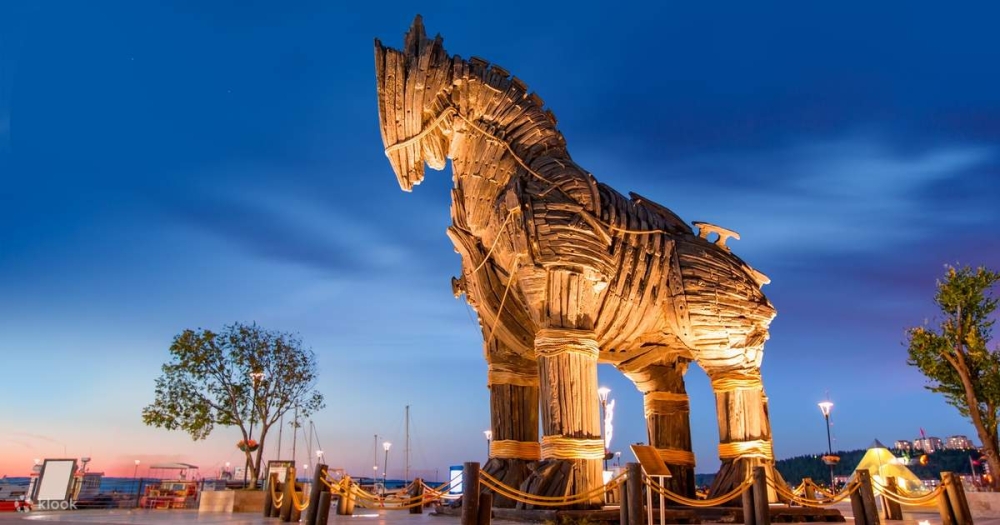
One of the first sights visitors encounter is the impressive wooden Trojan Horse standing near the entrance. While it is a modern reconstruction rather than an ancient artifact, it offers the perfect introduction to the legendary story and provides one of the most popular photo opportunities at the site.
The massive defensive walls of Troy are among its most remarkable surviving structures. Built using enormous limestone blocks, these fortifications demonstrate the city's military importance during the Bronze Age and help visitors imagine how difficult it would have been for ancient armies to capture the city.
Several monumental gateways remain visible today, allowing visitors to walk through the same entrances that were once used by merchants, soldiers, and residents thousands of years ago.
Dedicated to Athena, the Greek goddess of wisdom and warfare, this sanctuary reflects Troy's continued importance during the Greek and Roman periods.
Built centuries after the legendary Trojan War, the small Roman theater demonstrates that Troy remained an active settlement long after the events described by Homer.
No visit to Troy is complete without exploring the award-winning Troy Museum, located just a few minutes from the archaeological site.
The museum displays thousands of artifacts discovered during excavations, including pottery, jewelry, sculptures, inscriptions, everyday household items, and interactive exhibits that explain the site's archaeological layers. Together, the museum and archaeological site provide a complete understanding of Troy's extraordinary history.
Most visitors spend between 2 and 3 hours exploring the archaeological site itself.
If you also plan to visit the Troy Museum, allow at least another 1.5 to 2 hours. History enthusiasts often spend an entire day discovering both attractions.
Guided tours provide valuable historical context that helps bring the ruins to life, making the experience much more rewarding than exploring independently.
Troy can be visited year-round, but spring and autumn offer the most comfortable weather for sightseeing.
Morning visits are generally recommended, especially during the summer months.
Troy is easily accessible from several major destinations in Türkiye.
The archaeological site is approximately 30 minutes by car from the city center.
Travelers can reach Troy in around five to six hours by car or by combining a bus journey with a short transfer from Çanakkale.
The drive typically takes around four hours, making Troy an excellent addition to a longer itinerary through western Türkiye.
If you're planning a multi-day journey across the country's most iconic historical sites, consider combining Troy with destinations such as Ephesus, Pamukkale, Cappadocia, and Istanbul.
Absolutely. Troy is one of the world's most important archaeological sites and an essential destination for anyone interested in history, mythology, or ancient civilizations.
No. The famous wooden horse from mythology no longer exists. Visitors can see a modern replica located at the archaeological site.
Yes. Children often enjoy discovering the story of the Trojan Horse, while adults appreciate the historical significance of the site.
Expect approximately two to three kilometers of walking across uneven archaeological paths.
Yes. Many travelers visit Troy as a day trip from Çanakkale, while others include it as part of a longer journey across western Türkiye.
The museum is located nearby and is highly recommended as part of your visit.
While Troy is undoubtedly one of Türkiye's most legendary destinations, it's only one chapter in the country's extraordinary story. Ancient cities, natural wonders, and vibrant cultural traditions await throughout the region.
If you'd like to explore Troy alongside iconic destinations such as Istanbul, Ephesus, Pamukkale, and Cappadocia, our 10 Days Highlights of Turkey Tour offers a carefully designed itinerary that brings together the country's most remarkable historical and cultural landmarks in one unforgettable journey.
Whether you're fascinated by the legends of the Trojan War, the grandeur of Ephesus, or the breathtaking landscapes of Cappadocia, this immersive tour is the perfect way to experience the very best of Türkiye with expert guidance and seamless travel arrangements.
Troy is much more than the setting of an ancient legend. It is a place where mythology, archaeology, and history come together, allowing visitors to walk through one of humanity's most influential stories. From the famous Trojan Horse to the impressive city walls and the award-winning Troy Museum, every corner offers a glimpse into civilizations that shaped the ancient world.
Whether you're planning a dedicated visit or including Troy as part of a broader journey across Türkiye, this legendary city promises an unforgettable experience that continues to inspire travelers thousands of years after Homer's epic first captivated the world.

I graduated from Istanbul University with a degree in Radio, Television, and Cinema. During my academic journey, I focused on storytelling, visual communication, and cultural content creation, while my personal interests led me toward exploration and discovery.
Traveling, discovering new places, and experiencing different cultures are at the heart of my life. My strong interest in mythology allows me to see destinations not only as physical locations but as narratives shaped by history and meaning. My passion for reading continuously enriches and deepens this perspective.
I truly enjoy meeting new people and learning about diverse ways of life. With this mindset, I aim to share my experiences in a sincere, clear, and engaging way.
I love following the traces of stories wherever I go.
Disclosure Notice
By filling out this form, you agree that the personal data you provide to us will be processed in accordance with the Personal Data Protection Law No. 6698 and related legislation.
Your personal data will be processed solely for responding to your application, evaluating your requests, and fulfilling legal obligations; it will not be shared with third parties.
For detailed information, you can review our Privacy Policy.
By submitting the form, you acknowledge and consent to the processing of your personal data for the purposes specified above.

