Home to one of the world's most legendary archaeological sites, Troy National Park offers visitors the unique opportunity to explore thousands of years of history in a breathtaking natural setting. Located in northwestern Türkiye near the Dardanelles, the park protects the ruins of Ancient Troy, the city immortalized in Homer's epic poems and recognized as a UNESCO World Heritage Site.
Whether you're passionate about archaeology, fascinated by Greek mythology, or planning a cultural journey through Türkiye, a visit to Troy National Park promises an unforgettable experience. From impressive archaeological remains to scenic walking paths and the award-winning Troy Museum nearby, the area combines history, nature, and storytelling like few destinations in the world.
This complete guide explains everything you need to know before visiting Troy National Park Turkey, including its history, top attractions, travel tips, and how to make the most of your visit.
Before you go, explore our detailed Troy National Park guide for practical visitor information, nearby attractions, and travel inspiration.
Troy National Park is a protected cultural and archaeological landscape surrounding the ancient city of Troy (Truva), one of the world's most significant archaeological sites. The park preserves not only the famous ruins themselves but also the surrounding natural environment that has shaped human history for thousands of years.
Rather than being a traditional national park focused solely on nature, Troy National Park combines archaeological heritage with beautiful landscapes overlooking the Dardanelles. Visitors can experience ancient fortification walls, archaeological excavation areas, scenic viewpoints, and nearby cultural attractions all within the same protected region.
This unique combination makes Troy National Park one of Türkiye's most remarkable cultural destinations.
Troy National Park is located near the village of Tevfikiye in Çanakkale Province, approximately 30 kilometers southwest of Çanakkale city center.
The park occupies a strategic location overlooking the Dardanelles Strait, a waterway that has connected Europe and Asia for thousands of years. This advantageous position contributed significantly to Troy's wealth, political influence, and military importance during the Bronze Age.
Today, the park is easily accessible from Istanbul, Izmir, and other destinations throughout western Türkiye.
In 1998, UNESCO inscribed Ancient Troy on the World Heritage List in recognition of its exceptional archaeological, historical, and cultural significance.
Troy represents nearly four thousand years of continuous settlement, preserving evidence of civilizations that flourished from the Early Bronze Age through the Roman period. Few archaeological sites in the world demonstrate such a long and complex history within a single location.
Beyond its archaeological value, Troy occupies a unique place in global culture. The city inspired Homer's Iliad and Odyssey, influencing literature, art, theater, and education for more than two millennia.
Long before it became a protected national park, Troy stood at the crossroads of trade routes connecting the Aegean, Anatolia, and the Black Sea.
Its strategic location attracted merchants, travelers, and armies, transforming the city into one of the most influential settlements of the ancient world.
Archaeological research has revealed that Troy was repeatedly destroyed and rebuilt over thousands of years. Instead of representing a single city, the archaeological site consists of multiple layers, each reflecting a different civilization and historical period.
This extraordinary sequence allows visitors to literally walk through thousands of years of human history.
One of the most fascinating aspects of Troy National Park is that visitors are not exploring just one ancient city.
Archaeologists have identified nine major settlement layers, commonly referred to as Troy I through Troy IX.
These archaeological layers provide an unparalleled record of human civilization spanning more than four millennia.
Troy National Park offers far more than archaeological ruins. It allows visitors to experience the intersection of mythology, history, and nature in one extraordinary destination.
Whether you're following the story of the Trojan War, exploring UNESCO World Heritage Sites, or simply enjoying the landscapes of northwestern Türkiye, the park offers an unforgettable journey through one of humanity's most influential civilizations.
Walking through ancient gates, standing beside massive fortification walls, and overlooking the same landscapes that inspired generations of storytellers creates an experience unlike any other.
Continue reading: In Part 2, we'll explore the top attractions inside Troy National Park, the award-winning Troy Museum, walking routes, the best time to visit, transportation options, practical travel tips, and how to include Troy in an unforgettable journey across Türkiye.
Troy National Park is much more than a single archaeological site. It offers visitors the opportunity to explore ancient ruins, breathtaking landscapes, and one of Türkiye's most important cultural heritage areas. Whether you're spending a few hours or an entire day here, these highlights shouldn't be missed.
The archaeological ruins are the heart of the national park. As you walk through the site, you'll discover massive fortification walls, ancient gateways, residential remains, ceremonial areas, and structures dating from multiple civilizations. Every section represents a different chapter in Troy's remarkable history.
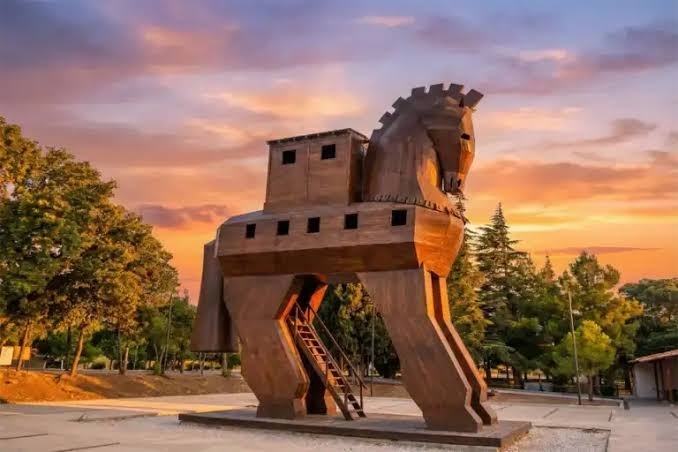
Near the entrance stands the famous wooden Trojan Horse replica, inspired by the legendary story of Homer's epic. Although it is a modern reconstruction, it has become one of the park's most recognizable landmarks and a favorite photo stop for visitors.
The impressive stone walls remain among Troy's most remarkable archaeological features. Their size and engineering provide insight into why the city remained one of the region's strongest fortified settlements during the Bronze Age.
Evidence of later Greek and Roman occupation can still be seen throughout the archaeological site, including the remains of temples and sacred areas dedicated to Athena.
Beyond its archaeological importance, Troy National Park offers beautiful views across the surrounding countryside toward the Dardanelles Strait. The peaceful landscape helps visitors appreciate why this strategic location played such an important role throughout history.
Only a short distance from the archaeological site, the award-winning Troy Museum is considered an essential part of any visit.
The museum presents thousands of artifacts discovered during archaeological excavations, including pottery, sculptures, jewelry, tools, inscriptions, coins, and interactive exhibits explaining Troy's archaeological layers.
Together, the museum and archaeological site provide one of the most comprehensive archaeological experiences in Türkiye.
Visitors can comfortably explore the archaeological site using well-marked walking paths that guide them through the different excavation areas.
Interpretive signs throughout the park explain the historical significance of important structures, making it easy to follow the evolution of the city from the Early Bronze Age to the Roman period.
Most visitors spend between two and three hours exploring the archaeological site, while adding the museum typically extends the experience to half a day.
Troy National Park can be visited throughout the year, but spring and autumn offer the most pleasant weather for outdoor exploration.
Morning visits are generally recommended, particularly during summer.
The park is approximately 30 minutes by car from Çanakkale city center.
Visitors can reach Troy by driving or by taking a bus to Çanakkale followed by a short transfer to the archaeological site.
The drive from Izmir takes approximately four hours, making Troy an excellent addition to a longer western Türkiye itinerary.
Absolutely. It combines one of the world's most important archaeological sites with beautiful natural surroundings and UNESCO-recognized cultural heritage.
Most visitors spend between two and three hours exploring the archaeological site. Including the Troy Museum usually requires half a day.
Yes. Families enjoy both the archaeological remains and the legendary story of the Trojan Horse, making it an engaging destination for visitors of all ages.
Yes. The museum is located only a few minutes from the archaeological site and is highly recommended as part of the overall experience.
It preserves one of the world's most influential archaeological sites while protecting the landscape that inspired Homer's legendary epics and shaped thousands of years of history.
While Troy National Park is one of Türkiye's most extraordinary destinations, it becomes even more memorable when combined with the country's other iconic historical and natural attractions.
Our 10 Days Highlights of Turkey Tour includes the legendary city of Troy alongside unforgettable destinations such as Istanbul, Ephesus, Pamukkale, and Cappadocia. It's the perfect itinerary for travelers who want to experience Türkiye's rich history, breathtaking landscapes, and cultural diversity in one seamless journey.
Troy National Park is far more than an archaeological destination—it's a place where mythology, history, archaeology, and nature come together. Walking through the ancient ruins, exploring the award-winning museum, and experiencing the landscapes that have inspired storytellers for thousands of years offers an unforgettable glimpse into one of humanity's greatest civilizations.
Whether you're passionate about UNESCO World Heritage Sites, fascinated by the Trojan War, or simply looking to explore one of Türkiye's most remarkable historical landmarks, Troy National Park deserves a place on your travel itinerary.

I graduated from Istanbul University with a degree in Radio, Television, and Cinema. During my academic journey, I focused on storytelling, visual communication, and cultural content creation, while my personal interests led me toward exploration and discovery.
Traveling, discovering new places, and experiencing different cultures are at the heart of my life. My strong interest in mythology allows me to see destinations not only as physical locations but as narratives shaped by history and meaning. My passion for reading continuously enriches and deepens this perspective.
I truly enjoy meeting new people and learning about diverse ways of life. With this mindset, I aim to share my experiences in a sincere, clear, and engaging way.
I love following the traces of stories wherever I go.
Disclosure Notice
By filling out this form, you agree that the personal data you provide to us will be processed in accordance with the Personal Data Protection Law No. 6698 and related legislation.
Your personal data will be processed solely for responding to your application, evaluating your requests, and fulfilling legal obligations; it will not be shared with third parties.
For detailed information, you can review our Privacy Policy.
By submitting the form, you acknowledge and consent to the processing of your personal data for the purposes specified above.

