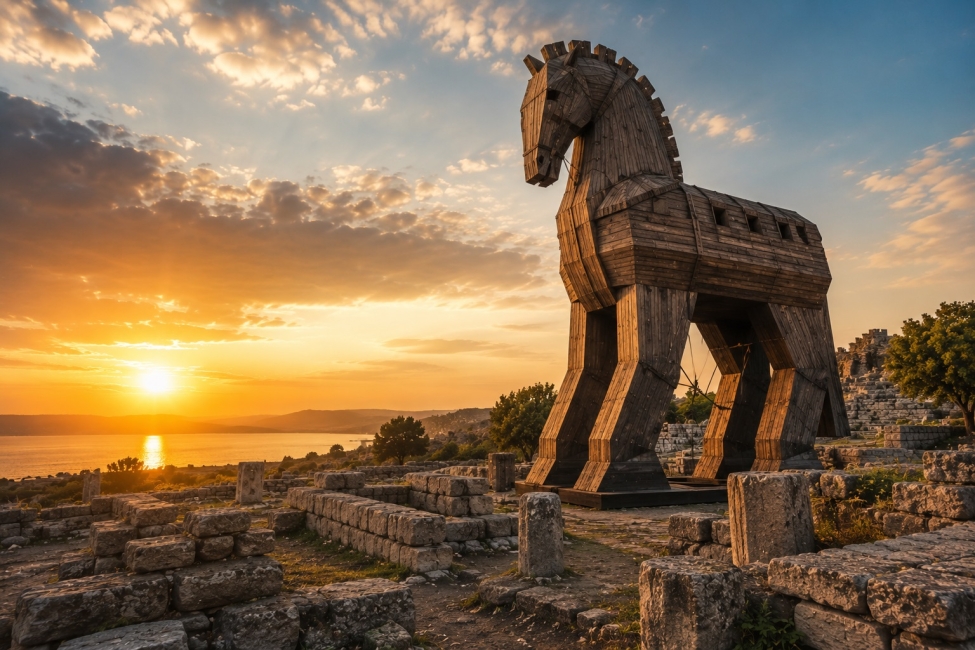
Few stories from the ancient world are as famous as the tale of the Trojan Horse. For more than two thousand years, this legendary wooden horse has symbolized clever strategy, deception, and one of history's greatest military victories. But was the Trojan Horse a real historical event, or simply one of mythology's greatest stories?
From Homer's Iliad to modern films, books, and museums, the legend of the Trojan Horse continues to captivate millions of people around the world. Today, visitors to Ancient Troy in northwestern Türkiye can explore the archaeological site where this legendary story is believed to have unfolded and discover the fascinating blend of myth and history that still surrounds the ancient city.
In this guide, we'll explore the origins of the Trojan Horse, what Homer actually wrote, what archaeologists believe today, and why this legendary symbol remains one of history's greatest mysteries.
If you're planning to visit Ancient Troy, don't miss our detailed Troy Trojan Horse story, where you'll find travel information, historical background, and visitor tips.
The Trojan Horse is a legendary wooden horse described in Greek mythology as the ingenious device that allowed the Greek army to capture the seemingly invincible city of Troy.
According to the story, after fighting unsuccessfully for ten years, the Greek army appeared to abandon the war. Before sailing away, they left behind an enormous wooden horse outside the city's gates as what seemed to be a peace offering.
Unknown to the Trojans, a carefully selected group of Greek soldiers was hiding inside the hollow horse.
Believing the war had ended, the people of Troy pulled the giant horse into their city as a symbol of victory. During the night, the hidden soldiers emerged, opened the city gates, and allowed the returning Greek army to enter, leading to the fall of Troy.
Whether historical fact or poetic fiction, the story has become one of the world's most enduring legends.
One of the biggest surprises for many readers is that the famous Trojan Horse does not actually appear in Homer's Iliad.
The Iliad focuses primarily on the final weeks of the Trojan War and the conflict between Achilles and Agamemnon. It concludes before the city falls.
The story of the Trojan Horse is instead described in later ancient works, most notably Homer's Odyssey, where Odysseus recounts the clever plan, and in Virgil's Aeneid, which provides one of the most detailed literary accounts of the horse and Troy's destruction.
This often surprises visitors, who naturally associate the Trojan Horse with the Iliad. In reality, the legend evolved through multiple ancient sources over several centuries.
Ancient historians and mythologists have long debated why the Greeks supposedly chose a horse instead of another object.
Several theories have been proposed:
No definitive answer exists, which only adds to the legend's enduring mystery.
This is perhaps the most frequently asked question by visitors to Troy.
To date, archaeologists have found no physical evidence proving that a giant wooden horse was ever built or used to capture the city.
However, the absence of evidence does not necessarily mean the story is entirely fictional. Many historians believe the legend may preserve memories of a real event that became increasingly dramatic as it was passed down through generations.
Several theories attempt to explain the origin of the story, ranging from military engineering to natural disasters.
Some historians believe the "horse" may have been a large wooden siege machine used to breach Troy's walls. Over time, oral tradition may have transformed this military device into the legendary horse we know today.
In ancient mythology, Poseidon was both the god of horses and earthquakes.
Some researchers suggest that a devastating earthquake may have damaged Troy's fortifications, allowing enemy forces to enter the city. As generations retold the story, the symbolic connection between horses and Poseidon may have evolved into the legend of the wooden horse.
Another possibility is that the Greeks infiltrated Troy through espionage or deception. Over centuries, this successful strategy may have transformed into the famous tale of soldiers hiding inside a wooden horse.
Whether real or mythical, the Trojan Horse has become a universal symbol of deception hidden behind an attractive gift.
Today, the expression "Trojan Horse" is used far beyond ancient history. It appears in politics, literature, cybersecurity, military strategy, and even everyday language to describe something that appears harmless but conceals a hidden danger.
Its enduring symbolism demonstrates the extraordinary cultural influence of the legend, thousands of years after the story first emerged.
Continue reading: In Part 2, we'll explore what archaeologists believe today, whether the Trojan War really happened, where you can see the famous Trojan Horse during your visit to Troy, fascinating facts about the legend, and why this ancient story continues to inspire books, films, and travelers from around the world.
Modern archaeology paints a fascinating picture of Ancient Troy. Excavations carried out over more than a century have confirmed that Troy was a real city, continuously inhabited for nearly 4,000 years. Archaeologists have uncovered impressive fortification walls, towers, gates, houses, temples, and thousands of everyday artifacts that reveal the city's strategic importance throughout history.
However, no archaeological evidence has ever confirmed the existence of a giant wooden horse.
Instead, many experts believe the legend may preserve the memory of a real historical event that became increasingly dramatic through centuries of oral storytelling. Like many ancient legends, the Trojan Horse may combine historical truth with literary imagination.
While historians continue to debate the details, many believe that a conflict similar to the Trojan War likely took place during the Late Bronze Age.
Archaeological evidence shows that one of Troy's settlement layers—often identified as Troy VI or Troy VII—was destroyed during a period that roughly corresponds with the traditional date of the Trojan War.
Whether the conflict involved Achilles, Hector, Odysseus, and Helen exactly as described by ancient poets remains uncertain. Nevertheless, archaeological discoveries strongly suggest that Troy experienced major wars and destruction, providing a historical foundation for one of history's greatest epics.
Yes—but not the original.
Visitors to Ancient Troy can see a large modern replica of the legendary Trojan Horse near the entrance to the archaeological site. Although it was not built in antiquity, it serves as a powerful symbol of the city's legendary past and has become one of the site's most recognizable attractions.
The replica offers visitors an opportunity to imagine how the famous story may have been told by ancient storytellers while exploring the archaeological remains surrounding it.
To learn more about visiting the archaeological site, nearby attractions, and practical travel advice, explore our Troy Trojan Horse story.
Few ancient stories have had such a lasting impact on global culture.
The Trojan Horse continues to inspire novels, films, television series, paintings, sculptures, theater productions, and even modern computer terminology. The phrase "Trojan Horse" has become synonymous with hidden danger, clever deception, and strategic thinking.
Its influence extends far beyond mythology, making it one of the most recognizable symbols from the ancient world.
No physical evidence has ever been discovered. Most historians consider it a legendary story, although it may have been inspired by real historical events or military strategies.
If it ever existed, it has not survived. The horse seen at Troy today is a modern reconstruction created to represent the legendary story.
According to mythology, the Trojans believed the Greeks had abandoned the war and left the horse as a sacred offering. Bringing it inside the city ultimately led to Troy's downfall.
Ancient tradition credits Odysseus with devising the ingenious strategy that ultimately allowed the Greeks to enter Troy.
Yes. The archaeological site of Ancient Troy in Çanakkale, Türkiye welcomes visitors from around the world and remains one of the country's most important historical destinations.
Reading about the Trojan Horse is one thing—standing where the legend was born is another. Exploring Ancient Troy allows visitors to connect mythology with archaeology while discovering one of the world's most influential historical sites.
Whether you're fascinated by Homer's epics, curious about the mysteries of the Bronze Age, or simply passionate about ancient civilizations, Troy offers an unforgettable journey through history.
The Trojan Horse remains one of history's greatest mysteries. Whether viewed as mythology, symbolic storytelling, or a distant memory of real historical events, its influence has endured for more than two thousand years.
Today, Ancient Troy continues to attract travelers who want to discover the truth behind the legend. Walking among its ancient walls, exploring the archaeological remains, and seeing the iconic Trojan Horse replica offers a unique opportunity to experience the place where one of humanity's greatest stories began.
If you're planning a trip to northwestern Türkiye, don't miss the chance to visit Troy and uncover the remarkable blend of history, archaeology, and mythology that has captivated the world for centuries.

I graduated from Istanbul University with a degree in Radio, Television, and Cinema. During my academic journey, I focused on storytelling, visual communication, and cultural content creation, while my personal interests led me toward exploration and discovery.
Traveling, discovering new places, and experiencing different cultures are at the heart of my life. My strong interest in mythology allows me to see destinations not only as physical locations but as narratives shaped by history and meaning. My passion for reading continuously enriches and deepens this perspective.
I truly enjoy meeting new people and learning about diverse ways of life. With this mindset, I aim to share my experiences in a sincere, clear, and engaging way.
I love following the traces of stories wherever I go.
Disclosure Notice
By filling out this form, you agree that the personal data you provide to us will be processed in accordance with the Personal Data Protection Law No. 6698 and related legislation.
Your personal data will be processed solely for responding to your application, evaluating your requests, and fulfilling legal obligations; it will not be shared with third parties.
For detailed information, you can review our Privacy Policy.
By submitting the form, you acknowledge and consent to the processing of your personal data for the purposes specified above.

