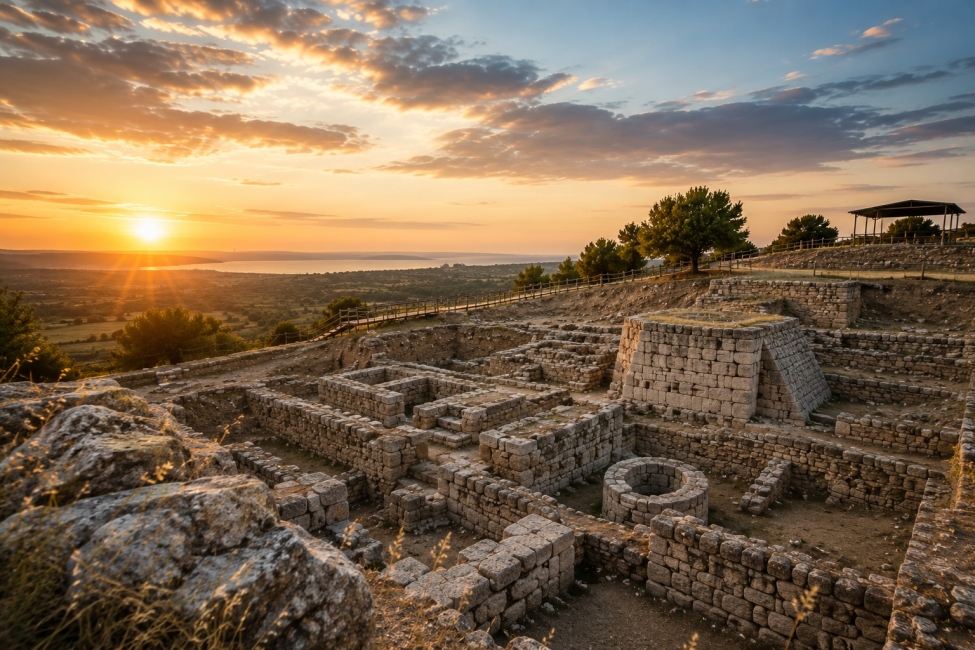
When most people think of Ancient Troy, they imagine the legendary Trojan Horse, Homer's Iliad, and the famous Trojan War. However, one of the site's most remarkable features has nothing to do with mythology. Beneath the visible ruins lies a fascinating archaeological record revealing that Troy was not a single city, but a succession of civilizations built one on top of another for nearly four thousand years.
Today, archaeologists recognize nine major layers of Troy, each representing a different era of human settlement. Together, these layers tell the story of changing cultures, architectural innovations, natural disasters, wars, trade, and everyday life from the Early Bronze Age to the Roman Empire.
Understanding these archaeological layers transforms a visit to Troy from simply seeing ancient ruins into experiencing one of the world's greatest archaeological discoveries.
In this guide, we'll explain how the nine cities of Troy were discovered, what makes each layer unique, and why they continue to reshape our understanding of ancient history.
Before planning your visit, you can also explore our complete guide to the Troy archaeological layers and discover more about one of Türkiye's most extraordinary UNESCO World Heritage Sites.
Unlike many ancient cities that were abandoned after destruction, Troy was rebuilt repeatedly over thousands of years.
Each time the city suffered from war, earthquakes, fires, or gradual decline, later generations constructed new buildings directly on top of the previous settlement. Over centuries, these rebuilding phases created an enormous archaeological mound known as a tell.
Today, this mound—called Hisarlık—contains nearly 4,000 years of continuous human occupation, making it one of the world's most important archaeological sites.
For centuries, many believed Troy existed only in mythology until German businessman and archaeologist Heinrich Schliemann began excavations at Hisarlık in 1871.
Although Schliemann successfully proved that an ancient city existed beneath the hill, his excavation techniques were extremely destructive by modern standards. Large sections of upper layers were removed before archaeologists understood the site's extraordinary complexity.
Later excavations led by Wilhelm Dörpfeld, Carl Blegen, and more recent international archaeological teams carefully documented the site's stratigraphy and identified nine principal settlement phases, now known as Troy I through Troy IX.
Modern archaeological methods continue to reveal new information about each occupation layer while preserving the site for future generations.
The key to understanding Troy lies in the archaeological concept of stratigraphy.
Just as the pages of a history book tell a story chapter by chapter, each archaeological layer represents a different period of occupation. By carefully studying the buildings, pottery, tools, and organic remains found within each layer, archaeologists can reconstruct thousands of years of human history.
At Troy, each layer reflects changing political powers, trade networks, architectural styles, and technological advances that shaped life in the ancient world.
The earliest settlement at Troy dates to approximately 3000 BC during the Early Bronze Age.
Although relatively small, Troy I already displayed many characteristics of an organized community. Archaeologists discovered stone defensive walls, simple houses, storage facilities, and evidence of farming and local trade.
This first settlement laid the foundation for thousands of years of continuous occupation.
Its strategic location overlooking routes between Europe and Asia would eventually transform Troy into one of the most influential cities of the ancient world.
Troy II marks the city's first major period of prosperity.
During this era, impressive defensive walls, monumental gateways, and large public buildings were constructed, indicating increasing wealth and political organization.
Heinrich Schliemann mistakenly believed this layer represented Homer's Troy because he discovered spectacular treasures of gold, silver, bronze, and precious jewelry nearby. He famously named these artifacts "Priam's Treasure," although modern archaeology has shown they predate the legendary Trojan War by more than a thousand years.
Despite this misunderstanding, Troy II remains one of the site's most significant archaeological discoveries.
Rather than experiencing dramatic expansion, these three settlement phases represent gradual rebuilding and adaptation following earlier destruction.
Archaeologists found modest residential buildings, workshops, storage areas, and defensive improvements that reveal a community continuing to thrive through changing political and environmental conditions.
Trade remained active, and daily life appears to have continued with remarkable resilience despite repeated challenges.
Although less spectacular than some later layers, Troy III through V provide valuable evidence of how ancient societies adapted over many centuries.
Visitors often focus on the legendary Trojan War, but the earliest archaeological layers reveal something equally fascinating: Troy's success did not happen overnight.
Long before Homer immortalized the city in epic poetry, generations of farmers, merchants, builders, and craftsmen transformed a small Bronze Age settlement into one of the eastern Mediterranean's most important urban centers.
These early civilizations established the strategic importance, wealth, and defensive strength that would later make Troy famous throughout the ancient world.
Continue reading: In Part 2, we'll explore Troy VI through Troy IX, examine which layer may be connected to the legendary Trojan War, explain how the city evolved during the Greek and Roman periods, and discover why the archaeological layers of Troy continue to fascinate historians today.
Among all nine archaeological layers, Troy VI is widely regarded as one of the city's greatest periods of prosperity. During this era, Troy developed into a wealthy, fortified settlement with impressive stone walls, monumental towers, and carefully planned streets.
The massive limestone fortifications that visitors admire today largely date from this period. Their sophisticated engineering demonstrates the city's military strength and strategic importance along the trade routes connecting the Aegean, Anatolia, and the Black Sea.
Archaeological discoveries also suggest extensive trade with Mycenaean Greece and neighboring civilizations, indicating that Troy was an important international commercial center.
Many historians once believed Troy VI represented Homer's legendary city. However, evidence suggests the settlement may have been severely damaged by an earthquake rather than warfare.
If one archaeological layer attracts the greatest attention, it is undoubtedly Troy VIIa.
Unlike its predecessor, this settlement shows clear evidence of destruction by fire, collapsed buildings, and emergency food storage inside houses—details that suggest the inhabitants may have prepared for a prolonged siege.
These discoveries have led many archaeologists to believe that Troy VIIa could represent the historical background behind the legendary Trojan War.
Although no archaeological evidence confirms the existence of Achilles, Hector, Paris, or the famous Trojan Horse, the timing and destruction of Troy VIIa closely match the traditional period associated with Homer's epic.
While the debate continues, Troy VII remains the strongest archaeological candidate for the city that inspired one of the world's greatest legends.
Centuries after the Bronze Age city disappeared, Troy experienced a remarkable revival during the Greek period.
The city became an important religious center where pilgrims visited to honor the legendary heroes of the Trojan War. Temples, public buildings, and sanctuaries were constructed, reflecting Troy's continued importance in the Greek world.
By this time, Homer's poems had already become famous throughout the Mediterranean, transforming Troy into a destination of cultural and historical significance.
During the Roman Empire, Troy reached yet another chapter in its long history.
Known as Ilion, the city enjoyed the patronage of several Roman emperors who believed they shared legendary ancestry with the Trojans through the hero Aeneas.
Large public buildings, theaters, baths, temples, and administrative structures were constructed during this period, turning Troy into a prosperous Roman city.
Visitors today can still see architectural remains from this era scattered throughout the archaeological site, demonstrating how Troy continued to evolve long after the Bronze Age.
| Layer | Approximate Date | Main Characteristics |
|---|---|---|
| Troy I | 3000–2550 BC | First fortified settlement |
| Troy II | 2550–2300 BC | Prosperous Bronze Age city and Priam's Treasure discoveries |
| Troy III–V | 2300–1700 BC | Gradual rebuilding and continued occupation |
| Troy VI | 1700–1250 BC | Powerful fortified city and international trade |
| Troy VII | 1250–950 BC | Evidence of destruction, often associated with the Trojan War |
| Troy VIII | 700–85 BC | Greek sanctuary and pilgrimage center |
| Troy IX | 85 BC–AD 500 | Prosperous Roman city known as Ilion |
The archaeological layers of Troy represent far more than different construction phases. Together, they provide one of the world's most complete records of long-term urban development.
Few archaeological sites preserve such a continuous sequence of human civilization across four millennia. By studying these layers, researchers gain valuable insights into changing architecture, trade networks, warfare, technology, religion, and daily life.
For visitors, understanding the different layers transforms Troy from a collection of ancient ruins into a living timeline of human history.
Because the city was repeatedly destroyed and rebuilt over thousands of years. Each rebuilding phase created a new archaeological layer on top of the previous settlement.
Most archaeologists believe Troy VIIa is the strongest candidate, although some researchers also consider Troy VI an important possibility.
Not every layer is visible individually, but many excavation areas reveal multiple occupation levels, allowing visitors to understand how the city evolved over time.
Heinrich Schliemann began excavations in the nineteenth century, while later archaeologists including Wilhelm Dörpfeld and Carl Blegen identified and documented the different settlement phases.
Troy preserves one of the world's longest continuous archaeological sequences while also connecting historical evidence with one of humanity's greatest literary traditions.
Reading about Troy's archaeological layers is fascinating, but standing among the ancient walls brings history to life in a way that books cannot. Walking through the excavation areas allows visitors to witness the remarkable story of a city that survived, evolved, and inspired civilizations for thousands of years.
If you'd like to experience Ancient Troy alongside other iconic destinations such as Istanbul, Gallipoli, Ephesus, Pamukkale, and Cappadocia, our 10 Days Highlights of Turkey Tour offers the perfect opportunity to explore Türkiye's most extraordinary historical and cultural treasures in one unforgettable journey.
The story of Troy is not the story of one city—it is the story of nine civilizations built upon one another across four thousand years. Each archaeological layer reveals new discoveries about humanity's ability to adapt, rebuild, and thrive despite war, natural disasters, and changing empires.
Whether you're fascinated by archaeology, inspired by Homer's epics, or planning your first visit to Ancient Troy, understanding these nine layers will deepen your appreciation of one of the world's most extraordinary UNESCO World Heritage Sites. Every stone at Troy represents another chapter in a remarkable timeline that continues to captivate historians and travelers alike.

I graduated from Istanbul University with a degree in Radio, Television, and Cinema. During my academic journey, I focused on storytelling, visual communication, and cultural content creation, while my personal interests led me toward exploration and discovery.
Traveling, discovering new places, and experiencing different cultures are at the heart of my life. My strong interest in mythology allows me to see destinations not only as physical locations but as narratives shaped by history and meaning. My passion for reading continuously enriches and deepens this perspective.
I truly enjoy meeting new people and learning about diverse ways of life. With this mindset, I aim to share my experiences in a sincere, clear, and engaging way.
I love following the traces of stories wherever I go.
Disclosure Notice
By filling out this form, you agree that the personal data you provide to us will be processed in accordance with the Personal Data Protection Law No. 6698 and related legislation.
Your personal data will be processed solely for responding to your application, evaluating your requests, and fulfilling legal obligations; it will not be shared with third parties.
For detailed information, you can review our Privacy Policy.
By submitting the form, you acknowledge and consent to the processing of your personal data for the purposes specified above.

