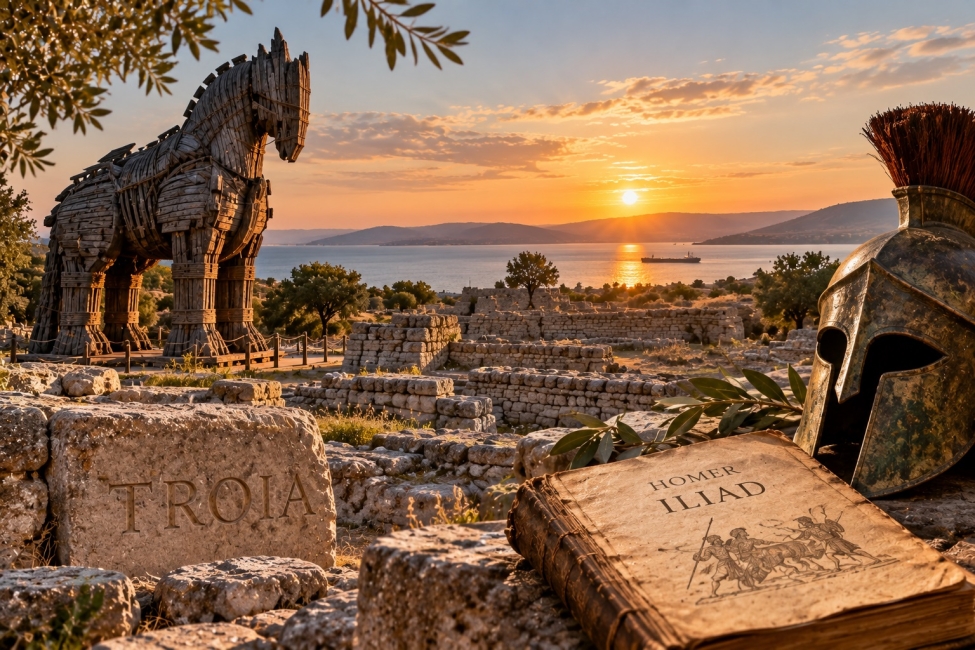
Was Troy real, or was it simply a legendary city created by Homer?
For centuries, the story of Troy was known primarily through ancient literature. Homer's Iliad tells the story of a powerful city, a long war and legendary figures such as Achilles, Hector and Helen. But for a long time, it was unclear whether the place described in the epic had a real historical counterpart.
Today, archaeologists have established that a major ancient settlement did exist at Hisarlık in modern-day Turkey. The site contains multiple archaeological layers representing thousands of years of occupation and is recognized as the Archaeological Site of Troy, a UNESCO World Heritage Site.
But this does not mean that archaeology has proven every event described in the Iliad.
The real story is much more fascinating. Archaeology provides strong evidence for the existence of Troy as an ancient settlement, while the precise relationship between that settlement, the Trojan War and Homer's epic remains a subject of scholarly discussion.
Yes, there was a real ancient city at the site traditionally identified as Troy.
The archaeological site is located at Hisarlık in northwestern Turkey, near the Dardanelles. Archaeological research has revealed a long sequence of settlements built on top of one another over thousands of years.
UNESCO describes the Archaeological Site of Troy as having approximately 4,000 years of history. The remains document different periods of settlement and provide important evidence for cultural connections between Anatolia, the Aegean and surrounding regions.
So the question is not really whether a city called Troy existed. Archaeology clearly demonstrates that a significant settlement existed at Hisarlık.
The more difficult question is whether this archaeological city was exactly the Troy described by Homer.
The ancient city traditionally identified as Troy is located at Hisarlık, in the historical region known as the Troad.
Its position is particularly significant. The site overlooks the plain near the Dardanelles, one of the most important geographical passages connecting the Aegean and Black Sea regions.
This strategic location helps explain why the settlement developed into an important center and why the region attracted different communities over many centuries.
The identification of Hisarlık with Troy has become widely accepted in modern scholarship, although questions remain about exactly which archaeological phase should be connected with the city described in the Iliad.
Homer is traditionally regarded as the poet associated with the Iliad and the Odyssey, two of the most influential works of ancient Greek literature.
The exact historical identity and lifetime of Homer remain uncertain. The poems were transmitted through an oral tradition before reaching the written form known to later generations.
This is important when considering the historical Troy.
The Iliad should not simply be treated as a modern-style historical record. It is an epic poem containing mythology, heroic traditions, poetic conventions and memories of an earlier world.
At the same time, the poem contains geographical and cultural details that have encouraged scholars to investigate whether some elements could preserve memories of real places and events.
The Iliad focuses on a period during the Trojan War, particularly the conflict between the Greek forces and the Trojans.
The story includes the Trojan prince Hector, the Greek warrior Achilles, King Priam and Helen, whose presence in Troy is central to the traditional story of the war.
One of the most important points to understand is that Homer's poem does not provide a straightforward archaeological description of Troy.
Instead, it presents a dramatic literary world in which heroic characters, divine intervention, warfare and human emotions are combined.
Archaeologists therefore compare the physical evidence from Hisarlık with the geographical and cultural information preserved in the epic, rather than assuming that every detail in the poem must correspond to an archaeological feature.
The traditional Trojan War is generally placed in the Late Bronze Age, although the exact historical date remains uncertain.
UNESCO associates the legendary siege of Troy with the 13th century B.C., while archaeological research has focused particularly on the Late Bronze Age settlement layers at Hisarlık.
Several archaeological phases at Troy date to this broad period, which is one reason the site has attracted so much attention from scholars studying the historical background of the Iliad.
However, archaeology has not produced a document saying, in effect, “this was the Trojan War described by Homer.” The evidence must instead be interpreted through settlement remains, destruction layers, artifacts, regional connections and chronology.
Two archaeological phases are particularly important in discussions about Homer's Troy: Troy VI and Troy VIIa.
Troy VI was a substantial Late Bronze Age settlement with impressive defensive walls and monumental architecture.
Its scale and fortifications have made it an important candidate in discussions about the historical background of the Trojan War.
However, archaeological research indicates that Troy VI was seriously damaged by an earthquake rather than simply destroyed by a military attack. This distinction is important because it demonstrates why the archaeological evidence cannot automatically be equated with Homer's narrative.
Troy VIIa followed Troy VI and retained significant continuity with the earlier settlement.
Evidence of destruction by fire and changes in the way the settlement was occupied have made Troy VIIa another major candidate in discussions about the possible historical background of the Iliad.
Some scholarly interpretations have therefore focused on Troy VIIa as a possible archaeological setting behind the tradition of a destroyed Troy.
There is archaeological evidence showing that Troy experienced destruction and upheaval during the Late Bronze Age.
There is also evidence of connections between Troy and the wider Aegean world, including Mycenaean material culture.
These discoveries make it plausible that memories of conflict involving Troy may have contributed to later traditions.
But archaeology has not conclusively proven the exact war described in the Iliad, nor has it established that Achilles, Hector, Helen or the other legendary figures existed as described in the poem.
This distinction is essential when answering the question “Is Homer's Troy real?”
The archaeological city is real. The literary story is real as an ancient cultural tradition. The precise historical events behind the story remain uncertain.
The modern search for Homer's Troy is closely connected with Heinrich Schliemann, whose excavations at Hisarlık began in the 19th century.
Schliemann strongly believed that the Troy described in Homer's works had a historical location and focused his excavations on Hisarlık.
His work attracted international attention and played a major role in bringing Troy into modern archaeological and popular consciousness. UNESCO identifies Schliemann's excavations beginning in 1870 as an important milestone in the modern study of the site.
However, Schliemann's methods and interpretations were not always consistent with modern archaeological standards.
Later archaeologists demonstrated that the mound contained multiple settlement layers and significantly changed our understanding of what had been found there.
This is where the story becomes more complicated.
Schliemann believed strongly that the remains he uncovered represented the Troy of Homer. His enthusiasm helped popularize the idea that the legendary city had been rediscovered.
Modern archaeology takes a more cautious approach.
The identification of Hisarlık as the location of ancient Troy is widely accepted, but the mound contains several different cities. Therefore, saying that Schliemann simply “found Homer's Troy” oversimplifies the archaeological evidence.
Later excavations revealed a much more complex history than Schliemann originally understood.
One of the most famous discoveries associated with Schliemann is what he called Priam's Treasure.
Schliemann believed that the collection of gold and other objects he uncovered was connected to King Priam, the legendary ruler of Troy in Homer's Iliad.
Modern archaeological chronology, however, shows that the objects associated with this famous find belong to a period significantly earlier than the Late Bronze Age levels generally discussed in connection with the Homeric Troy.
This is an important example of why the story of Troy cannot be separated from the history of archaeological interpretation.
Schliemann's discoveries were significant, but some of his conclusions were later revised as archaeological methods and knowledge improved.
Archaeology can establish several important facts about Troy.
What archaeology cannot currently prove with certainty is that every event described in the Iliad happened exactly as Homer tells it.
This is why the most accurate answer is neither “Troy was completely fictional” nor “archaeology has proven the entire Trojan War.”
The evidence points to a real ancient city that existed in the right geographical setting and during the right broad period to have inspired, or contributed to, the traditions that eventually became the story of Homer's Troy.
There are several reasons scholars have connected the archaeological site at Hisarlık with the Troy described in Homer's Iliad.
First, the geographical location fits remarkably well. The site is positioned near the Dardanelles, an important strategic passage in the ancient world.
Second, the archaeological evidence demonstrates that a substantial settlement existed there during the Late Bronze Age. Troy was not a small or insignificant village; some phases had impressive fortifications and complex urban structures.
Third, the wider region was connected to the Aegean world. Archaeological discoveries indicate interaction between Troy and Mycenaean Greece, providing an important historical context for the stories of conflict between Greeks and Trojans.
These factors do not prove that Homer's entire story happened exactly as written, but they help explain why Hisarlık is so strongly associated with the legendary city.
It is possible that the tradition of the Trojan War preserves memories of real conflicts that took place in or around the Troad during the Late Bronze Age.
The ancient eastern Mediterranean was a world of competing kingdoms, trade networks and military alliances. Troy's strategic position would have made conflicts over the region plausible.
However, there is no archaeological discovery that can definitively be identified as the Trojan War.
Instead, researchers consider a combination of evidence: destruction layers, weapons, settlement changes, regional trade connections and references to the area in ancient texts.
The possibility that several historical memories were eventually transformed into one great epic story is one explanation that has attracted scholarly attention.
There is currently no archaeological evidence that conclusively proves Achilles or Hector existed as historical individuals exactly as they appear in Homer's Iliad.
Achilles is presented in the epic as an extraordinary Greek warrior, while Hector is the heroic defender of Troy. Their confrontation forms one of the emotional centers of the poem.
They belong primarily to the literary and mythological tradition surrounding Troy. Archaeology can reveal the world in which such stories were created and preserved, but it cannot confirm the existence of individual legendary heroes without independent evidence.
Helen is another famous figure whose story has become inseparable from Troy.
According to the epic tradition, Helen's departure to Troy with Paris played a central role in triggering the Trojan War.
Like Achilles and Hector, however, Helen has not been independently established by archaeology as a historical individual.
Her importance lies in the extraordinary cultural influence of the story. For centuries, Helen has appeared in literature, painting, theatre and other forms of art inspired by the Trojan tradition.
The Trojan Horse is probably the most famous element of the Troy story, but there is no archaeological evidence for a giant wooden horse being used to capture the city in the manner described by later traditions.
The story of the horse appears in the wider literary tradition surrounding the Trojan War and became one of its defining symbols.
Several interpretations have been proposed over the years, including the possibility that the story could have developed from a metaphor, a siege technology or an element of oral storytelling. None of these interpretations has been conclusively proven.
What we can say with confidence is that the Trojan Horse became an extraordinarily powerful symbol of Troy and continues to shape how the ancient city is represented today.
When you visit Troy today, the most important thing to remember is that you are looking at multiple cities rather than one single archaeological layer.
The settlement was rebuilt repeatedly. Walls were modified, buildings were constructed over earlier structures and communities changed over thousands of years.
This makes Troy particularly valuable to archaeologists because the site provides a long record of human settlement in the region.
Instead of asking only, “Did Homer's Troy exist?”, it is often more interesting to ask what the archaeological evidence tells us about the people who actually lived at Hisarlık.
The Bronze Age was a period of major cultural development across the eastern Mediterranean.
Communities in Anatolia, the Aegean and the wider eastern Mediterranean were connected through trade, diplomacy and migration. Troy's location placed it directly within this interconnected world.
The archaeological evidence from Troy therefore contributes to a much larger understanding of Bronze Age societies.
Pottery, architecture, fortifications and other material remains help researchers reconstruct how people lived and how Troy interacted with neighboring regions.
One of the biggest mistakes visitors can make is assuming that everything visible at Troy belongs to the same period.
It does not.
The mound contains numerous archaeological layers, each representing a different stage in the site's development. Some structures may be separated from one another by centuries or even longer periods.
Understanding this makes the visit much more interesting. You are essentially looking at a vertical timeline of human history.
The ruins are not simply remains of a destroyed city; they are evidence of generations of people who repeatedly built their lives on the same strategic location.
The identification of Hisarlık with the ancient city of Troy is widely accepted among scholars and archaeologists.
The combination of the site's geographical position, ancient literary references and archaeological evidence provides a strong basis for the identification.
What remains more difficult is determining exactly which archaeological layer corresponds most closely to the city and events remembered in the Homeric tradition.
This distinction is important. The identification of the location is one question; identifying the precise historical events behind an epic poem is another.
A visit to Troy becomes much more rewarding if you approach it as an archaeological site rather than simply a location connected with the Trojan Horse.
Take time to observe the defensive walls, settlement remains and different archaeological levels.
If possible, visit the museum as well. Museum displays can help you understand objects and historical periods that are difficult to interpret from the ruins alone.
Reading a short introduction to the Iliad before your visit can also add another dimension. You will recognize the names and stories that have made Troy famous while being able to distinguish literary tradition from archaeological evidence.
The enduring appeal of Troy comes from the fact that two different stories exist side by side.
One is the story told by archaeology: a settlement with thousands of years of history, multiple layers, fortifications, destruction and cultural interaction.
The other is the story told by mythology and literature: Achilles, Hector, Helen, Paris, Priam and the Trojan Horse.
Neither story needs to completely replace the other.
In fact, the tension between archaeology and mythology is precisely what makes Troy so fascinating.
When you walk through the ruins, you are standing in a real ancient landscape that later became one of the most influential settings in world literature.
So, is Homer's Troy real?
The most accurate answer is: there was a real ancient city at Hisarlık that is identified with Troy, but archaeology has not proven that every event in Homer's Iliad happened exactly as described.
The archaeological evidence demonstrates that Troy was a significant settlement with a long history. It also shows that the city experienced destruction and existed within a complex network of relationships across the Bronze Age Aegean and Anatolian world.
Whether these events directly inspired the Trojan War described by Homer, or whether the epic combined memories of several conflicts and generations of storytelling, remains open to interpretation.
That uncertainty does not make Troy less interesting. It is one of the reasons the site continues to attract archaeologists, historians and travelers from around the world.
Yes. Archaeological excavations at Hisarlık in modern-day Turkey have revealed a major ancient settlement identified with Troy.
Hisarlık is widely identified as the location of ancient Troy, but scholars continue to discuss which archaeological layer most closely corresponds to the city and period remembered in Homer's epic.
There is evidence of destruction and conflict in the wider region during the Late Bronze Age, but archaeology has not conclusively proven the specific Trojan War described in the Iliad.
There is no conclusive archaeological evidence establishing Achilles as a historical individual in the form presented by Homer.
Hector is known from the literary tradition of the Trojan War, but there is no independent archaeological evidence proving that he existed as a historical person exactly as described in the Iliad.
Schliemann's excavations at Hisarlık played a major role in the modern rediscovery and study of Troy, but later archaeological research demonstrated that the site contained numerous settlement layers and provided a much more complex understanding of its history.
The archaeological site of Troy is located at Hisarlık in Çanakkale Province, northwestern Turkey. Visitors can explore the ruins and combine the visit with the Troy Museum and other historical attractions in the Çanakkale region.
Absolutely. Even without an interest in the Trojan War, Troy is valuable for its archaeology, Bronze Age history, architecture and evidence of thousands of years of human settlement.
If Troy is part of your Turkey itinerary, give yourself enough time to appreciate both the archaeological site and the history behind it.
Rather than viewing Troy simply as the place of the Trojan Horse, think of it as a window into the ancient world of Anatolia and the Aegean.
For practical information, historical background and ideas for exploring the destination, visit our Troy history and mythology guide.
The question “Was Troy real?” has a surprisingly nuanced answer.
Archaeology has established the existence of a remarkable ancient settlement at Hisarlık. The site contains thousands of years of history and provides valuable evidence about Bronze Age societies and their connections across the Aegean and Anatolia.
What archaeology cannot establish with absolute certainty is whether the Trojan War unfolded exactly as Homer described it, or whether the legendary heroes of the Iliad were historical individuals.
Perhaps that is what makes Troy so captivating.
It is a real archaeological landscape surrounded by one of humanity's most enduring stories. The ruins give us evidence; Homer's epic gives us imagination. Between the two lies the mystery that has kept people searching for Troy for centuries.
Troy may not give us every answer about the Trojan War, but it gives us something just as valuable: a chance to walk through the real landscape that inspired one of the greatest stories ever told.

I graduated from Istanbul University with a degree in Radio, Television, and Cinema. During my academic journey, I focused on storytelling, visual communication, and cultural content creation, while my personal interests led me toward exploration and discovery.
Traveling, discovering new places, and experiencing different cultures are at the heart of my life. My strong interest in mythology allows me to see destinations not only as physical locations but as narratives shaped by history and meaning. My passion for reading continuously enriches and deepens this perspective.
I truly enjoy meeting new people and learning about diverse ways of life. With this mindset, I aim to share my experiences in a sincere, clear, and engaging way.
I love following the traces of stories wherever I go.
Disclosure Notice
By filling out this form, you agree that the personal data you provide to us will be processed in accordance with the Personal Data Protection Law No. 6698 and related legislation.
Your personal data will be processed solely for responding to your application, evaluating your requests, and fulfilling legal obligations; it will not be shared with third parties.
For detailed information, you can review our Privacy Policy.
By submitting the form, you acknowledge and consent to the processing of your personal data for the purposes specified above.

