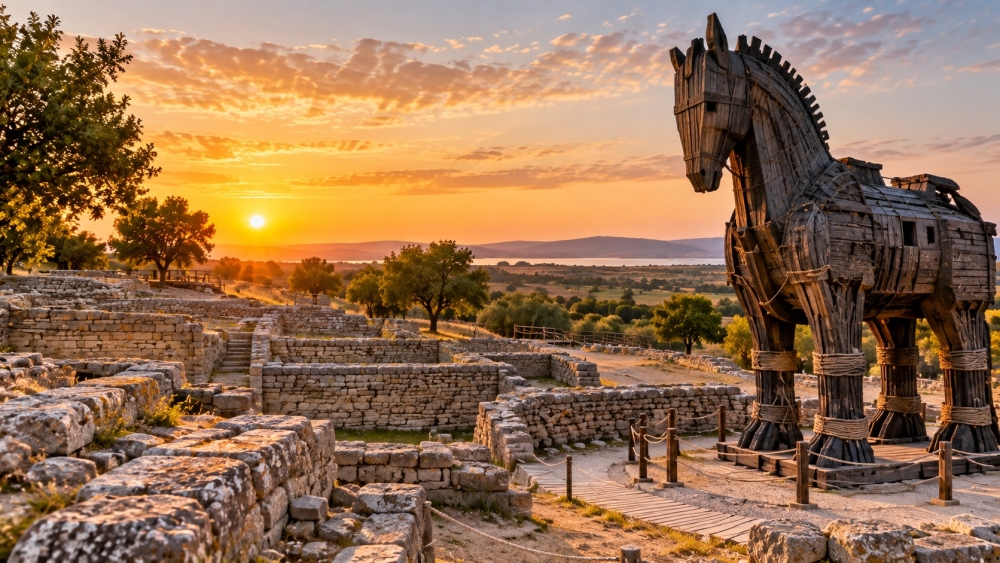
Walking through Troy is unlike visiting an ordinary ancient city. Here, layers of archaeology, mythology and history overlap in the same landscape, creating a place where the stories of the past feel remarkably close.
But when is the best time to visit Troy, Turkey?
The answer depends on what you want from your visit. Spring brings fresh landscapes and comfortable temperatures, summer offers long daylight hours but can be hot, autumn creates a quieter and often atmospheric setting, while winter provides a completely different experience with fewer visitors and a more dramatic landscape.
In this guide, we will explore the best seasons for a Troy visit, what the weather is generally like throughout the year, when the archaeological site is most comfortable to explore, and how to plan your visit around the nearby Troy Museum and other attractions in the Çanakkale region.
The ancient city of Troy is located near Tevfikiye Village in Çanakkale Province, in northwestern Türkiye.
The archaeological site is famous for its connection with Homer's Iliad and the legendary Trojan War. Archaeological research has also revealed multiple settlement layers extending across more than 3,000 years.
The Ministry of Culture and Tourism describes Troy as one of the world's most famous ancient cities, with nine archaeological layers representing more than 3,000 years of settlement. The site was added to the UNESCO World Heritage List in 1998. :contentReference[oaicite:0]{index=0}
For more ideas about exploring the region, you can also plan your Troy visit with our destination guide.
Troy is an open-air archaeological site, which means weather has a noticeable effect on the experience.
Unlike a museum where you can move between indoor galleries, visiting Troy involves walking outdoors between archaeological remains, paths and different levels of the ancient settlement.
This makes temperature, sunlight, wind and rainfall important factors when deciding when to go to Troy, Turkey.
The surrounding landscape also changes throughout the year. Spring can bring fresh greenery and flowers, summer creates bright Mediterranean-style light, autumn produces softer colors, and winter can make the archaeological landscape feel particularly quiet and dramatic.
Spring is one of the most comfortable seasons for exploring Troy.
As temperatures become milder, walking around the archaeological site becomes more pleasant than during the hottest part of summer. The surrounding countryside is also greener, creating a beautiful contrast with the ancient stones and earth-colored archaeological remains.
Spring is particularly appealing if your trip focuses on archaeology, history and photography rather than simply ticking the site off your itinerary.
Early spring can still bring cooler days and occasional rain, so visitors should be prepared for changing conditions.
By April, the landscape around Troy can feel noticeably more vibrant, making it an attractive period for walking and photography.
May often provides a balance between pleasant temperatures and longer daylight hours. It can be a particularly comfortable month for spending several hours exploring Troy and the surrounding area.
Summer is the most popular period for many travelers visiting Türkiye, and Troy benefits from long daylight hours during this season.
However, the archaeological site is largely outdoors, so daytime heat should be taken seriously when planning your visit.
The main disadvantage is heat, particularly around the middle of the day. If you are visiting Troy during July or August, an early morning visit can make walking around the archaeological site much more comfortable.
Start your visit earlier in the day whenever possible. Bring water, sunscreen, sunglasses and a hat, and wear comfortable shoes suitable for walking on uneven archaeological paths.
Another option is to visit the Troy Museum before or after the archaeological site. The museum provides an indoor environment where you can learn about Troy's different archaeological layers and discoveries.
Autumn can be one of the most atmospheric times to visit Troy.
As the intense summer heat begins to fade, the archaeological landscape takes on a quieter character. The softer seasonal light can also be particularly attractive for photography.
September can still feel very much like summer, while October generally brings cooler conditions and a more relaxed atmosphere.
If you want to explore Troy slowly and spend time understanding the archaeological remains rather than simply taking photographs of the famous wooden horse, autumn can be a particularly rewarding period.
Winter offers a completely different perspective on Troy.
The landscape can feel quiet and dramatic, with fewer visitors and a stronger sense of isolation around the ancient settlement.
However, winter weather can be cooler, wetter and windier, so outdoor conditions should be considered carefully.
Winter is especially suitable for travelers who enjoy historical sites in a quieter setting and do not mind less predictable weather.
If photography is an important part of your trip, the season can make a noticeable difference.
Spring and autumn offer softer landscapes and more comfortable conditions for spending time outdoors. Early morning and late afternoon can also produce more atmospheric light than the middle of the day.
The archaeological layers, stone remains, surrounding hills and open landscape create many opportunities for wide-angle photography.
Summer can provide strong blue skies and bright colors, but harsh midday sunlight can create stronger shadows around the ruins.
If your priority is a quieter experience, consider visiting outside the busiest summer period.
Spring and autumn can provide a good balance between comfortable conditions and a more relaxed atmosphere. Winter generally offers the quietest experience, although weather conditions can be less predictable.
Regardless of the season, visiting earlier in the day can help you experience the site more peacefully.
Allowing around 1.5 to 2 hours can give many visitors enough time to walk through the main archaeological areas and understand the site's different layers.
If you are particularly interested in archaeology, history or photography, you may want to allow additional time.
It is also worth adding the Troy Museum to your itinerary. Located at the entrance to the archaeological site, the museum presents artifacts and information related to Troy and the cultures of the wider Troas region. The museum officially opened in its current form in 2019. :contentReference[oaicite:1]{index=1}
The Troy Museum provides useful context before or after exploring the archaeological site.
Its exhibitions cover the archaeology and history of Troy and the surrounding Troas region, with collections including sculptures, inscriptions, pottery, metal objects, coins, jewelry and other archaeological finds. :contentReference[oaicite:2]{index=2}
For first-time visitors, seeing the museum and archaeological site together can make it easier to understand how Troy developed through its many settlement layers.
Yes. The two locations are at the same archaeological destination, making it practical to combine them in one visit.
A common approach is to visit the archaeological site first and then explore the museum, allowing the museum displays to provide additional context for what you have seen outdoors.
The Ministry of Culture and Tourism currently lists both the Troy Archaeological Site and Troy Museum as open daily, with current listed hours of 08:30 to 20:00 and ticket office closing at 19:30. Because opening hours can change seasonally or for special circumstances, it is best to check the official museum page before your visit. :contentReference[oaicite:3]{index=3}
One of the advantages of visiting Troy is that it can easily be included in a wider itinerary around Çanakkale and northwestern Türkiye.
Depending on how much time you have, you can combine Troy with destinations such as the Gallipoli Peninsula, Çanakkale city, Assos or other archaeological sites in the Troas region.
This makes Troy particularly suitable for travelers who want to combine ancient history, mythology, archaeology and the landscapes of the Aegean and Marmara regions.
If Troy is part of a larger Türkiye itinerary, you can combine your visit with some of the country's most important historical destinations.
For travelers who want to see Troy as part of a comprehensive journey through Türkiye, our 10 Days Highlights of Turkey tour includes a visit to Troy alongside other major destinations.
This type of itinerary allows you to experience Troy as part of a broader journey rather than visiting the ancient city as a standalone destination.
Comfortable clothing and walking shoes are important regardless of the season.
Because much of the archaeological site is outdoors, your clothing should reflect the weather conditions on the day of your visit.
There is no single answer to the question of the best time to visit Troy, Turkey. Each season offers a different way to experience this extraordinary archaeological landscape.
Spring brings fresh greenery and comfortable walking conditions. Summer offers long days but requires more preparation for the heat. Autumn combines pleasant conditions with a quieter atmosphere, while winter provides a more solitary and dramatic experience.
Whichever season you choose, give yourself enough time to explore both the archaeological site and the Troy Museum. Together, they provide a much deeper understanding of the ancient city and the many civilizations that occupied this remarkable landscape.
Once you know what each season offers, planning your Troy visit becomes much easier. The most important factors are temperature, daylight, walking conditions and how much time you want to spend outdoors.
Troy is not a site that should be rushed. The archaeological remains spread across an open landscape, and understanding the different settlement layers takes time. Choosing a comfortable time of day can therefore make as much difference as choosing the right season.
For many travelers, early morning is one of the most comfortable times to explore Troy, particularly during the warmer months.
Morning visits can provide cooler temperatures, softer sunlight and a quieter atmosphere. They also leave the rest of the day available for visiting the Troy Museum or other attractions in the Çanakkale region.
Late afternoon can also be atmospheric, especially for photography, as the lower sunlight creates longer shadows across the archaeological remains.
Yes. Summer can be a good time to visit Troy if you plan around the heat.
The archaeological site is outdoors and has relatively little shade, so the middle of the day can feel hot during July and August. An early morning visit, plenty of water and sun protection can make the experience considerably more comfortable.
Summer also provides long daylight hours, making it easier to combine Troy with other destinations in the region.
Spring is particularly attractive for travelers who want comfortable walking conditions and a greener landscape.
The countryside surrounding Troy can look especially fresh during this period, creating a beautiful setting for the archaeological remains.
Spring is also a good season for travelers planning a broader cultural itinerary because the weather is generally more suitable for spending long periods outdoors than during the hottest part of summer.
Autumn offers another excellent opportunity to explore Troy.
September can still be warm, while October generally brings cooler conditions. The changing light and quieter atmosphere can make the archaeological landscape particularly appealing to photographers and history enthusiasts.
If you want to combine Troy with other archaeological sites in western Türkiye, autumn can provide comfortable conditions for a longer itinerary.
Winter changes the character of Troy considerably.
The site can feel peaceful and atmospheric, with fewer visitors and a more dramatic landscape. However, rain, wind and cooler temperatures can make outdoor exploration less comfortable.
If you visit during winter, check the weather forecast before setting out and dress in layers with suitable footwear.
A visit to Troy can generally be completed in a few hours, but the ideal amount of time depends on your interest in archaeology and history.
Allow approximately 1.5 to 2 hours for the archaeological site if you want to walk through the main areas at a comfortable pace.
If you also plan to visit the Troy Museum, allow additional time. Seeing both locations together provides a more complete picture of the site's history and archaeological discoveries.
Troy is famous for its many archaeological layers, which represent different periods of settlement at the same location.
Visitors can explore remains associated with different phases of the ancient city, including defensive walls, gateways, foundations and other architectural elements.
The modern wooden horse at the entrance is one of Troy's most recognizable symbols.
It is important to remember that the horse visitors see today is a modern reconstruction inspired by the famous story of the Trojan War. The archaeological site itself provides a much broader story than the legend alone.
The defensive walls are among the most impressive remains at Troy. They help visitors understand the scale and strategic importance of the settlement.
One of the most fascinating aspects of Troy is that the city was rebuilt repeatedly. Archaeologists have identified multiple settlement layers, each representing a different period in the site's long history.
This is why visiting Troy with some background knowledge can make the experience more rewarding. What may initially look like scattered stones becomes easier to understand when viewed as part of a sequence of cities built on the same location.
Troy occupies an important place in the history of archaeology because excavations revealed that the famous city was not a single settlement but a complex archaeological site containing multiple layers.
The work of Heinrich Schliemann brought international attention to Troy during the 19th century, although his excavation methods and treatment of archaeological remains have subsequently been criticized by scholars.
Later archaeological research provided a more detailed understanding of the site's chronology and helped distinguish the different settlement phases.
Troy's fame is inseparable from the stories associated with the Trojan War and Homer's Iliad.
The literary tradition tells of a long conflict between the Greeks and Trojans and includes figures such as Achilles, Hector and Priam.
However, it is important to distinguish between the literary tradition and archaeological evidence. Archaeology confirms the existence of a major settlement at Troy and provides evidence of destruction and rebuilding at different periods, but it does not establish every detail of the Homeric story as historical fact.
This combination of mythology, literature and archaeology is precisely what makes Troy such a fascinating destination.
A practical itinerary is to begin with the archaeological site and then continue to the museum.
Walking through the ruins first gives you a physical sense of the landscape. The museum can then provide additional information about the artifacts, settlement layers and archaeological discoveries associated with Troy.
If you visit during the warmer months, this order can also allow you to spend the hottest part of the day indoors.
Troy is located in a region with a rich concentration of historical and cultural attractions, making it easy to create a longer itinerary.
The city of Çanakkale is a natural base for exploring Troy. The city sits on the Dardanelles and offers waterfront views, museums, restaurants and access to the wider region.
The Gallipoli Peninsula lies across the Dardanelles and is home to numerous sites connected with the Gallipoli Campaign of the First World War.
Combining Troy with Gallipoli creates an itinerary covering very different periods of history, from the ancient world to the modern era.
Further south along the Aegean coast, Assos offers another important archaeological destination. The ancient city is particularly known for its hilltop setting and Temple of Athena.
Troy does not have to be a standalone excursion. It can easily become part of a wider journey through Türkiye.
Travelers following a longer cultural itinerary can combine Troy with Istanbul, Cappadocia, Ephesus, Pamukkale and other major destinations.
If you prefer an organized journey, our 10 Days Highlights of Turkey tour includes Troy as part of a broader itinerary through some of Türkiye's most important historical destinations.
Spring and autumn are particularly comfortable periods for exploring Troy because temperatures are generally more suitable for walking. Summer can also be enjoyable with an early start, while winter offers a quieter but potentially wetter and colder experience.
Allow around 1.5 to 2 hours for the archaeological site. If you also want to visit the Troy Museum, plan additional time.
The archaeological site and museum operate throughout the year, but opening hours can vary. Always check the latest official information before your visit.
Yes. You can explore the site independently. However, because Troy contains multiple archaeological layers, a guide or detailed information about the site's chronology can help make the ruins easier to understand.
Yes. The story of Troy, the Trojan War and the famous wooden horse can make the destination engaging for younger visitors. Families should simply be prepared for outdoor walking and uneven archaeological paths.
Comfortable walking shoes, water, sunscreen, sunglasses and weather-appropriate clothing are the most useful items. A camera is also worthwhile if you enjoy photographing archaeological landscapes.
The best time to visit Troy, Turkey ultimately depends on the experience you want.
Choose spring for fresh landscapes and comfortable walking, summer for long days and bright skies, autumn for pleasant temperatures and atmospheric light, or winter for a quieter experience with a more dramatic landscape.
Whatever season you choose, Troy deserves more than a quick stop for a photograph of the wooden horse. Take time to walk through its archaeological layers, visit the Troy Museum and consider the relationship between the ancient remains and the stories that made Troy famous around the world.
If Troy is part of a wider Türkiye journey, you can also explore our plan your Troy visit guide or discover our 10 Days Highlights of Turkey tour for an itinerary that includes Troy alongside other major destinations.

I graduated from Istanbul University with a degree in Radio, Television, and Cinema. During my academic journey, I focused on storytelling, visual communication, and cultural content creation, while my personal interests led me toward exploration and discovery.
Traveling, discovering new places, and experiencing different cultures are at the heart of my life. My strong interest in mythology allows me to see destinations not only as physical locations but as narratives shaped by history and meaning. My passion for reading continuously enriches and deepens this perspective.
I truly enjoy meeting new people and learning about diverse ways of life. With this mindset, I aim to share my experiences in a sincere, clear, and engaging way.
I love following the traces of stories wherever I go.
Disclosure Notice
By filling out this form, you agree that the personal data you provide to us will be processed in accordance with the Personal Data Protection Law No. 6698 and related legislation.
Your personal data will be processed solely for responding to your application, evaluating your requests, and fulfilling legal obligations; it will not be shared with third parties.
For detailed information, you can review our Privacy Policy.
By submitting the form, you acknowledge and consent to the processing of your personal data for the purposes specified above.

