Few archaeological sites in the world capture the imagination quite like Truva Antik Kenti (Ancient Troy). Known for inspiring Homer's Iliad and the legendary Trojan War, this UNESCO World Heritage Site is where mythology and history meet. Every year, thousands of visitors travel to northwestern Türkiye to explore the ancient ruins, admire the famous Trojan Horse replica, and walk through one of humanity's most legendary cities.
If you're planning a trip to Truva Antik Kenti Turkey, this guide covers everything you need to know—from where Troy is located and why it's famous to what you'll see during your visit and practical travel tips.
For even more visitor information, attractions, and travel planning advice, don't forget to explore our detailed Truva ancient city guide.
Truva Antik Kenti, internationally known as Ancient Troy, is one of the world's most famous archaeological sites. Located in Türkiye's Çanakkale Province, the city became legendary through Homer's epic poem The Iliad, which tells the story of the Trojan War and some of mythology's greatest heroes.
Today, visitors can explore thousands of years of history preserved within the archaeological site. Rather than representing a single city, Troy consists of multiple layers of settlements that were built, destroyed, and rebuilt over nearly four millennia.
This remarkable sequence has made Troy one of the most significant archaeological discoveries ever made.
Many international travelers search for "Truva nerede?" or "Truva Antik Kenti nerede?" before planning their trip.
Ancient Troy is located near the village of Tevfikiye in Çanakkale Province, northwestern Türkiye. The archaeological site sits approximately 30 kilometers southwest of Çanakkale city center and overlooks the Dardanelles, one of history's most strategic waterways connecting Europe and Asia.
Its location helped transform Troy into an important commercial and military center throughout the Bronze Age, controlling trade routes between the Aegean and the Black Sea.
Troy owes its worldwide fame to both mythology and archaeology.
For thousands of years, readers have been fascinated by Homer's account of the Trojan War—a legendary conflict involving heroes such as Achilles, Hector, Odysseus, Paris, and Helen of Troy.
At the same time, archaeological excavations proved that Troy was far more than a mythical city. Beneath Hisarlık Hill, researchers uncovered multiple ancient settlements dating back to around 3000 BC, confirming that Troy was a real place with an extraordinary history.
This unique combination of literature, mythology, and archaeology makes Troy unlike any other destination in Türkiye.
According to Greek mythology, the Trojan War began when Paris, prince of Troy, brought Helen—the wife of Menelaus, king of Sparta—to Troy.
Determined to bring Helen home, the Greek kingdoms united and laid siege to Troy for ten years. The story eventually culminated in the famous Trojan Horse, a giant wooden structure hiding Greek soldiers who secretly entered the city and opened its gates.
Whether every detail happened exactly as described remains uncertain, but archaeological evidence indicates that Troy experienced multiple conflicts during the Late Bronze Age, suggesting that Homer's story may have been inspired by real historical events.
One of the most surprising facts about Troy is its incredible age.
The earliest settlement dates back to approximately 3000 BC, making Troy over 5,000 years old.
Archaeologists have identified nine major archaeological layers, commonly referred to as Troy I through Troy IX. Each represents a different period of occupation, from the Early Bronze Age through the Roman Empire.
These overlapping cities tell the story of thousands of years of continuous human civilization, making Troy one of the world's most important archaeological sites.
For centuries, many scholars believed Troy existed only in Homer's imagination.
Everything changed in 1871 when German archaeologist Heinrich Schliemann began excavating Hisarlık Hill after becoming convinced that it was the legendary city described in The Iliad.
Although modern archaeologists criticize many of Schliemann's excavation methods, his discoveries forever changed our understanding of ancient history.
Later excavations continued to uncover temples, fortification walls, gates, streets, houses, and countless artifacts that revealed Troy's extraordinary past.
UNESCO inscribed Troy on the World Heritage List in 1998 because of its exceptional cultural value.
The archaeological site represents thousands of years of continuous settlement while also preserving the legendary city that inspired one of history's greatest literary masterpieces.
Troy's influence extends far beyond archaeology. It has shaped literature, theater, art, cinema, and popular culture for centuries, making it one of the world's most recognizable ancient cities.
Visiting Troy is about much more than seeing ancient ruins. It's an opportunity to stand where mythology, archaeology, and history intersect.
Whether you're fascinated by the Trojan Horse, interested in Bronze Age civilizations, or simply looking to experience one of Türkiye's most remarkable UNESCO sites, Troy offers an unforgettable journey into the ancient world.
Continue reading: In Part 2, you'll discover what to see at the archaeological site, the Troy Museum, opening hours, ticket information, transportation options, practical visitor tips, and the best ways to include Troy in a longer journey across Türkiye.
Although Troy may appear modest at first glance, every section of the archaeological site tells a different chapter of a story spanning more than 4,000 years. Exploring the ruins with an understanding of their history transforms scattered stones into one of the world's greatest archaeological experiences.
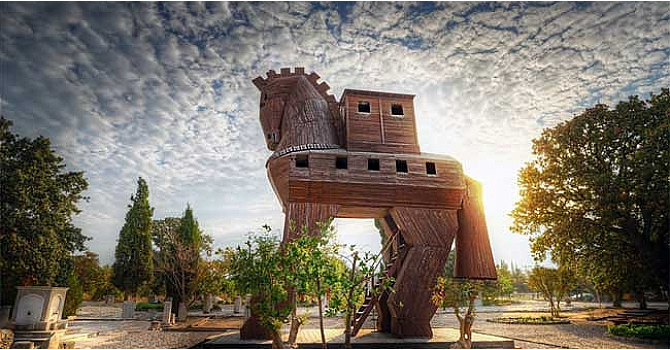
The iconic wooden Trojan Horse near the entrance is one of the site's most photographed landmarks. While it is a modern reconstruction inspired by Homer's epic, it provides visitors with an excellent introduction to the legendary tale before entering the archaeological area.
One of the highlights of Troy is its impressive defensive walls. Constructed from enormous limestone blocks, these fortifications protected the city during different historical periods and demonstrate why Troy occupied such a strategically important position.
Walking through Troy's ancient gateways allows visitors to imagine merchants, soldiers, diplomats, and travelers entering the city thousands of years ago.
Built during the Greek period, the Temple of Athena reflects Troy's continued importance long after the legendary Trojan War.
This small theater reminds visitors that Troy continued to flourish during Roman times, serving as an active settlement for centuries after the events described in Homer's poems.
Located only a few minutes from the archaeological site, the Troy Museum is considered one of Türkiye's finest archaeological museums.
Its modern exhibition design presents thousands of artifacts discovered during excavations, including pottery, sculptures, jewelry, tools, coins, inscriptions, and interactive displays explaining the evolution of Troy through its different archaeological layers.
Visiting both the museum and the archaeological site provides a much richer understanding of Troy's remarkable history.
As opening hours and admission fees may change depending on the season and official regulations, visitors are encouraged to check the latest information before traveling.
If you're planning your visit, our detailed Truva ancient city guide includes practical information, travel tips, and destination highlights to help you prepare your trip.
The archaeological site is approximately 30 kilometers from Çanakkale city center and can easily be reached by car, taxi, or organized tour.
Travelers can reach Troy by driving approximately five to six hours or by taking a bus to Çanakkale followed by a short transfer to the archaeological site.
The journey from Izmir takes around four hours by car, making Troy an excellent stop on a longer western Türkiye itinerary.
Troy welcomes visitors throughout the year, but spring and autumn offer the most enjoyable sightseeing conditions.
Morning visits are especially recommended during summer to avoid the afternoon heat.
Absolutely. It is one of Türkiye's most significant archaeological sites and one of the world's most famous historical destinations.
Most visitors spend between two and three hours exploring the archaeological site, while those visiting the museum should allow at least half a day.
The replica displayed at the archaeological site is designed primarily as a symbolic landmark and photo opportunity.
Yes. Families often enjoy learning about the Trojan Horse and the legendary heroes while exploring the ancient ruins together.
While self-guided visits are possible, hiring a professional guide greatly enhances the experience by explaining the archaeological layers and historical context.
Definitely. The Troy Museum complements the archaeological site perfectly and helps visitors understand thousands of years of history through its outstanding collection.
While Troy is one of the country's most legendary destinations, it is only one chapter in Türkiye's extraordinary cultural heritage. Many travelers combine their visit with world-famous sites such as Ephesus, Pamukkale, Cappadocia, and Istanbul to experience the country's incredible diversity.
If you're looking for the ultimate cultural adventure, our 10 Days Highlights of Turkey Tour includes Troy alongside many of Türkiye's most iconic destinations. It's the perfect itinerary for travelers who want to experience ancient history, breathtaking landscapes, and vibrant local culture in one seamless journey.
Truva Antik Kenti is far more than the legendary setting of Homer's Iliad. It is a remarkable archaeological treasure where myth, history, and civilization come together. Walking through its ancient streets, fortification walls, and archaeological layers offers a unique opportunity to connect with one of humanity's greatest stories.
Whether you're fascinated by the Trojan War, interested in Bronze Age civilizations, or simply exploring the best historical sites in Türkiye, Ancient Troy promises an unforgettable experience. Add it to your travel itinerary, explore the nearby Troy Museum, and discover why this legendary city continues to inspire visitors from around the world.

I graduated from Istanbul University with a degree in Radio, Television, and Cinema. During my academic journey, I focused on storytelling, visual communication, and cultural content creation, while my personal interests led me toward exploration and discovery.
Traveling, discovering new places, and experiencing different cultures are at the heart of my life. My strong interest in mythology allows me to see destinations not only as physical locations but as narratives shaped by history and meaning. My passion for reading continuously enriches and deepens this perspective.
I truly enjoy meeting new people and learning about diverse ways of life. With this mindset, I aim to share my experiences in a sincere, clear, and engaging way.
I love following the traces of stories wherever I go.
Disclosure Notice
By filling out this form, you agree that the personal data you provide to us will be processed in accordance with the Personal Data Protection Law No. 6698 and related legislation.
Your personal data will be processed solely for responding to your application, evaluating your requests, and fulfilling legal obligations; it will not be shared with third parties.
For detailed information, you can review our Privacy Policy.
By submitting the form, you acknowledge and consent to the processing of your personal data for the purposes specified above.

