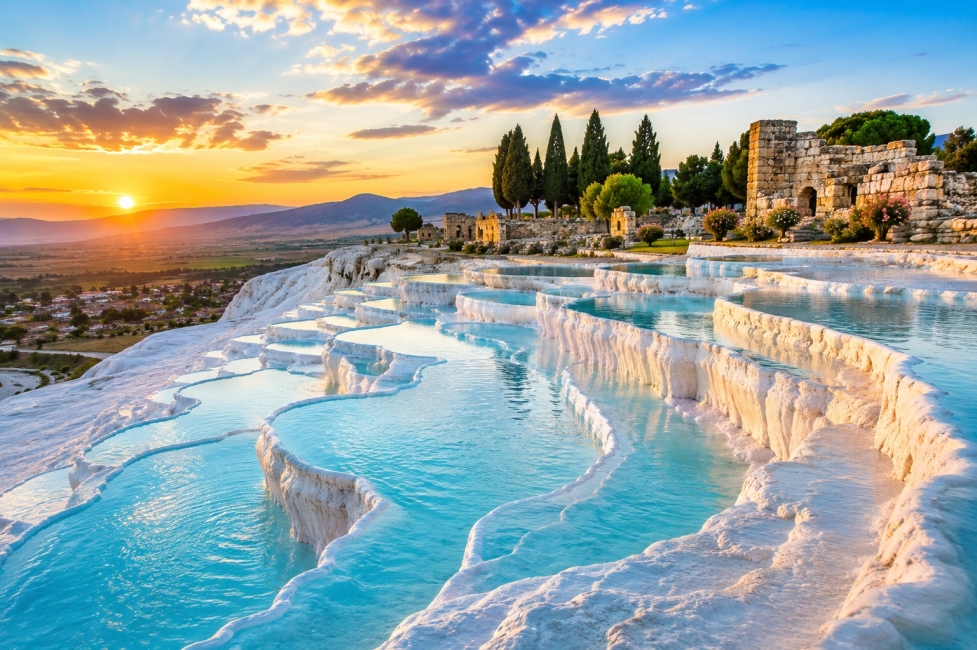
Few places in the world combine breathtaking natural beauty and ancient history as spectacularly as Pamukkale. Famous for its dazzling white travertine terraces and the remarkable ancient city of Hierapolis, Pamukkale is one of Turkey’s most visited UNESCO World Heritage Sites.
Often called the "Cotton Castle," Pamukkale attracts millions of travelers who come to experience its thermal waters, walk among ancient ruins, and witness one of nature's most extraordinary landscapes.
This comprehensive pamukkale turkey travel guide covers everything you need to know before visiting.
Pamukkale, meaning "Cotton Castle" in Turkish, is a natural wonder created by mineral-rich thermal waters flowing down a hillside for thousands of years.
As the hot water cools, it deposits calcium carbonate, forming:
The result is one of the most recognizable landscapes in the world.
Pamukkale is located in Denizli Province in southwestern Turkey.
It is easily accessible from:
Its central location makes it one of Turkey's most popular day-trip destinations.
The brilliant white terraces appear almost like snow or ice from a distance.
Built above the terraces, Hierapolis was one of the most important spa cities of the Roman Empire.
The combination of natural beauty and ancient history makes Pamukkale unique.
The travertines formed over thousands of years as hot spring water rich in calcium flowed down the mountainside.
When exposed to air:
This natural process continues today, although strict conservation measures help protect the site.
One of the most memorable experiences in Pamukkale is walking barefoot across the terraces.
Visitors can enjoy:
To protect the travertines, shoes are not allowed on designated sections.
Founded during the Hellenistic period and later expanded by the Romans, Hierapolis became a major thermal spa destination.
Today visitors can explore:
The site offers a fascinating glimpse into life nearly 2,000 years ago.
One of Hierapolis' most impressive landmarks is its exceptionally preserved Roman Theater.
It remains one of Turkey's finest ancient theaters.
The Necropolis of Hierapolis is among the largest ancient cemeteries in Anatolia.
Visitors can see:
The vast cemetery reflects Hierapolis' importance throughout antiquity.
One of Pamukkale's most popular attractions is the famous Antique Pool, often called Cleopatra's Pool.
Visitors can swim among:
The water remains warm throughout the year.
Ideal weather and comfortable temperatures.
Warm conditions with larger visitor numbers.
Pleasant temperatures and excellent sightseeing conditions.
Fewer crowds and unique photographic opportunities.
Many travelers consider spring and autumn the best seasons.
Pamukkale is one of Turkey's most photogenic destinations.
Early morning generally offers the best lighting and smaller crowds.
Remember that shoes must be removed when walking on the travertines.
Most visitors spend:
A full-day visit allows the most complete experience.
Pamukkale is a protected UNESCO World Heritage Site.
To preserve the travertines:
These measures help maintain the site's beauty for future generations.
Pamukkale pairs well with several destinations in western Turkey, including Ephesus and the Aegean coast.
Travelers planning a broader itinerary can learn more through the Pamukkale destination guide.
Absolutely. It is one of Turkey's most iconic natural and historical attractions.
Visitors can swim in Cleopatra's Antique Pool and designated thermal areas.
The white color comes from calcium carbonate deposits left by thermal spring water.
A full day is recommended to fully explore both the travertines and Hierapolis.
Yes. Pamukkale and Hierapolis are jointly listed as a UNESCO World Heritage Site.
A visit to Pamukkale offers an unforgettable combination of natural beauty, ancient history, and unique geological wonders. From walking across the famous white terraces to exploring the remarkable ruins of Hierapolis, Pamukkale remains one of the most extraordinary places to visit in Turkey.
Whether you're interested in photography, archaeology, wellness, or simply witnessing one of nature's masterpieces, Pamukkale deserves a place on every Turkey itinerary.

I graduated from Istanbul University with a degree in Radio, Television, and Cinema. During my academic journey, I focused on storytelling, visual communication, and cultural content creation, while my personal interests led me toward exploration and discovery.
Traveling, discovering new places, and experiencing different cultures are at the heart of my life. My strong interest in mythology allows me to see destinations not only as physical locations but as narratives shaped by history and meaning. My passion for reading continuously enriches and deepens this perspective.
I truly enjoy meeting new people and learning about diverse ways of life. With this mindset, I aim to share my experiences in a sincere, clear, and engaging way.
I love following the traces of stories wherever I go.
Disclosure Notice
By filling out this form, you agree that the personal data you provide to us will be processed in accordance with the Personal Data Protection Law No. 6698 and related legislation.
Your personal data will be processed solely for responding to your application, evaluating your requests, and fulfilling legal obligations; it will not be shared with third parties.
For detailed information, you can review our Privacy Policy.
By submitting the form, you acknowledge and consent to the processing of your personal data for the purposes specified above.

