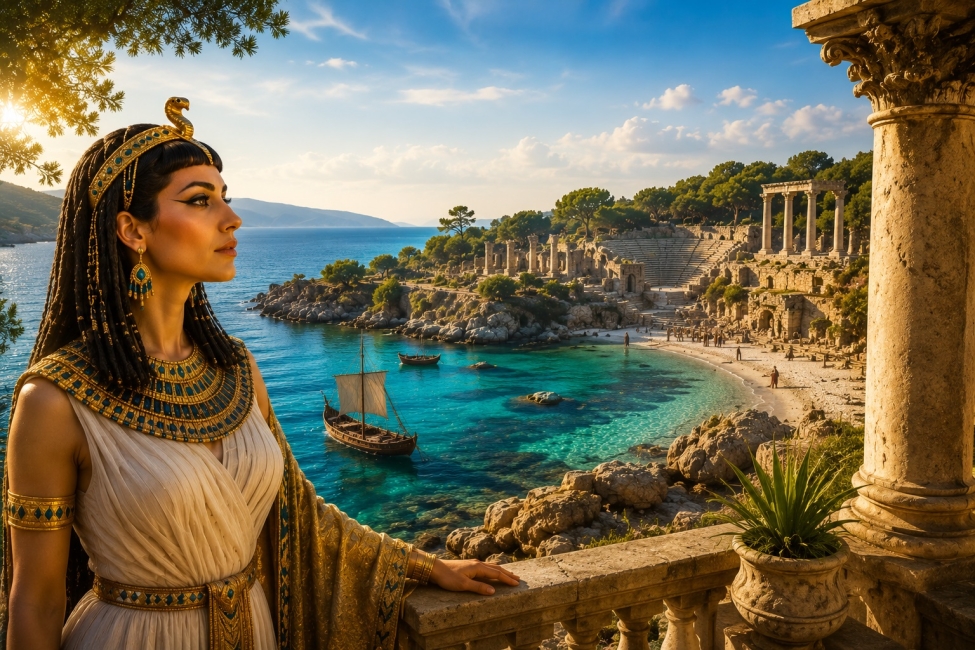
When travelers hear the name Cleopatra Island, most immediately think of crystal-clear waters, white sands, and the legendary romance between Cleopatra and Mark Antony. Yet beyond the famous beach lies a fascinating story that many visitors never discover.
Located in the Gulf of Gökova near Marmaris, Sedir Island, commonly known as Cleopatra Island, is much more than a beautiful swimming destination. It is home to ancient ruins, archaeological mysteries, unique geological formations, and centuries of legends that continue to captivate historians and travelers alike.
This guide explores the lesser-known history of Cleopatra Island and reveals why it remains one of the most intriguing destinations on Turkey’s Aegean coast.
Long before becoming associated with Cleopatra, the island was known as Kedrai (Cedrae), an important ancient settlement in the region of Caria.
Archaeological evidence suggests the city played both strategic and commercial roles due to its position within the Gulf of Gökova.
Today, visitors can still see:
Most tourists spend their time on the beach and never realize they are walking through the remains of a city that flourished for centuries.
The island's most famous legend claims that Mark Antony gifted the island to Cleopatra.
According to the story, Cleopatra disliked the local shoreline, so Antony ordered ships to bring special sand from Egypt to create a beach worthy of a queen.
The legend became so popular that the island eventually became known as Cleopatra Island.
However, historians have never found definitive evidence proving Cleopatra actually visited the island.
While the story remains one of Turkey's most romantic legends, modern researchers generally view it as folklore rather than documented history.
Many visitors believe the sand's uniqueness comes from its alleged Egyptian origin.
The truth may be even more interesting.
The beach is famous for its rare oolitic sand, composed of tiny calcium carbonate formations that resemble miniature pearls.
These grains are extremely unusual and are found in very few places worldwide.
Scientific studies suggest the sand formed naturally over thousands of years rather than being transported from Egypt.
Because of its rarity, the beach is heavily protected.
Visitors are prohibited from:
Strict conservation measures help preserve this extraordinary natural phenomenon.
One of the island's hidden treasures is its ancient theater.
Unlike the grand theaters of Ephesus or Hierapolis, Kedrai's theater is modest in size, yet its setting is spectacular.
Overlooking the turquoise waters of Gökova Bay, it offers one of the most picturesque archaeological viewpoints on the Turkish coast.
Many visitors pass nearby without realizing they are standing in a venue where performances and public gatherings once took place more than two millennia ago.
Another little-known fact is that Cleopatra Island remained important long after the Roman period.
Archaeologists have identified several Byzantine-era churches on the island, including a large basilica and smaller religious structures hidden among pine trees and ancient ruins.
These buildings demonstrate that the island continued to serve as a religious center for centuries after the decline of Kedrai.
Like many ancient coastal cities, Kedrai experienced changing political powers, economic shifts, and regional conflicts.
Historical records indicate that the settlement suffered during military campaigns in antiquity and gradually declined over the centuries.
During Byzantine and later Ottoman periods, the once-important city eventually lost its regional significance.
Today, the island stands as a peaceful reminder of civilizations that once controlled the Aegean coastline.
Recent archaeological interest in Kedrai has renewed attention on the island's forgotten history.
Researchers continue to study the city's urban layout, religious structures, and maritime connections.
New excavations are helping historians better understand the role Kedrai played in ancient Caria and the wider Aegean world.
This means that Cleopatra Island is not only a place of legends—it remains an active archaeological story still being written.
For cruise passengers arriving in Marmaris, Cleopatra Island offers a unique combination of natural beauty and ancient history.
Visitors can:
Travelers looking for a private and comfortable experience can join the Private Cleopatra Island & Marmaris City Tour from Marmaris Cruise Port, which combines the island's historical highlights with the cultural attractions of Marmaris.
The connection comes from local legend rather than confirmed historical evidence.
The beach contains extremely rare oolitic sand formations that require thousands of years to develop.
The island was home to the ancient Carian city of Kedrai (Cedrae).
Yes. Ancient theaters, city walls, churches, and other remains can still be seen across the island.
Absolutely. It combines mythology, archaeology, unique geology, and stunning natural scenery in a single destination.
Most visitors come to Cleopatra Island for its famous beach, but those who look beyond the turquoise waters discover a far richer story.
Ancient Kedrai, Byzantine churches, mysterious geological formations, and enduring legends all contribute to making Sedir Island one of Turkey's most fascinating destinations.
Whether you're interested in archaeology, mythology, history, or simply breathtaking landscapes, Cleopatra Island offers far more than most travelers expect.

I graduated from Istanbul University with a degree in Radio, Television, and Cinema. During my academic journey, I focused on storytelling, visual communication, and cultural content creation, while my personal interests led me toward exploration and discovery.
Traveling, discovering new places, and experiencing different cultures are at the heart of my life. My strong interest in mythology allows me to see destinations not only as physical locations but as narratives shaped by history and meaning. My passion for reading continuously enriches and deepens this perspective.
I truly enjoy meeting new people and learning about diverse ways of life. With this mindset, I aim to share my experiences in a sincere, clear, and engaging way.
I love following the traces of stories wherever I go.
Disclosure Notice
By filling out this form, you agree that the personal data you provide to us will be processed in accordance with the Personal Data Protection Law No. 6698 and related legislation.
Your personal data will be processed solely for responding to your application, evaluating your requests, and fulfilling legal obligations; it will not be shared with third parties.
For detailed information, you can review our Privacy Policy.
By submitting the form, you acknowledge and consent to the processing of your personal data for the purposes specified above.

