The first time many travelers hear about Göbeklitepe, they assume it must be another Roman ruin or medieval site. Then they learn the truth. This stone sanctuary in southeastern Turkey was built around 9600 BCE, thousands of years before Stonehenge and far earlier than the pyramids of Egypt. That alone makes it one of the most important archaeological discoveries of modern times.
If you are searching for a reliable gobekli tepe turkey travel guide, this article will help you understand why the site matters, how to visit, what to expect, and how to make the most of your time in the region. Göbeklitepe offers more than ancient stones. It changes the way many people think about early human civilization.
Göbeklitepe sits near the city of Şanlıurfa in southeastern Turkey. The name means “Potbelly Hill” in Turkish, a reference to the rounded shape of the mound where the site was discovered. Although locals knew the hill for generations, its global significance became clear in the 1990s after systematic excavations began.
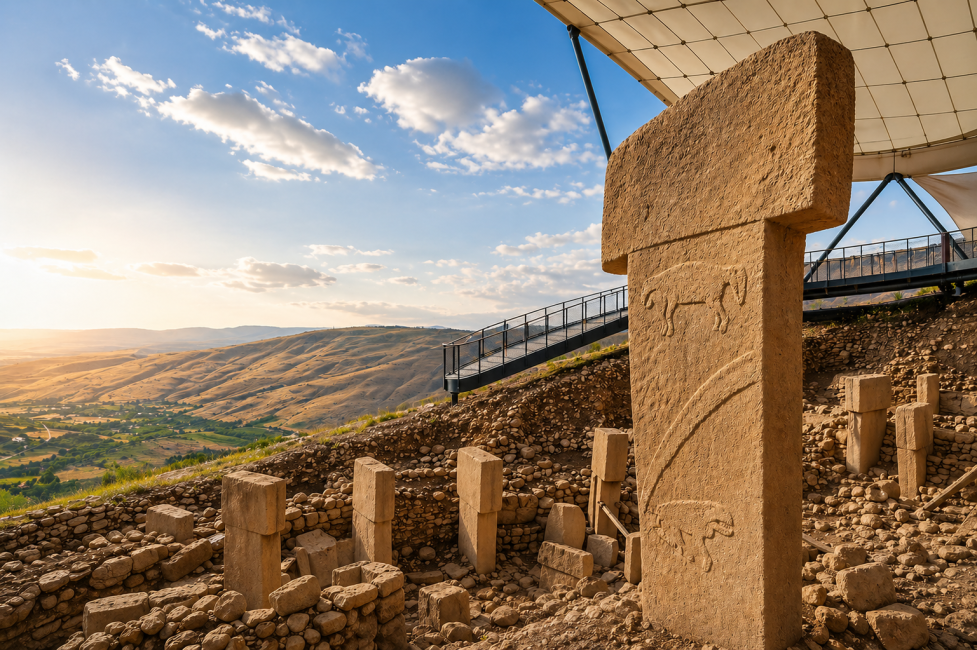
What archaeologists uncovered surprised the academic world. Massive T-shaped limestone pillars arranged in circles, many carved with animals such as foxes, snakes, boars, birds, and gazelles. These monuments were built by hunter-gatherer communities long before pottery, metal tools, or organized cities existed.
For years, scholars believed agriculture came first, followed by religion and monumental architecture. Göbeklitepe suggested the reverse may also be true. Shared rituals and gathering places may have helped communities organize, eventually leading to farming settlements.
Many ancient places are impressive because of size or decoration. Göbeklitepe is important because of age and meaning. It is widely considered the oldest known monumental ritual complex in the world.
Many travelers search for göbeklitepe nerede, which means “where is Göbeklitepe?” The site is located about 15 kilometers northeast of Şanlıurfa city center in southeastern Turkey.
Flights connect Şanlıurfa GAP Airport with Istanbul, Ankara, and other Turkish cities. From the airport, the city center is roughly a 40-minute drive depending on traffic.
Travelers who want a smoother regional experience can review the Göbeklitepe destination guide for route planning and nearby highlights.
Modern visitor facilities make a gobekli tepe visit guide easier than ever. The site is protected by a large roof that shields the excavation area from sun and weather. Elevated walkways allow visitors to look down into the main enclosures without damaging the remains.
The famous T-shaped pillars are the highlight. Some stand over 5 meters tall. Many are carved with relief figures, abstract symbols, and stylized arms.
Several circular or oval ritual spaces have been excavated. These were intentionally built, used, buried, and in some cases rebuilt over time.
Signs explain the chronology, excavation process, and theories about the site. Reading them adds real value to the visit.
The hilltop setting offers wide views over the surrounding plains. This helps visitors understand why the location may have been chosen as a gathering point.
Hours may vary by season and national holidays. Always check current schedules before travel.
Ticket prices can change annually. Some museum cards may apply.
Most visitors spend 1 to 2 hours at the site. If you enjoy archaeology, allow more time and pair it with museums in Şanlıurfa.
Yes. Göbeklitepe dates to around 9600 BCE, while the Egyptian pyramids were built much later.
It is near Şanlıurfa in southeastern Turkey, around 15 kilometers from the city center.
Most travelers spend between 1 and 2 hours at the site.
Yes, especially for travelers interested in archaeology and ancient history.
Spring and autumn are usually the most comfortable times to visit.
Yes. Most travelers fly from Istanbul to Şanlıurfa and continue by road.
Göbeklitepe is not a place that relies on dramatic ruins or grand palaces. Its power comes from age, mystery, and the questions it raises about human history. Standing beside stones carved over 11,000 years ago feels surprisingly immediate.
If you want to explore this remarkable region with local insight and efficient planning, Apasas Travel can help turn a complex journey into a rewarding cultural experience.

I graduated from Istanbul University with a degree in Radio, Television, and Cinema. During my academic journey, I focused on storytelling, visual communication, and cultural content creation, while my personal interests led me toward exploration and discovery.
Traveling, discovering new places, and experiencing different cultures are at the heart of my life. My strong interest in mythology allows me to see destinations not only as physical locations but as narratives shaped by history and meaning. My passion for reading continuously enriches and deepens this perspective.
I truly enjoy meeting new people and learning about diverse ways of life. With this mindset, I aim to share my experiences in a sincere, clear, and engaging way.
I love following the traces of stories wherever I go.
Disclosure Notice
By filling out this form, you agree that the personal data you provide to us will be processed in accordance with the Personal Data Protection Law No. 6698 and related legislation.
Your personal data will be processed solely for responding to your application, evaluating your requests, and fulfilling legal obligations; it will not be shared with third parties.
For detailed information, you can review our Privacy Policy.
By submitting the form, you acknowledge and consent to the processing of your personal data for the purposes specified above.

