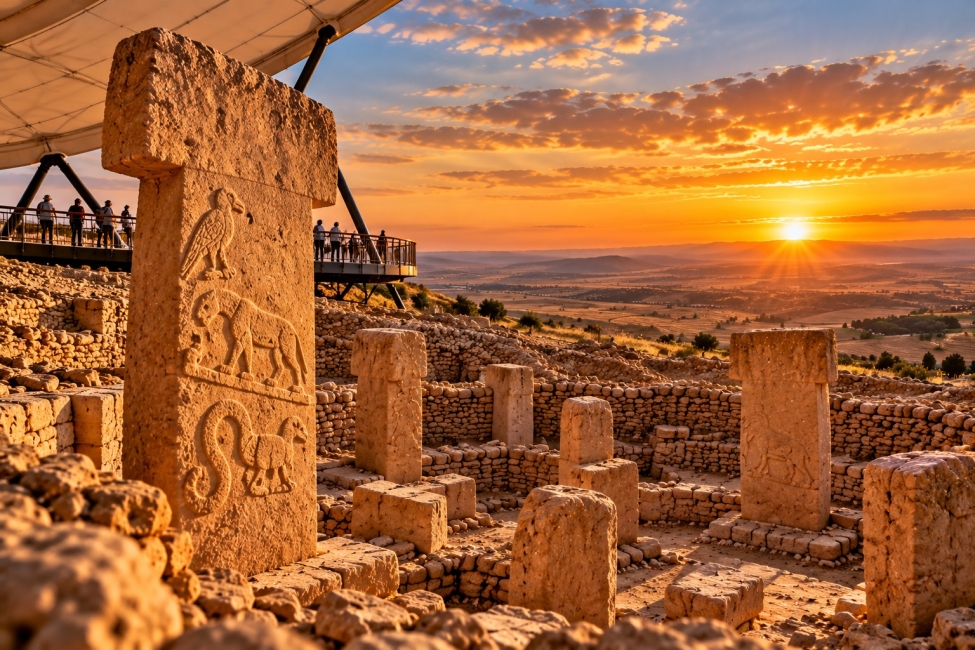
Located near Şanlıurfa in southeastern Türkiye, Göbeklitepe is one of the most significant archaeological discoveries in the study of early human societies. Its monumental stone pillars, carefully arranged enclosures and intricate animal carvings date back more than 11,000 years, offering a remarkable glimpse into the lives and beliefs of prehistoric communities.
What makes Göbeklitepe so fascinating is not simply its age. The site challenges older assumptions about what hunter-gatherer communities could achieve, how they organised collective activities and how monumental architecture developed before the widespread adoption of farming. It has become a key location for understanding the complex transition from mobile ways of life to more settled communities.
For travellers interested in archaeology, ancient civilisations and the deeper story of humanity, visiting Göbeklitepe near Şanlıurfa is an experience unlike a typical historic-site visit. The landscape, the scale of the stone structures and the questions that remain unanswered all contribute to its extraordinary appeal.
In this guide, you will discover the history of Göbeklitepe, what makes its architecture remarkable, what to look for during a visit and how to include it in a wider journey through southeastern Türkiye. If you are planning a multi-day archaeological trip, you can also explore our Nemrut and Göbeklitepe tour from Istanbul.
Göbeklitepe is situated approximately 15 kilometres northeast of central Şanlıurfa, near the village of Örencik. The archaeological site lies in the Germuş mountain area of southeastern Anatolia, within the wider historical landscape of Upper Mesopotamia.
Its location makes it a practical excursion from Şanlıurfa, a city known for its historic bazaars, religious traditions, museums and regional cuisine. Many travellers visit Göbeklitepe as part of a broader itinerary that also includes Balıklıgöl, the Şanlıurfa Archaeology Museum or the historic settlement of Harran.
Göbeklitepe lies in a region where some of the world's earliest farming communities emerged. During the Neolithic period, people across Upper Mesopotamia were experiencing profound changes in how they obtained food, interacted with their environment and organised their communities.
The monumental structures at Göbeklitepe provide evidence of sophisticated building activity during this period. They also show that the people who created them could coordinate labour, work stone and produce elaborate imagery on a substantial scale.
The site should not be viewed in isolation. It forms part of a wider archaeological landscape that continues to help researchers investigate the development of early communities across southeastern Türkiye and neighbouring regions.
The monumental structures at Göbeklitepe date broadly to between approximately 9600 and 8200 BCE, during the Pre-Pottery Neolithic period. This places them among the earliest known examples of monumental architecture anywhere in the world.
To understand the scale of this timeline, consider that these structures were built thousands of years before the construction of many famous ancient monuments. Göbeklitepe predates the Egyptian pyramids by several millennia and is far older than Stonehenge in Britain.
These comparisons are useful for appreciating the site's age, but Göbeklitepe is important for more than being older than better-known monuments. Its architecture and imagery offer evidence about how prehistoric communities organised themselves and created places for collective activities.
Göbeklitepe's monumental enclosures were constructed by groups generally described as hunter-gatherers during the Pre-Pottery Neolithic period. This makes the site particularly important to discussions about the relationship between food production, settled life and large-scale building projects.
Older explanations of early civilisation often placed the development of farming and permanent settlements before major communal architecture. Göbeklitepe complicates that simple sequence. It demonstrates that hunter-gatherer communities could organise substantial construction projects, even as ways of life in the wider region were changing.
However, the history of agriculture and settlement was not a single, uniform process. Communities developed different practices over long periods, and the relationship between ritual activity, social organisation and food production remains an active area of research.
Göbeklitepe has influenced archaeological discussions because its monumental structures reveal a level of collective organisation that older models of prehistoric society did not always anticipate. Its significance lies in several connected discoveries rather than one simple answer.
The site contains large enclosures built from substantial limestone pillars and stone walls. Some of the central pillars reach several metres in height, creating architectural spaces that required planning, technical knowledge and coordinated effort.
These structures demonstrate that monumental architecture was possible among communities that did not yet have the cities, writing systems or state institutions associated with later civilisations.
Many pillars feature carefully carved images of wild animals, including snakes, foxes, birds and other creatures. Some pillars also include features interpreted as elements of human anatomy or clothing.
These carvings were not simply random decorations. Their placement and repetition suggest that imagery played a meaningful role in the spaces where people gathered. Exactly what each animal or symbol meant to the people who created it remains uncertain, which is part of what makes the site so intriguing.
Researchers interpret Göbeklitepe's monumental enclosures as communal buildings probably associated with social gatherings and ritual activities. Some interpretations also consider the possibility of feasting and funerary practices, although the precise function of the structures is not fully established.
This evidence encourages archaeologists to investigate whether shared beliefs, ceremonies and social cooperation helped bring people together in ways that influenced broader changes in society.
Göbeklitepe has become central to discussions about whether communal or ritual activity could have encouraged people to gather and cooperate on a large scale. It does not prove that religion alone caused agriculture or permanent settlement, but it shows why the relationship between belief, social organisation and economic change deserves careful study.
The wider lesson is that early human history was not a straightforward march from simple hunter-gatherer groups to farming villages and then cities. Different communities experimented with different forms of social life, and the archaeological evidence continues to refine our understanding.
The most recognisable features of Göbeklitepe are its monumental T-shaped limestone pillars. They stand within circular, oval and rectangular enclosures, forming one of the site's most distinctive architectural characteristics.
Some of the pillars are decorated with detailed reliefs, while others include abstract features that researchers interpret as representations of the human form. Belts, loincloth-like details and the position of the arms appear on certain examples, suggesting that at least some pillars may have represented stylised human figures.
Look carefully at the carved surfaces and you may recognise a variety of wild animals. Snakes, foxes, birds and other creatures appear in the site's visual repertoire. Their presence provides clues about the symbolic world of the communities who built the enclosures.
It is tempting to assign a definite meaning to every image, but the evidence does not allow researchers to explain all the carvings with certainty. Rather than treating the pillars as a fully decoded message, visitors should appreciate the craftsmanship and consider the many questions the imagery raises.
The pillars were carved from local limestone, using stone-working techniques available to Neolithic communities. Their size and weight would have made extraction, shaping, transport and placement challenging tasks.
The construction process required knowledge of the local stone, an understanding of how to shape large blocks and cooperation among the people involved. The finished structures show that monumental building did not depend exclusively on metal tools or the advanced machinery associated with much later periods.
Göbeklitepe is frequently described in popular writing as the world's oldest temple. This phrase communicates its extraordinary age and the possible ritual importance of its monumental enclosures, but it can oversimplify what archaeologists know.
The structures are widely interpreted as communal buildings associated with ritual activities. Their exact functions, however, remain under investigation. The site also contains evidence of less monumental, potentially domestic structures, adding complexity to the picture of how the area was used.
For this reason, it is more accurate to describe Göbeklitepe as one of the world's earliest known monumental architectural and probable ritual complexes rather than claim that every structure was definitively a temple in the modern sense.
This distinction does not make the site less impressive. On the contrary, it highlights the value of archaeological research: material evidence can transform our understanding of the past while leaving important questions open for future discoveries.
Göbeklitepe was inscribed on the UNESCO World Heritage List in 2018. Its international recognition reflects the site's importance for understanding early monumental architecture and the development of prehistoric communities.
UNESCO recognises the site's distinctive megalithic structures, T-shaped pillars and carved imagery as evidence of an important period in human history. The remains illustrate the technical achievements and creative capacity of communities living in Upper Mesopotamia during the Pre-Pottery Neolithic period.
World Heritage status also highlights the importance of protecting the site. Visitors can help by staying on designated paths, respecting barriers and following local instructions intended to preserve the archaeological remains for future generations.
Photographs can show the pillars and carvings, but an in-person visit provides a better sense of their scale, arrangement and relationship with the surrounding landscape. Standing near the enclosures helps you appreciate the physical effort involved in creating the structures more than 11,000 years ago.
The site also invites a different kind of historical reflection. Rather than focusing on kings, empires or written records, Göbeklitepe draws attention to communities whose beliefs, social relationships and daily lives must be reconstructed primarily through archaeological evidence.
Whether you are passionate about archaeology or simply curious about humanity's distant past, Göbeklitepe offers an opportunity to explore a period of history that is difficult to imagine through books alone.
Once you arrive at Göbeklitepe, take time to observe the archaeological structures rather than treating the site as a quick photo stop. Its significance becomes clearer when you look at the pillars, carvings, enclosures and surrounding landscape together.
The enclosures are among the most important features of Göbeklitepe. Their stone walls and monumental pillars form organised spaces that demonstrate a remarkable level of architectural planning for the period.
As you explore, notice the relationship between the central pillars and the surrounding structures. The layout provides evidence of deliberate design rather than a random collection of standing stones.
The pillars are the defining visual feature of the site. Look for animal reliefs and details that suggest stylised human figures. The carvings are particularly interesting because they were created long before the writing systems of later civilisations.
Try to examine the details carefully, but remember that interpretations of individual symbols are not always certain. A good guide can help explain which observations are supported by archaeological research and which remain hypotheses.
A protective roof covers important excavated areas, helping shield the archaeological remains from environmental exposure. The modern structure also allows visitors to observe parts of the site within a managed setting.
The contrast between the modern protective architecture and the ancient stone structures is a reminder that archaeological sites need active conservation. Follow the designated visitor route and avoid touching or climbing on the remains.
Göbeklitepe's setting is part of the experience. The archaeological area sits within the rolling landscape of southeastern Anatolia, and its elevated position offers a sense of the wider environment in which prehistoric communities lived.
Take a moment to look beyond the pillars. The surrounding hills and open views help place the site within the broader landscape of Upper Mesopotamia.
Göbeklitepe is approximately 15 kilometres northeast of central Şanlıurfa. The journey is relatively short by regional standards, making the archaeological site a practical excursion for visitors staying in the city.
Driving or taking a taxi gives you flexibility over departure time and how long you spend at the site. If you plan to visit other attractions on the same day, arrange transport in advance and confirm the return journey before setting out.
An organised tour can simplify transport and help you understand the site's archaeological importance. This can be particularly useful if you have limited time or want to combine Göbeklitepe with other destinations.
Travellers beginning their trip in Istanbul can consider the Nemrut and Göbeklitepe tour from Istanbul. Review the current itinerary and inclusions to see how the journey is organised and which locations are covered.
Yes, independent visits are possible if you arrange your own transport and check the current visitor information. However, the experience may be more rewarding with a guide who can explain the site's chronology, architecture and archaeological interpretations.
Whichever option you choose, check current opening hours, admission arrangements and access conditions before departure. Visitor information can change, and it is best not to rely on outdated schedules.
Many visitors allow around two hours to explore Göbeklitepe, although the ideal duration depends on your interests. Travellers with a strong interest in archaeology may want extra time to study the carvings and read the interpretive information.
If you are planning a wider day in Şanlıurfa, consider how long you want to spend at the archaeological site before adding other attractions. The city's museums and historic centre deserve time of their own, particularly if you want to understand the wider cultural context of the region.
Yes. Göbeklitepe can be combined with selected attractions in Şanlıurfa during a well-planned day. However, you will need to prioritise because the site, museums and historic centre each offer a different experience.
This itinerary offers an introduction to both prehistoric archaeology and the city's living culture. If you want to visit several museums in detail or include Harran, consider staying longer rather than rushing through the attractions.
Göbeklitepe is a natural starting point for a broader journey through southeastern Türkiye. The region contains archaeological sites, historic cities and landscapes associated with different periods of human history.
The Şanlıurfa Archaeology Museum provides context for the prehistoric communities and archaeological discoveries of the region. Its collections help visitors understand the objects, artistic traditions and wider cultural developments associated with sites such as Göbeklitepe.
Visiting the museum before or after the archaeological site can make the experience more meaningful by connecting the monumental structures with the material evidence of human life.
Harran is known for its traditional beehive-shaped houses and archaeological remains. It offers a different perspective on the region's long history, with architecture and settlement remains that reflect later periods than Göbeklitepe.
Because Harran is farther from the city centre and requires a separate journey, allow sufficient time for transport and exploration. It is generally more comfortable to include it in a longer itinerary.
Mount Nemrut, famous for its monumental statues and royal sanctuary, offers a striking contrast with Göbeklitepe. The site is associated with King Antiochus I of Commagene and dates to the first century BCE, thousands of years after Göbeklitepe's monumental enclosures were constructed.
Combining these destinations allows travellers to experience different chapters of ancient history, from Neolithic communal architecture to the royal and religious traditions of the Commagene Kingdom.
For travellers who want to explore both places as part of one organised journey, our Nemrut and Göbeklitepe tour from Istanbul is a useful starting point for comparing itinerary options.
Spring and autumn are often comfortable seasons for exploring Göbeklitepe and other outdoor attractions around Şanlıurfa. Summer temperatures can be high, so early visits, sun protection and regular water breaks are particularly important.
Winter can be cooler and occasionally wet. If you plan to travel during this season, check the weather forecast and allow some flexibility in your schedule.
Morning visits can be a good choice during warmer months because temperatures are generally more comfortable earlier in the day. They can also make it easier to combine Göbeklitepe with other attractions afterward.
Afternoon visits may suit travellers whose schedules require a later departure. Consider the season, daylight and your transport arrangements when choosing a time.
Göbeklitepe is located approximately 15 kilometres northeast of central Şanlıurfa in southeastern Türkiye, near the village of Örencik.
The monumental structures date broadly to between approximately 9600 and 8200 BCE, during the Pre-Pottery Neolithic period.
Göbeklitepe provides evidence of monumental architecture, coordinated construction and complex visual traditions among prehistoric communities. It has influenced archaeological discussions about social organisation, ritual activity and the development of early settlements.
Göbeklitepe is often described as the world's oldest temple, but this phrase is a simplification. Its monumental enclosures are widely interpreted as communal buildings associated with ritual activity, while their precise functions remain under investigation. It is more accurate to describe it as one of the world's earliest known monumental architectural complexes.
Yes. Göbeklitepe was inscribed on the UNESCO World Heritage List in 2018 because of its exceptional archaeological and historical significance.
Yes. You can plan a journey from Istanbul that focuses on Göbeklitepe or includes other destinations in southeastern Türkiye. The most suitable option depends on your available time, transport arrangements and preferred itinerary.
A visit to the archaeological site can often fit into a half-day excursion from Şanlıurfa, depending on transport and how long you spend exploring. If you want to include museums or other attractions, allow additional time.
Consider the Şanlıurfa Archaeology Museum, Balıklıgöl and the historic bazaar area. With more time, Harran and other regional destinations can add further depth to your trip.
Göbeklitepe is much more than an ancient archaeological site. Its monumental pillars and carved imagery provide an extraordinary opportunity to explore how prehistoric communities built, gathered and expressed ideas long before the rise of familiar ancient civilisations.
Its importance lies not in a single dramatic claim, but in the evidence it offers and the questions it continues to raise. By visiting the site alongside Şanlıurfa's museums and historic landmarks, travellers can gain a richer understanding of the region's place in human history.
If you want to explore Göbeklitepe alongside Mount Nemrut, take a look at our Nemrut and Göbeklitepe tour from Istanbul and consider how a multi-day archaeological journey could fit your travel plans.

I graduated from Istanbul University with a degree in Radio, Television, and Cinema. During my academic journey, I focused on storytelling, visual communication, and cultural content creation, while my personal interests led me toward exploration and discovery.
Traveling, discovering new places, and experiencing different cultures are at the heart of my life. My strong interest in mythology allows me to see destinations not only as physical locations but as narratives shaped by history and meaning. My passion for reading continuously enriches and deepens this perspective.
I truly enjoy meeting new people and learning about diverse ways of life. With this mindset, I aim to share my experiences in a sincere, clear, and engaging way.
I love following the traces of stories wherever I go.
Disclosure Notice
By filling out this form, you agree that the personal data you provide to us will be processed in accordance with the Personal Data Protection Law No. 6698 and related legislation.
Your personal data will be processed solely for responding to your application, evaluating your requests, and fulfilling legal obligations; it will not be shared with third parties.
For detailed information, you can review our Privacy Policy.
By submitting the form, you acknowledge and consent to the processing of your personal data for the purposes specified above.

