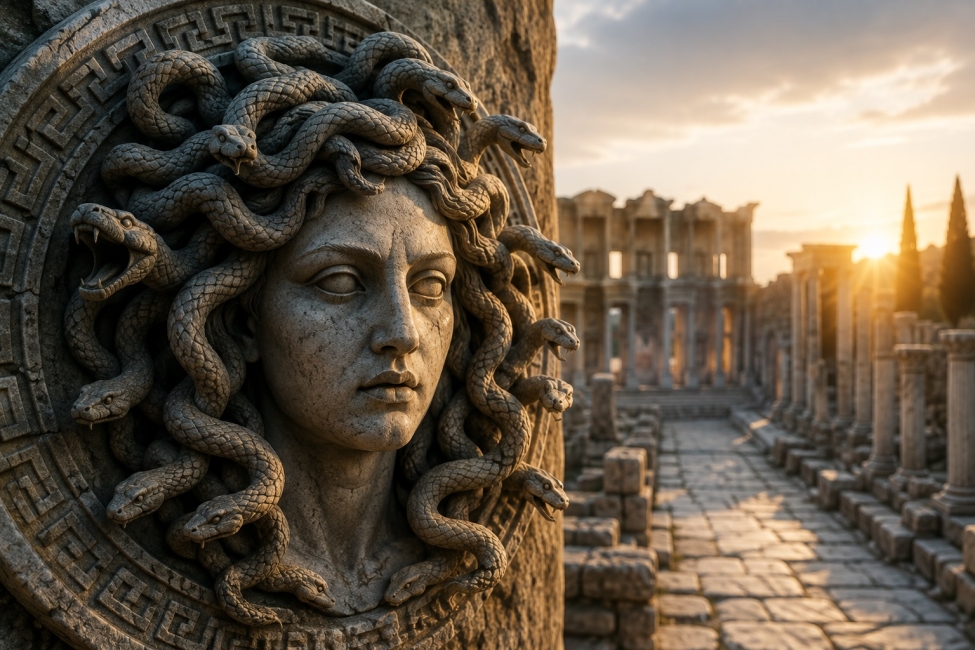
Few figures in Greek mythology have fascinated artists, historians, and travelers quite like Medusa. With her serpent-covered hair and gaze that could turn anyone to stone, she has become one of the most recognizable mythological characters in history. Yet behind this terrifying image lies a story far more complex than many people realize.
Was Medusa always a monster? Was she cursed by Athena? Why do ancient sources tell different versions of her story? And why has her image continued to appear in art, architecture, fashion, and popular culture for more than two thousand years?
The answers take us deep into the world of ancient Greece—a world where mythology explained human emotions, divine justice, and the unpredictable power of the gods.
Although Medusa herself was not connected directly to Ephesus, her story belongs to the same mythological universe that shaped the great cities of ancient Ionia. Understanding legends like Medusa's allows visitors to appreciate sites such as Ephesus, the Temple of Artemis, and the sanctuaries dedicated to the Olympian gods from a much deeper perspective.
If you're planning to explore this remarkable ancient world, our Ephesus day tours offer the perfect opportunity to discover where mythology and history come together.
Today, Medusa is almost always depicted as a terrifying creature with snakes instead of hair. However, this famous image tells only part of her story.
In Greek mythology, Medusa was one of the three Gorgons, alongside her immortal sisters Stheno and Euryale. Unlike her sisters, Medusa was mortal—a detail that would ultimately shape her destiny.
The name "Gorgon" comes from the ancient Greek word meaning "terrible" or "fearsome," and throughout antiquity Gorgon images were commonly placed on temples, shields, and city gates to ward off evil spirits.
Ironically, the face that frightened heroes eventually became one of the ancient world's most powerful protective symbols.
One of the biggest misconceptions surrounding Medusa is that there is only one "official" version of her myth. In reality, ancient writers preserved multiple traditions, each reflecting different beliefs and literary styles.
In the earliest surviving Greek sources, particularly the works of Hesiod, Medusa is introduced as a Gorgon from the very beginning. She is not described as an ordinary woman transformed into a monster but as one of three fearsome sisters born to the sea deities Phorcys and Ceto.
In this version, Medusa's terrifying appearance is part of her original nature, and the myth focuses primarily on the hero Perseus and his quest to defeat her.
The version most people know today comes from the Roman poet Ovid's Metamorphoses, written centuries later.
Here, Medusa begins as an extraordinarily beautiful young woman, admired especially for her magnificent hair. According to Ovid, Poseidon desired Medusa and encountered her inside the temple of Athena.
Enraged by the desecration of her sacred sanctuary, Athena transformed Medusa's beautiful hair into venomous snakes and cursed anyone who looked directly into her eyes to become stone.
This dramatic transformation became one of the most influential stories in Western literature and continues to shape modern interpretations of Medusa.
This question has sparked debate for centuries.
Modern readers often view Medusa as a tragic victim, while ancient audiences may have understood the story differently. Greek mythology rarely presents the gods as perfectly fair or morally consistent. Instead, divine actions often reflect power, fate, honor, and the sacred importance of temples.
Athena, goddess of wisdom and protector of cities, was deeply associated with order and sacred law. Whether Medusa's transformation should be interpreted as punishment, protection, or symbolic change depends largely on which ancient source one follows.
This ambiguity is one reason why the myth continues to inspire new interpretations today.
Medusa's serpentine hair has fascinated artists for centuries, but snakes carried rich symbolic meaning in the ancient Mediterranean.
For ancient audiences, transforming Medusa's hair into snakes made her more than simply terrifying—it elevated her into a supernatural guardian whose image possessed protective power.
The story reaches its climax with the arrival of the hero Perseus.
Rather than looking directly at Medusa, Perseus cleverly used the polished shield given to him by Athena as a mirror. Guided by Hermes and equipped with divine gifts, he approached the sleeping Gorgon and successfully beheaded her without meeting her deadly gaze.
From Medusa's blood sprang two remarkable beings: Pegasus, the winged horse, and Chrysaor, a legendary warrior. Their birth symbolized that even in death, Medusa's story continued to shape Greek mythology.
In Part 2, we'll explore how Medusa became a powerful symbol in ancient art, why her face appeared on Greek temples, how her legend connects with Ephesus and the Temple of Artemis, and why she continues to fascinate travelers and historians today.
Long before Medusa became a symbol of mystery in modern books and films, her image was one of the most recognizable protective symbols in the ancient Greek world.
The face of Medusa, known as the Gorgoneion, appeared on temples, shields, armor, city gates, coins, mosaics, and even household objects. Ancient Greeks believed her frightening appearance could repel evil, protect sacred spaces, and guard both people and buildings from misfortune.
Rather than representing evil itself, Medusa often functioned as a supernatural protector.
This explains why archaeologists continue to discover Gorgon imagery throughout the Mediterranean, including regions that were once part of ancient Ionia.
Although Medusa never appears in the mythology of Ephesus itself, her story belongs to the same rich mythological landscape that shaped the ancient city.
Ephesus was one of the most important cities of the Greek and Roman worlds, where mythology influenced religion, architecture, politics, and everyday life. The city's famous Temple of Artemis—one of the Seven Wonders of the Ancient World—stood within a civilization where stories of Athena, Apollo, Hermes, Perseus, and Medusa were widely known.
Visitors walking through Ephesus today often notice decorative carvings, mythological motifs, and artistic influences inspired by the same gods and heroes that appear throughout Greek mythology.
Understanding Medusa's story adds another layer of meaning to exploring one of antiquity's greatest cities.
Over the centuries, Medusa has evolved far beyond her ancient origins.
Renaissance painters portrayed her as both terrifying and beautiful. Sculptors transformed her into one of mythology's most dramatic subjects. In recent decades, writers, filmmakers, and artists have reinterpreted Medusa as everything from a tragic heroine to a symbol of resilience, transformation, and female power.
This remarkable evolution demonstrates how mythology continues to change alongside society, allowing each generation to find new meaning in ancient stories.
There is no single answer.
Depending on the perspective, Medusa has been interpreted as:
This richness of interpretation helps explain why Medusa remains one of the most discussed figures in all of Greek mythology.
While Ephesus is not directly associated with Medusa's myth, visitors can still encounter artistic traditions inspired by the broader mythological world she belongs to.
The city's monuments reflect centuries of Greek and Roman artistic influence, where gods, heroes, mythological creatures, and symbolic figures were woven into architecture and sculpture.
Exploring Ephesus with an understanding of Greek mythology transforms every column, relief, and temple into part of a much larger cultural story.
Not necessarily. Earlier Greek sources describe her as one of the original Gorgons, while the Roman poet Ovid tells the famous story of her transformation from a beautiful young woman into a fearsome creature.
The Greek hero Perseus defeated Medusa using a polished shield as a mirror so he could avoid looking directly into her eyes.
According to Ovid's version of the myth, Athena transformed Medusa's beautiful hair into living snakes after the desecration of her sacred temple.
Ancient mythology offers no simple answer. Depending on the source, she may be viewed as a terrifying monster, a tragic victim, or a powerful supernatural guardian.
Her legend is not set in Ephesus, but it belongs to the same mythological tradition that shaped the religious and cultural life of ancient Ionia. Learning about figures like Medusa helps visitors better understand the beliefs and artistic influences present throughout Ephesus.
Reading the myths is only the beginning. Walking through the marble streets of Ephesus, standing beside the remains of the Temple of Artemis, and discovering the stories of the Olympian gods allows visitors to experience the world that inspired legends like Medusa's.
Our Ephesus day tours bring these ancient stories to life through expert guides who combine archaeology, mythology, and history into an unforgettable experience. Whether you're fascinated by Athena, Artemis, Hermes, or Medusa, Ephesus offers one of the best places in Türkiye to explore the enduring legacy of Greek mythology.
Medusa's transformation is far more than the story of a mythical monster. It is a tale that has evolved through centuries of storytelling, shaped by different authors, cultures, and interpretations. From Hesiod's ancient poems to Ovid's Metamorphoses, and from temple carvings to modern art, Medusa has remained one of mythology's most compelling figures.
Her legend reminds us that mythology is rarely simple. Instead, it invites us to question, interpret, and explore the many ways ancient civilizations understood justice, power, beauty, and transformation. And when those stories are paired with a visit to remarkable places like Ephesus, they become even more vivid—connecting the timeless world of myth with the extraordinary landscapes where these legends have echoed for thousands of years.

I graduated from Istanbul University with a degree in Radio, Television, and Cinema. During my academic journey, I focused on storytelling, visual communication, and cultural content creation, while my personal interests led me toward exploration and discovery.
Traveling, discovering new places, and experiencing different cultures are at the heart of my life. My strong interest in mythology allows me to see destinations not only as physical locations but as narratives shaped by history and meaning. My passion for reading continuously enriches and deepens this perspective.
I truly enjoy meeting new people and learning about diverse ways of life. With this mindset, I aim to share my experiences in a sincere, clear, and engaging way.
I love following the traces of stories wherever I go.
Disclosure Notice
By filling out this form, you agree that the personal data you provide to us will be processed in accordance with the Personal Data Protection Law No. 6698 and related legislation.
Your personal data will be processed solely for responding to your application, evaluating your requests, and fulfilling legal obligations; it will not be shared with third parties.
For detailed information, you can review our Privacy Policy.
By submitting the form, you acknowledge and consent to the processing of your personal data for the purposes specified above.

