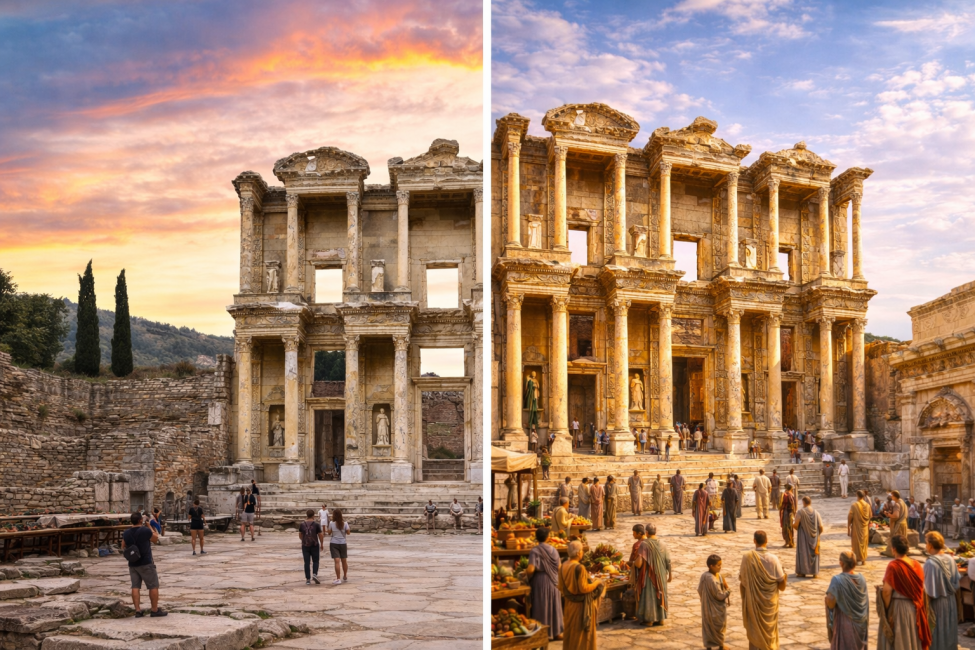
Some places do more than preserve history—they let you feel it. Standing in front of the Library of Celsus in the ancient city of Ephesus, visitors often experience exactly that. Its elegant marble façade, rising dramatically against the Anatolian sky, is one of the most iconic sights in Türkiye and one of the finest surviving examples of Roman architecture in the Mediterranean.
But the Library of Celsus was never just a beautiful building. It was a symbol of learning, prestige, memory, and civic pride. Nearly two thousand years after its construction, it continues to inspire travelers from around the world.
If you would like to experience this remarkable site in person, join our Daily Ephesus Tour and discover the wonders of the ancient city with expert local guides.
The Library of Celsus was built in the early 2nd century AD, between approximately 110 and 135 AD, during the Roman Empire. It was commissioned by Gaius Julius Aquila in honor of his father, Tiberius Julius Celsus Polemaeanus, a Roman senator and former governor of Asia.
What makes this structure especially unique is that it served two purposes:
Celsus was buried in a sarcophagus beneath the building—an extremely rare privilege in Roman cities.
At its peak, the library is believed to have held around 12,000 scrolls, making it one of the largest libraries of its time. While it may not have rivaled Alexandria in scale, it was one of the most important intellectual centers in Roman Asia Minor.
The collection likely included works on:
For the citizens of Ephesus, this was more than a place to store texts. It represented education, culture, and connection to the wider Roman world.
The façade seen today is what makes the Library of Celsus so unforgettable. Carefully reconstructed from original fragments, it demonstrates Roman mastery of proportion, symmetry, and visual illusion.
Tall Corinthian columns frame niches, doorways, and windows, creating depth and grandeur.
Four female statues once stood in niches representing virtues associated with Celsus:
The architects used subtle design tricks to make the building appear larger and more dramatic than it actually was.
Like many ancient monuments, the Library of Celsus suffered from war, fire, earthquakes, and time. In the 3rd century AD, a fire damaged the interior and destroyed many scrolls. Later earthquakes caused the façade to collapse.
For centuries, its stones lay scattered.
Then, between 1970 and 1978, archaeologists carefully reconstructed the façade using surviving original pieces. Thanks to this remarkable effort, visitors today can admire one of antiquity’s most recognizable landmarks.
The Library of Celsus is not only one of the highlights of Ephesus—it is also a reminder that civilizations are remembered not only for power, but for what they choose to preserve and share.
Located within the UNESCO-listed ancient city of Ephesus, near Selçuk in western Türkiye, the library is one of the most photographed and admired sites in the country.
Early morning or late afternoon for softer light and fewer crowds.
Make the most of your visit with our guided Daily Ephesus Tour.
The Library of Celsus is more than a ruin—it is a conversation across centuries.
Its columns no longer hold shelves of scrolls, yet it still stores something precious: memory. Every traveler who stands before it becomes part of that story.
If you visit Ephesus, pause for a moment in front of its façade. Imagine the footsteps, voices, scholars, and citizens who once passed through those doors.
Some libraries never truly close.

I graduated from Istanbul University with a degree in Radio, Television, and Cinema. During my academic journey, I focused on storytelling, visual communication, and cultural content creation, while my personal interests led me toward exploration and discovery.
Traveling, discovering new places, and experiencing different cultures are at the heart of my life. My strong interest in mythology allows me to see destinations not only as physical locations but as narratives shaped by history and meaning. My passion for reading continuously enriches and deepens this perspective.
I truly enjoy meeting new people and learning about diverse ways of life. With this mindset, I aim to share my experiences in a sincere, clear, and engaging way.
I love following the traces of stories wherever I go.
Disclosure Notice
By filling out this form, you agree that the personal data you provide to us will be processed in accordance with the Personal Data Protection Law No. 6698 and related legislation.
Your personal data will be processed solely for responding to your application, evaluating your requests, and fulfilling legal obligations; it will not be shared with third parties.
For detailed information, you can review our Privacy Policy.
By submitting the form, you acknowledge and consent to the processing of your personal data for the purposes specified above.

