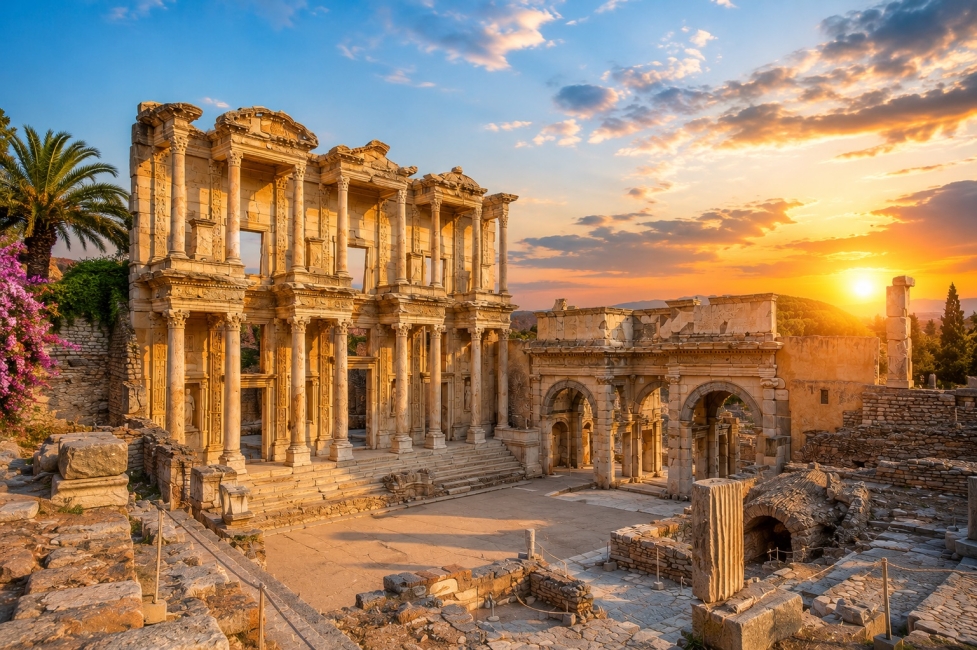
Ephesus is one of the most visited archaeological sites in the world, attracting millions of travelers who come to walk its marble streets, admire the magnificent Library of Celsus, and experience the atmosphere of one of antiquity's greatest cities.
Yet despite its popularity, most visitors only scratch the surface of Ephesus' remarkable story.
Behind the famous landmarks lies a city filled with surprising secrets, advanced engineering, forgotten innovations, and stories that rarely appear in guidebooks. Some of these facts completely change how visitors see the ancient city.
If you're planning a trip to Turkey or simply love ancient history, these interesting facts about Ephesus will help you appreciate why this UNESCO World Heritage Site remains one of the greatest archaeological treasures on Earth.
One of the biggest surprises for first-time visitors is discovering that Ephesus was once located directly on the coast.
Today, the ancient city sits several kilometers inland, surrounded by fields and rolling hills. Looking at the landscape, it is difficult to imagine ships arriving here from across the Mediterranean.
In antiquity, however, Ephesus was one of the busiest ports in the Roman Empire.
Its strategic location allowed merchants from Greece, Egypt, Italy, and Asia Minor to trade goods, ideas, and cultures.
Over centuries, the Küçük Menderes River gradually deposited sediment into the harbor. The coastline slowly moved farther away, causing the city's port to become unusable.
Ironically, one of the reasons Ephesus declined was the same natural process that helped make it rich in the first place.
Many visitors know that the Temple of Artemis was one of the Seven Wonders of the Ancient World.
What most people don't know is that the temple was rebuilt multiple times throughout its history.
The most famous version was destroyed in 356 BC by a man named Herostratus, who intentionally set fire to the structure in an attempt to achieve fame.
Instead of disappearing forever, the temple was rebuilt on an even grander scale.
At its peak, it was larger than many modern cathedrals and attracted pilgrims from across the ancient world.
Today, only a few fragments remain, but its influence on ancient culture cannot be overstated.
The Library of Celsus is the most photographed monument in Ephesus.
Its elegant façade has become one of Turkey's most recognizable archaeological landmarks.
Yet many visitors don't realize how important the building once was.
The library housed approximately 12,000 scrolls, making it one of the largest libraries in the Roman world.
Books were copied by hand and considered extremely valuable. Possessing such a collection demonstrated the city's wealth, influence, and commitment to knowledge.
For centuries, scholars traveled to Ephesus to study and exchange ideas.
Standing in front of the library today, it is worth imagining the thousands of manuscripts that once filled its walls.
Ancient public toilets are unexpectedly one of the most popular stops during guided tours.
While they often make visitors laugh, they also reveal something remarkable about Roman engineering.
The public latrines of Ephesus featured flowing water systems and sophisticated drainage.
Citizens sat side by side on marble benches while discussing politics, business, and daily life.
There were no private stalls.
For Romans, visiting the toilet was often a social activity.
The existence of such advanced sanitation systems demonstrates how sophisticated urban life had become nearly two thousand years ago.
Modern central heating may seem like a recent invention, but wealthy residents of Ephesus enjoyed a surprisingly advanced version of it.
Known as a hypocaust system, this technology circulated hot air beneath floors and inside walls.
The result was a comfortable indoor environment during cooler months.
Many affluent homes, bathhouses, and public buildings used this system.
Visitors exploring the Terrace Houses can still see evidence of these impressive engineering solutions.
The level of comfort enjoyed by some residents would surprise many modern travelers.
Marketing did not begin with the internet.
One of the most famous carvings in Ephesus is often described as one of the world's earliest advertisements.
The carving includes:
According to many historians, it served as a directional sign leading visitors toward a brothel.
Whether every detail of this interpretation is accurate remains debated, but it demonstrates that ancient businesses understood the value of attracting customers.
Even two thousand years ago, people were using visual symbols to communicate commercial messages.
The Great Theater is one of the largest ancient theaters ever constructed.
Capable of seating approximately 25,000 people, it was the entertainment center of Ephesus.
The venue hosted:
The acoustics remain impressive even today.
Visitors standing on the stage often discover they can be heard clearly throughout much of the theater.
The sheer size of the structure provides a glimpse into the importance of Ephesus during the Roman period.
Ephesus played a significant role in early Christianity.
According to the New Testament, St. Paul spent several years in the city and preached extensively to its residents.
His teachings attracted followers but also created tensions.
Many local craftsmen earned their living by producing religious items connected to the worship of Artemis.
As Christianity spread, some feared their businesses would suffer.
This conflict eventually led to a dramatic public reaction inside the Great Theater.
Today, Ephesus remains an important destination for Christian pilgrims from around the world.
Most cities remain in the same geographic relationship to their surroundings.
Ephesus did not.
As sediment accumulated over centuries, the coastline gradually shifted farther west.
What had once been a bustling maritime center became increasingly isolated from the sea.
City leaders repeatedly attempted to dredge channels and maintain harbor access.
Eventually, nature won.
Without efficient access to maritime trade routes, Ephesus lost much of its economic importance.
The city's decline was not caused by a single disaster but by a slow environmental transformation.
This may be the most fascinating fact of all.
The portion of Ephesus that visitors explore today represents only a fraction of the original city.
Archaeologists estimate that large sections remain buried beneath the surrounding landscape.
Excavations continue to uncover:
Every year brings new discoveries.
This means that Ephesus is not merely an ancient city. It is an active archaeological project that continues to reveal secrets thousands of years after its founding.
Future generations may experience parts of Ephesus that remain completely hidden today.
What makes Ephesus truly extraordinary is not simply its architecture.
It is the realization that this was once a living city filled with merchants, scholars, families, politicians, travelers, and dreamers.
The ancient streets were once crowded with people discussing business deals, attending performances, visiting temples, and shaping history.
Every stone tells part of that story.
The more visitors learn about Ephesus, the more fascinating the city becomes.
Reading about Ephesus is one thing.
Walking through its marble streets is something entirely different.
Visitors interested in exploring the ancient city with expert guidance can join the Ephesus tour from Kuşadası with lunch, which includes many of the site's most important highlights and historical landmarks.
A knowledgeable guide helps bring these stories to life and reveals details that many independent visitors might otherwise miss.
Many visitors are surprised to learn that Ephesus was once a major port city directly connected to the sea.
The area's history stretches back more than 3,000 years, although most visible ruins date to the Greek and Roman periods.
Ephesus is famous for the Library of Celsus, the Temple of Artemis, its role in early Christianity, and its exceptionally preserved Roman architecture.
Absolutely. It is widely considered one of the best-preserved ancient cities in the Mediterranean region.
Yes. Many tours include a stop at the Temple of Artemis, one of the Seven Wonders of the Ancient World.
The ancient city of Ephesus continues to fascinate historians, archaeologists, and travelers alike. Beyond its famous monuments lies a deeper story filled with innovation, mystery, religion, trade, and human ambition.
From one of the world's earliest advertisements to sophisticated heating systems and a harbor that vanished over time, Ephesus proves that the ancient world was often far more advanced than many people imagine.
The next time you walk through its marble streets, remember that there is far more to Ephesus than meets the eye.

I graduated from Istanbul University with a degree in Radio, Television, and Cinema. During my academic journey, I focused on storytelling, visual communication, and cultural content creation, while my personal interests led me toward exploration and discovery.
Traveling, discovering new places, and experiencing different cultures are at the heart of my life. My strong interest in mythology allows me to see destinations not only as physical locations but as narratives shaped by history and meaning. My passion for reading continuously enriches and deepens this perspective.
I truly enjoy meeting new people and learning about diverse ways of life. With this mindset, I aim to share my experiences in a sincere, clear, and engaging way.
I love following the traces of stories wherever I go.
Disclosure Notice
By filling out this form, you agree that the personal data you provide to us will be processed in accordance with the Personal Data Protection Law No. 6698 and related legislation.
Your personal data will be processed solely for responding to your application, evaluating your requests, and fulfilling legal obligations; it will not be shared with third parties.
For detailed information, you can review our Privacy Policy.
By submitting the form, you acknowledge and consent to the processing of your personal data for the purposes specified above.

