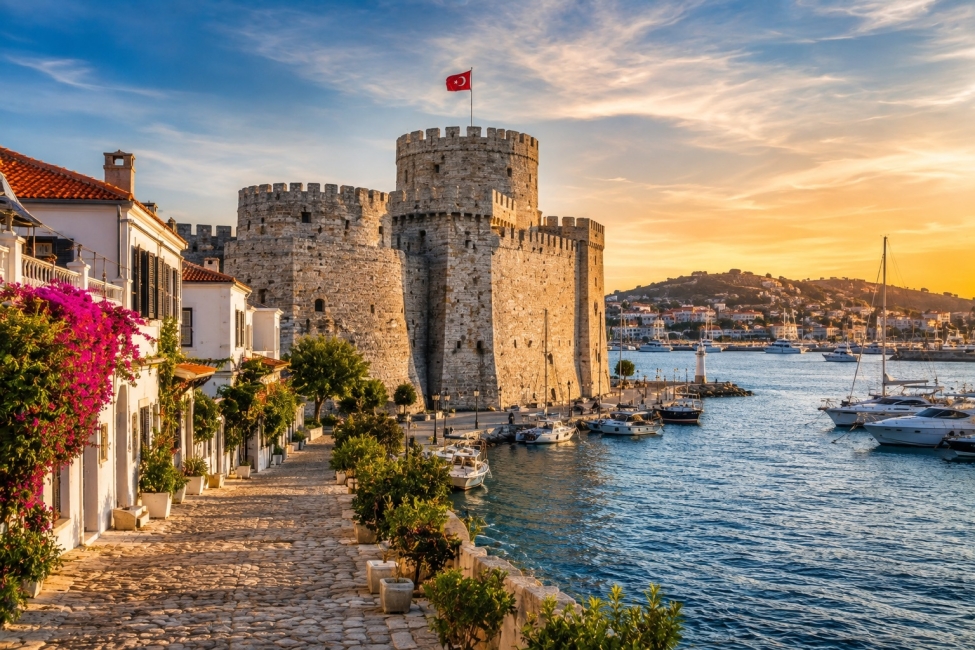
If you want to discover the historical side of the Aegean coast, Çeşme Castle and Old Town Turkey should be high on your itinerary. Located beside the harbor in the heart of Çeşme, the castle is one of the town's most recognizable landmarks and an important part of the region's architectural heritage.
Today, visitors can explore the castle and its museum collections before wandering through the surrounding streets of Çeşme. Together, the fortress, harbor, historic buildings, fountains, and traditional townscape reveal a side of Çeşme that is easy to miss when visiting only for its beaches.
In this guide, we will explore the history of Çeşme Castle, its architecture, the museum inside the fortress, the historic character of the town, and the best way to combine the castle with other Çeşme historical sites.
Çeşme Castle stands in the center of Çeşme, directly overlooking the harbor and the Aegean Sea. Its location reflects the town's historical importance as a maritime settlement and makes the castle one of the first landmarks many visitors encounter when exploring central Çeşme.
The castle is also close to Çeşme Marina, the waterfront, local restaurants, shops, and other attractions in the town center. This makes it easy to include the fortress in a walking itinerary rather than planning a separate trip just to see it.
GoTürkiye lists the 16th-century castle among Çeşme's principal historical attractions and highlights the town's combination of historical monuments, beaches, thermal waters, and vibrant coastal life.
The history of Çeşme Castle reflects the strategic importance of the town and its position on the Aegean coast.
According to the Turkish Ministry of Culture and Tourism, there are indications that the castle was first constructed by the Genoese in the 15th century to help protect maritime trade between Çeşme and the nearby island of Chios. The fortress was subsequently enlarged and repaired during the reign of Sultan Bayezid II, with major additions dating to 1508–1509.
This history gives the castle a particularly interesting architectural identity. Rather than representing a single period, the fortress reflects both Genoese and Ottoman architectural influences.
The castle remained in use until the 19th century, after which it was abandoned as a military fortress. Its later transformation into a museum gave the historic structure a new role in preserving the archaeological heritage of the Çeşme region.
The architecture of Çeşme Castle is one of the reasons it deserves more than a quick photograph from outside.
The fortress has a rectangular plan and was constructed on a rocky slope overlooking the sea. The western side faces the water, while the other three sides were protected by a moat. The main entrance is located on the southern side of the castle.
The combination of defensive walls, towers, open spaces, and elevated position demonstrates how closely the architecture was connected to the castle's original military function.
At the same time, the structure provides an excellent example of how different architectural traditions became part of Çeşme's built heritage. Genoese influences can be seen alongside later Ottoman additions, making the fortress particularly interesting for travelers interested in medieval and Ottoman architecture.
One of the most fascinating chapters in the story of Çeşme Castle is its transformation from military fortress into museum.
In 1965, weapons brought from Istanbul's Topkapı Palace Museum were displayed inside the castle, and the building opened to visitors as a weapons museum. In 1984, following further arrangements, it began serving as the Çeşme Archaeological Museum.
Today, the museum provides an opportunity to explore the history of Çeşme and its surrounding region without leaving the historic fortress itself.
The collections include archaeological finds from Bağlararası, the Bronze Age settlement in central Çeşme, as well as artifacts discovered during excavations at the ancient city of Erythrai, located in modern-day Ildırı.
The museum collections make a visit to the castle much more interesting than simply walking around the fortress walls.
Among the objects displayed are sculptures, figurines, coins, pottery, oil lamps, glass vessels, amphorae, and other archaeological finds representing different periods of the region's history.
The amphora collection is particularly relevant to understanding the ancient maritime character of the region. These large ceramic containers were used to transport and store products such as wine, olive oil, and grain, providing a connection between archaeology and the commercial world of antiquity.
Another important part of the museum is its focus on the 1770 Russo-Ottoman Naval Battle of Çeşme.
The naval battle was a major historical event connected directly to the town's maritime setting. Today, the museum includes displays dedicated to the conflict, allowing visitors to explore an important chapter in Ottoman naval history within the very fortress that overlooks Çeşme harbor.
The museum also displays maritime archaeological material, including amphorae recovered from the sea, which further illustrates the importance of maritime trade in the region's history.
Standing on the castle walls, it becomes easier to understand why Çeşme developed as an important maritime settlement.
The fortress looks toward the harbor and the sea route connecting the Çeşme Peninsula with the nearby islands. Its position was not chosen simply for its views. The elevated location provided a strategic advantage for monitoring and protecting the harbor.
This relationship between the castle and the sea is one of the defining characteristics of Çeşme history. The town's past cannot be separated from maritime trade, military activity, shipping, and its position on the Aegean.
After visiting the castle, take some time to explore the surrounding center of Çeşme on foot.
The historic atmosphere of the town can be discovered through its older buildings, narrow streets, traditional fountains, and structures reflecting different periods of Çeşme's past. The area around the castle and harbor is particularly suitable for a relaxed walking tour.
The Turkish Ministry of Culture and Tourism specifically encourages visitors to explore Çeşme's historic fountains, older buildings associated with both Turkish and Greek communities during the Ottoman period, and the historic streets of the town.
Rather than treating the castle as an isolated attraction, think of it as the starting point for discovering the wider historic center.
The name Çeşme itself is closely associated with water, and fountains are an important part of the town's historic landscape.
As you walk through central Çeşme, look for traditional fountains integrated into the older urban fabric. These structures reflect the importance of public water sources in Ottoman-era towns and add another layer to the architectural character of the center.
Exploring the fountains alongside older houses, streets, and religious or civic structures gives visitors a better understanding of how the town developed beyond its role as a coastal resort.
One of the most rewarding aspects of a Çeşme Old Town visit is noticing the variety of architectural details throughout the center.
Historic buildings reflect the multicultural character of the peninsula and the different communities that lived in Çeşme over the centuries. Stone construction, traditional doors, windows, fountains, and older façades contribute to the visual identity of the town.
Some historic structures have been adapted to modern uses, while others remain part of the everyday urban landscape. This mixture of old and new is what makes walking through Çeşme more interesting than simply visiting individual monuments.
You can visit the castle and museum in a relatively short amount of time, but it is worth allowing additional time to explore the surrounding center.
A practical approach is to spend time inside the museum, walk around the fortress, enjoy the views toward the harbor, and then continue through the historic streets of Çeşme.
If you combine the castle with Çeşme Marina, the waterfront, local restaurants, and nearby attractions, you can easily turn the visit into a half-day exploration of central Çeşme.
One of the best ways to experience Çeşme Castle and Old Town Turkey is to continue exploring the streets surrounding the fortress. The castle may be the area's most prominent landmark, but several other historic structures are located nearby.
Because many of these places are concentrated around the center and waterfront, you can explore them as part of a walking route rather than visiting each attraction separately.
Just a short walk from the castle, the historic Çeşme Caravanserai provides another glimpse into the town's Ottoman past.
The caravanserai was built during the reign of Sultan Süleyman the Magnificent in the 16th century and was historically used to accommodate merchants and travelers. Its location close to the harbor reflects Çeşme's importance as a commercial and maritime settlement.
The building has a central courtyard surrounded by rooms and shops, following the traditional caravanserai layout. Today, the historic structure has been adapted for modern use while retaining its architectural character. Official Çeşme sources date the caravanserai to 1528, while the Ministry of Culture and Tourism gives 1529 for its construction. :contentReference[oaicite:1]{index=1}
Another historic structure near the castle is the Parga Hammam, traditionally associated with the Ottoman period.
The hammam was constructed in connection with the development of Çeşme as an Ottoman maritime center. Its history is linked to the naval presence in the bay and the construction of the nearby caravanserai.
Although it is not as visually dominant as the castle, the hammam helps illustrate how Çeşme's historic center once functioned as a complete urban environment, with accommodation, bathing facilities, commercial spaces, religious buildings, and public fountains all connected to everyday life. :contentReference[oaicite:2]{index=2}
Water is an important part of Çeşme history, and the town's historic fountains are among its most distinctive architectural details.
The name Çeşme itself is associated with fountains and water sources. Over the centuries, numerous fountains were constructed around the town, providing water for local residents, travelers, and merchants.
As you walk through the old town, pay attention to fountains integrated into historic streets and buildings. Some are relatively simple, while others feature decorative stonework and architectural details.
The Çeşme District Governorate notes that several historic fountains from the 18th and 19th centuries remain in different parts of the town, including the Kaymakam Fountain and Molla Fountain.
A Çeşme Old Town visit is not only about ticking historical monuments off a list. Some of the most interesting details are found in the buildings and streets between the major attractions.
Look for traditional stone façades, wooden doors, old window frames, decorative details, courtyards, fountains, and buildings that reflect the multicultural history of the peninsula.
The historic center preserves traces of different communities and periods, including buildings associated with the Turkish and Greek populations that lived in Çeşme during the Ottoman period. The Ministry of Culture and Tourism specifically recommends exploring the old structures and streets that reflect this shared history.
For photographers, early morning and late afternoon are particularly good times to explore. The softer light brings out the texture of the stone walls and creates more atmospheric views of the historic streets.
The relationship between the castle and the harbor is essential to understanding why the fortress was built where it stands.
Çeşme developed around its maritime position, and the castle was constructed to protect the harbor and the important sea routes connecting the peninsula with nearby islands.
When you stand near the castle today, it is easy to imagine how different the coastline once looked. The castle was originally built directly beside the sea. Land reclamation over time changed the shoreline, leaving the fortress farther from the water than it was when first constructed.
This is one of the most interesting details to keep in mind while exploring the area: the relationship between Çeşme Castle and the sea has changed physically, but the town's maritime identity remains central to its character.
The history of the castle is also closely connected to the 1770 Ottoman-Russian Naval Battle of Çeşme.
The battle was a major event in the maritime history of the Ottoman Empire and is commemorated inside the Çeşme Archaeological Museum.
The Umur Bey Tower within the castle contains an exhibition dedicated to the 1770 naval battle. Other parts of the museum display stone and marble works, inscriptions, archaeological finds, and objects recovered from the region.
For visitors interested in military and maritime history, this part of the museum adds an important historical dimension to the castle visit.
Çeşme's history goes much further back than the Ottoman period.
Archaeological excavations at Bağlararası, in central Çeşme, have revealed evidence of a Bronze Age settlement. The discoveries demonstrate that the area was inhabited thousands of years ago and played a role in early regional trade and production.
One particularly remarkable discovery is evidence of an ancient wine-production facility. Archaeological research indicates that the settlement experienced a major earthquake approximately 3,700 years ago, which brought an end to that phase of occupation.
Artifacts from Bağlararası are displayed in the Çeşme Archaeological Museum, allowing visitors to connect what they see inside the castle with the much older history beneath the modern town.
If you have more time, continue your historical journey beyond the town center to Erythrai in modern-day Ildırı.
Erythrai was one of the ancient Ionian cities and is located approximately 22 kilometres from Çeşme. Archaeological excavations have uncovered remains of both public and residential structures, providing another important chapter in the history of the Çeşme Peninsula.
The connection between Erythrai and Çeşme Castle is particularly interesting because many archaeological finds from Erythrai are displayed in the museum inside the castle.
In other words, visiting the castle museum can serve as an introduction to a much larger archaeological landscape across the peninsula.
If you want to explore the main historical highlights on foot, you can follow a simple route through the center.
This route can be completed at a relaxed pace and leaves plenty of time for photography and spontaneous discoveries along the way.
Allow at least half a day if you want to explore the castle and historic center without rushing.
A shorter visit can focus on the castle and museum, followed by a walk around the harbor. However, travelers interested in architecture and local history should allow more time to explore the surrounding streets, fountains, caravanserai, and historic buildings.
If you combine the old town with Çeşme Marina, lunch, and shopping, a half-day itinerary works particularly well.
For the most comfortable sightseeing experience, visit during the morning or late afternoon, particularly during the hot summer months.
Morning visits offer cooler temperatures and softer light for photography. Late afternoon can be equally attractive because you can continue from the castle toward the harbor and finish your historical walk with sunset views.
Because museum opening times and access arrangements can change seasonally, check the official museum information before your visit. The current Ministry of Culture and Tourism listing provides the latest visitor information.
Yes. Çeşme Castle is one of the town's most important historical landmarks and also houses the Çeşme Archaeological Museum. The combination of fortress architecture, archaeological collections, and harbor views makes it one of the essential historical stops in Çeşme.
The castle houses the Çeşme Archaeological Museum, with archaeological and ethnographic objects from Çeşme and the surrounding region. Collections include finds from Erythrai and Bağlararası, sculptures, figurines, coins, amphorae, and other artifacts. The castle also contains an exhibition related to the 1770 Ottoman-Russian Naval Battle of Çeşme.
The present Ottoman castle was expanded and developed during the reign of Sultan Bayezid II in 1508–1509. Official museum information also notes evidence suggesting an earlier Genoese fortress dating to the 15th century.
Nearby attractions include the historic Caravanserai, traditional fountains, Parga Hammam, Çeşme Marina, the harbor, and the streets of the old town. These can easily be combined into a walking tour of central Çeşme.
Yes. Central Çeşme is well suited to walking, particularly around the castle, harbor, marina, and historic streets. Exploring on foot allows you to notice architectural details and historic fountains that you might otherwise miss.
Yes. If you have additional time, you can visit Erythrai in Ildırı after exploring the castle and museum. The connection is especially interesting because archaeological finds from Erythrai are displayed inside the Çeşme Archaeological Museum.
Çeşme is often associated with beaches, beach clubs, and summer holidays, but its history gives the destination another layer of character.
From the fortress overlooking the harbor to Ottoman-era buildings, historic fountains, Bronze Age discoveries, and the ancient city of Erythrai, the peninsula preserves traces of thousands of years of human activity.
Taking the time to explore these places can turn a simple beach holiday into a much richer cultural experience.
If you want to discover more of the region's ancient heritage after exploring Çeşme, Ephesus is a natural next step. The ancient city offers monumental Roman architecture, marble streets, the Library of Celsus, the Great Theatre, and several other remarkable archaeological remains.
You can combine your exploration of the Çeşme historical sites with a private day trip to Ephesus from Çeşme. Our Çeşme historical sites experience allows you to continue from the Aegean coast into the ancient world.
Çeşme Castle and Old Town Turkey offer a fascinating contrast to the region's famous beaches and summer lifestyle. The castle tells the story of Çeşme's military and maritime importance, while the surrounding streets reveal the everyday architectural heritage of the town.
Take time to explore the museum, walk around the historic center, look for traditional fountains, visit the caravanserai, and finish your route beside the harbor. If your itinerary allows, continue toward Ildırı and Erythrai to discover an even older layer of the peninsula's history.
Çeşme may be famous for its sea, but its historic streets show that there is much more to discover beyond the beach.
Ready to explore the historical side of the Aegean? Add Ephesus to your Çeşme itinerary and discover another extraordinary chapter of western Turkey's ancient heritage.

I graduated from Istanbul University with a degree in Radio, Television, and Cinema. During my academic journey, I focused on storytelling, visual communication, and cultural content creation, while my personal interests led me toward exploration and discovery.
Traveling, discovering new places, and experiencing different cultures are at the heart of my life. My strong interest in mythology allows me to see destinations not only as physical locations but as narratives shaped by history and meaning. My passion for reading continuously enriches and deepens this perspective.
I truly enjoy meeting new people and learning about diverse ways of life. With this mindset, I aim to share my experiences in a sincere, clear, and engaging way.
I love following the traces of stories wherever I go.
Disclosure Notice
By filling out this form, you agree that the personal data you provide to us will be processed in accordance with the Personal Data Protection Law No. 6698 and related legislation.
Your personal data will be processed solely for responding to your application, evaluating your requests, and fulfilling legal obligations; it will not be shared with third parties.
For detailed information, you can review our Privacy Policy.
By submitting the form, you acknowledge and consent to the processing of your personal data for the purposes specified above.

