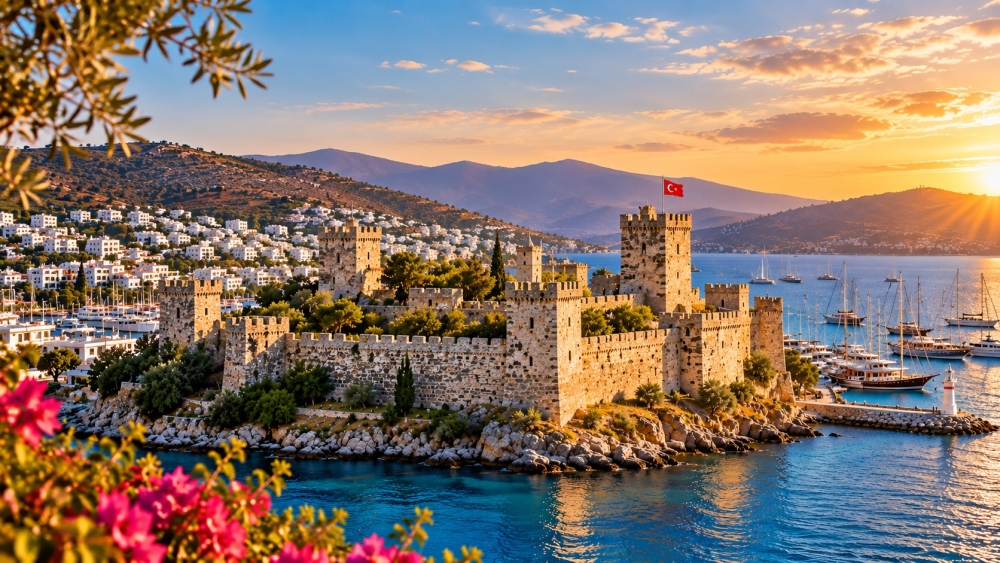
Standing beside the turquoise waters of Bodrum Harbor, Bodrum Castle is one of the most recognizable landmarks on Turkey's Aegean coast. Also known as the Castle of St. Peter, this impressive medieval fortress combines Crusader history, ancient ruins, maritime heritage and one of the most important underwater archaeology collections in Turkey.
Today, the castle is one of the highlights of a visit to Bodrum. Its towers, courtyards, stone walls and panoramic views make it more than just a historic monument. It is a place where several different periods of Bodrum's history come together.
Whether you are interested in medieval castles, ancient history, archaeology or simply want to discover one of the most atmospheric landmarks on the Aegean coast, this complete guide will help you understand the history of Bodrum Castle and plan your visit.
Bodrum Castle, also known as Castle of St. Peter, is a medieval fortress located on a small peninsula between Bodrum's two harbors.
The castle was built by the Knights of St. John during the early 15th century. The knights established their headquarters in the region and constructed the fortress as an important defensive stronghold.
The castle's location was carefully chosen. Surrounded by the sea on several sides, it provided a strategic position overlooking the harbor and the surrounding coastline.
Today, the castle is one of Bodrum's most important historical attractions and an essential stop for visitors exploring the city.
The name Castle of St. Peter comes from the Knights Hospitaller, also known as the Knights of St. John.
The knights dedicated the fortress to Saint Peter and incorporated Christian symbolism into the architecture of the castle.
The name remained associated with the fortress throughout its medieval history and is still widely used when referring to Bodrum Castle today.
The history of the castle cannot be separated from the much older history of Bodrum, ancient Halicarnassus.
Long before the medieval fortress was constructed, this area was home to one of the most important cities of the ancient Carian region.
Halicarnassus became particularly famous during the 4th century BC under Mausolus, the ruler of Caria. His monumental tomb, the Mausoleum at Halicarnassus, became one of the Seven Wonders of the Ancient World.
Centuries later, the medieval knights arrived in the region and began constructing their fortress.
Interestingly, some architectural elements from the ancient Mausoleum were reused in the construction of the castle. This means that visitors exploring Bodrum Castle are also encountering stones and materials connected with the much older history of Halicarnassus.
The castle was built by the Knights Hospitaller, a Christian military order that played an important role in the eastern Mediterranean during the medieval period.
Construction began in the early 15th century under the leadership of the Knights of St. John.
The fortress was designed with strong defensive walls and several towers. Different sections of the castle were associated with various national groups within the order, including English, French, German and Italian knights.
This international character is still visible in the names and architectural details associated with some parts of the fortress.
One of the most distinctive features of Bodrum Castle is its four major towers.
These towers are traditionally associated with the different groups of knights who participated in the construction and defense of the fortress.
The English Tower is one of the most recognizable sections of the castle. Its architecture reflects the defensive character of the medieval fortress.
The French Tower is another major defensive structure within the castle complex and forms part of the impressive medieval skyline overlooking Bodrum Harbor.
The German Tower reflects the international organization of the Knights of St. John and their presence within the fortress.
The Italian Tower completes the group of major towers that helped protect the castle and its strategic harbor position.
Together, these towers demonstrate how Bodrum Castle was designed not simply as a residence, but as a heavily fortified military structure.
The history of Bodrum Castle continued long after the Knights of St. John left the region.
In the 16th century, the fortress came under Ottoman control. The castle continued to exist as an important structure, although its role changed over time.
During the Ottoman period, a mosque was added to the castle complex, reflecting the changing religious and political environment of Bodrum.
The castle eventually became less important as a military fortress and entered a new chapter in its history as a cultural and archaeological site.
One of the reasons Bodrum Castle is particularly important today is its connection with underwater archaeology.
The castle houses the Museum of Underwater Archaeology, one of the most significant collections of its kind in Turkey.
The museum presents archaeological discoveries recovered from shipwrecks and underwater excavations in the Aegean and Mediterranean seas.
Visitors can see objects that reveal how people traveled, traded and lived across the eastern Mediterranean thousands of years ago.
The Bodrum Museum of Underwater Archaeology is one of the main reasons to allow enough time for your castle visit.
Its collections include ancient amphorae, glass objects, ceramics, coins and other archaeological discoveries connected with maritime history.
One of the most fascinating aspects of the museum is the way it tells stories through shipwreck archaeology. Instead of focusing only on objects found on land, the exhibits reveal what happened beneath the sea.
For anyone interested in ancient trade routes and maritime civilizations, the museum adds another dimension to the experience of visiting Bodrum Castle.
Among the museum's most memorable sections is the collection of ancient glass objects.
Glass was an important luxury material in the ancient Mediterranean, and underwater discoveries have helped archaeologists understand its production, transportation and use.
The delicate objects displayed in the museum provide a striking contrast to the massive stone walls of the medieval castle surrounding them.
One of the most important discoveries represented at the Museum of Underwater Archaeology is the Uluburun Shipwreck.
The shipwreck was discovered off the southern coast of Turkey near Kaş and dates to the Late Bronze Age.
The archaeological evidence recovered from the wreck demonstrates the extensive trade networks that connected different parts of the eastern Mediterranean during the Bronze Age.
The cargo included materials and objects from different regions, providing valuable evidence of long-distance trade and cultural exchange.
The Uluburun collection is one of the highlights for visitors who want to understand how connected the ancient Mediterranean world really was.
One of the most interesting aspects of visiting Bodrum Castle is its connection with the Mausoleum of Halicarnassus.
The Mausoleum was built as the monumental tomb of Mausolus and became one of the Seven Wonders of the Ancient World.
Although the original monument no longer survives in its ancient form, parts of its remains were incorporated into later structures in Bodrum, including the medieval castle.
This creates a fascinating historical layer. Within the same city, travelers can explore the remains of ancient Halicarnassus, the medieval Castle of St. Peter and the modern town of Bodrum.
A visit to the castle is much more than walking around its exterior walls.
Inside the complex, visitors can explore medieval towers, courtyards, archaeological exhibitions, ancient artifacts and sections dedicated to underwater discoveries.
The castle also offers elevated viewpoints over Bodrum's harbor and coastline.
Some of the most interesting things to look for during your visit include:
Bodrum Castle brings together several thousand years of history in one location.
You can begin by learning about ancient Halicarnassus, continue into the medieval period with the Knights of St. John, explore the Ottoman chapter of the fortress and finish with one of Turkey's most important underwater archaeology collections.
That combination makes the castle one of the defining landmarks of Bodrum.
If you are planning a wider trip along Turkey's Aegean coast, our Bodrum Castle guide can also help you discover more about the city and the surrounding region.
In Part 2 of this guide, we will explore the Museum of Underwater Archaeology in greater detail, the most important sections of Bodrum Castle, practical visitor information, the best time to visit, how much time you should allow, and other historical sites you can combine with the castle during your Bodrum trip.
One of the highlights of visiting Bodrum Castle is discovering the Museum of Underwater Archaeology inside the fortress. The museum transforms the castle from a medieval monument into a journey through thousands of years of maritime history.
Its collections bring together objects recovered from ancient shipwrecks, including ceramics, glassware, amphorae, jewelry, coins and other archaeological materials. Together, these discoveries reveal how ships, merchants and communities were connected across the Aegean and Mediterranean seas.
The shipwreck collections are among the most fascinating parts of the museum. Archaeologists can learn a great deal about ancient societies by studying what ships carried and how their cargo was organized.
Amphorae, for example, were widely used to transport products such as wine, olive oil and other goods. Their shapes, materials and origins can provide clues about ancient trade routes.
For visitors, these objects offer a glimpse into the practical side of life in the ancient Mediterranean. The sea was not simply a geographical boundary. It was one of the main ways people, products and ideas moved between different civilizations.
The Uluburun Shipwreck is one of the most important archaeological discoveries represented at Bodrum's underwater archaeology museum.
The wreck dates to the Late Bronze Age and was discovered near the southern coast of Turkey. Its cargo contained a remarkable variety of materials originating from different parts of the eastern Mediterranean and beyond.
Among the discoveries were copper ingots, glass, ceramics, jewelry and other valuable materials.
The collection demonstrates the scale and complexity of maritime trade during the Bronze Age. Long before the Roman and medieval periods, ships were already connecting distant communities across the Mediterranean.
Another memorable section of the museum focuses on ancient glass.
Glass objects are particularly valuable to archaeologists because they provide information about craftsmanship, trade and daily life. The underwater discoveries displayed in Bodrum allow visitors to see examples of ancient glass production and transportation.
The delicate appearance of these objects creates an interesting contrast with the thick medieval walls and stone towers surrounding the museum.
After exploring the museum, take time to appreciate Bodrum Castle itself.
The fortress is dominated by four major towers traditionally associated with the English, French, German and Italian sections of the Knights of St. John.
These towers were important elements of the castle's defensive system. Their height and position also provide some of the best viewpoints across Bodrum and the surrounding coastline.
The English Tower is one of the most prominent structures within the castle. Its imposing stone architecture reflects the military character of the medieval fortress.
The French Tower forms another important part of the defensive complex and helps illustrate the international organization of the Knights of St. John.
The German Tower represents another section of the medieval order and contributes to the castle's distinctive architectural character.
The Italian Tower completes the group of major towers that dominate the castle complex.
Do not rush through the castle's courtyards and towers. One of the great pleasures of visiting Bodrum Castle is the opportunity to look across the harbor from different points within the fortress.
From the higher sections of the castle, you can see Bodrum's marina, traditional whitewashed buildings, the blue waters of the Aegean and the surrounding coastline.
The views also help explain why the site was chosen for a fortress. Its position provided a commanding perspective over the harbor and surrounding maritime routes.
Allowing around two to three hours is a reasonable starting point for a visit if you want to explore both the castle and its museum.
Travelers who have a strong interest in archaeology or maritime history may want to spend longer, particularly when exploring the shipwreck collections.
If you are visiting Bodrum as part of a busy day trip, it is better to allow enough time for the museum rather than treating the castle as a quick photo stop.
Bodrum can be hot and sunny during the summer months, and much of the castle experience involves walking outdoors between different sections of the complex.
Morning visits can be more comfortable during the hottest part of the year. Late afternoon can also provide beautiful light over the harbor and surrounding landscape.
Spring and autumn are particularly pleasant seasons for exploring Bodrum's historical attractions, especially if you plan to combine the castle with several outdoor archaeological sites.
Comfortable footwear is strongly recommended. The castle includes stairs, stone paths and uneven surfaces, so shoes suitable for walking will make the visit easier.
During warmer months, bring water, sunglasses and sun protection. A light layer can also be useful outside the summer season when the wind from the Aegean can make the castle feel cooler.
Yes. Bodrum Castle can be an interesting destination for families because the experience combines a medieval fortress with archaeological discoveries and shipwreck collections.
Children who enjoy castles, ancient objects and stories about ships may find the museum particularly engaging.
The towers and views also give the visit a sense of exploration that can make the historical experience more memorable for younger travelers.
Bodrum Castle is located in the heart of the town, making it easy to combine with several other attractions.
After visiting the castle, walk around Bodrum Harbor to enjoy the waterfront, traditional boats, restaurants and views of the fortress from the sea.
The ruins of the Mausoleum at Halicarnassus are one of the most important ancient sites in Bodrum. The monument was one of the Seven Wonders of the Ancient World and was built as the monumental tomb of Mausolus.
Although only fragments remain today, the site provides important context for understanding ancient Halicarnassus and the origins of some of the architectural material later used in Bodrum Castle.
The ancient theater is another important archaeological site overlooking Bodrum. Its elevated position provides beautiful views across the modern town and the surrounding landscape.
After exploring the archaeological sites, take time to walk through Bodrum's old streets. Whitewashed houses, narrow lanes, small shops and waterfront cafés create a completely different atmosphere from the medieval fortress.
One of the most interesting aspects of visiting Bodrum is the way different historical periods overlap.
Ancient Halicarnassus existed centuries before the medieval castle was built. The Knights of St. John later transformed the landscape with their fortress, and the Ottomans subsequently added their own architectural elements.
Today, all of these periods can be experienced within the same city.
This makes Bodrum particularly rewarding for travelers who enjoy historical layers rather than a single-period archaeological site.
Bodrum Castle offers several different experiences in one location. Visitors can explore medieval military architecture, see archaeological material recovered from the sea, learn about ancient maritime trade and enjoy panoramic views over Bodrum Harbor.
The combination of the fortress and the Museum of Underwater Archaeology also makes the site different from many other castles in Turkey.
For travelers interested in the history of the Aegean, it provides a useful introduction to the region's long maritime heritage.
Bodrum Castle is also known as the Castle of St. Peter, a name connected with the Knights of St. John who built the medieval fortress.
The castle was built by the Knights Hospitaller, also known as the Knights of St. John, beginning in the early 15th century.
The castle houses the Museum of Underwater Archaeology, featuring archaeological discoveries from shipwrecks and maritime excavations.
Around two to three hours is a useful amount of time for visitors who want to explore both the fortress and the museum. History and archaeology enthusiasts may prefer to spend longer.
Yes. The castle, towers, archaeological objects and shipwreck collections can make the visit interesting for both adults and children.
You can combine Bodrum Castle with the Mausoleum at Halicarnassus, the Ancient Theater, Bodrum Harbor and the old town.
A visit to Bodrum Castle works particularly well as part of a wider exploration of the city.
Start with the medieval fortress and its underwater archaeology collections, then continue to the Mausoleum of Halicarnassus to explore the ancient history of the city. From there, the Ancient Theater and Bodrum's historic waterfront can complete the experience.
If you are planning a longer Aegean journey, Bodrum can also be combined with other destinations along Turkey's western coast.
For more ideas and destinations, explore our Bodrum Castle guide and discover what else you can experience in and around Bodrum.
Bodrum Castle is much more than a medieval fortress. It is a place where the ancient world of Halicarnassus, the medieval Knights of St. John, Ottoman history and modern underwater archaeology meet within the same landscape.
From its imposing towers to the shipwreck collections inside the Museum of Underwater Archaeology, the castle offers a journey through different chapters of Aegean history.
Whether you are visiting Bodrum for its beaches, exploring Turkey's archaeological heritage or looking for historic places beyond the coast, Bodrum Castle deserves a place on your itinerary.
After exploring the fortress, take time to enjoy the harbor and the surrounding historic sites. Seeing Bodrum Castle from the waterfront at sunset offers a completely different perspective on one of the Aegean coast's most recognizable landmarks.

I graduated from Istanbul University with a degree in Radio, Television, and Cinema. During my academic journey, I focused on storytelling, visual communication, and cultural content creation, while my personal interests led me toward exploration and discovery.
Traveling, discovering new places, and experiencing different cultures are at the heart of my life. My strong interest in mythology allows me to see destinations not only as physical locations but as narratives shaped by history and meaning. My passion for reading continuously enriches and deepens this perspective.
I truly enjoy meeting new people and learning about diverse ways of life. With this mindset, I aim to share my experiences in a sincere, clear, and engaging way.
I love following the traces of stories wherever I go.
Disclosure Notice
By filling out this form, you agree that the personal data you provide to us will be processed in accordance with the Personal Data Protection Law No. 6698 and related legislation.
Your personal data will be processed solely for responding to your application, evaluating your requests, and fulfilling legal obligations; it will not be shared with third parties.
For detailed information, you can review our Privacy Policy.
By submitting the form, you acknowledge and consent to the processing of your personal data for the purposes specified above.

